
Cricket is one of the most exciting and strategic sports in the world. Over the years, the game has evolved through rule changes designed to make matches faster, more competitive, and more entertaining for fans. One of the most important modern innovations in limited-overs cricket is the introduction of Powerplay rules. These rules have changed the way teams bat, bowl, and plan their strategies during One Day Internationals (ODIs) and T20 matches.
Powerplay rules create special periods in a cricket match where fielding restrictions apply. During these overs, the fielding team cannot place too many players outside the boundary circle. This gives batters more opportunities to score runs aggressively and creates exciting moments for spectators.
Today, Powerplay overs are considered one of the most important phases of modern cricket. Teams prepare special batting plans, bowling strategies, and field placements specifically for these overs. Whether you are a beginner learning cricket rules, a student studying sports strategy, or a passionate cricket fan, understanding Powerplay rules is essential for fully enjoying the game.
This complete guide explains everything about Powerplay rules, including their history, fielding restrictions, strategies, player roles, equipment, major tournaments, benefits, and interesting facts.
What Are Powerplay Rules in Cricket?
Powerplay rules are special fielding restrictions used in limited-overs cricket formats like ODIs and T20 matches. During Powerplay overs, only a limited number of fielders are allowed outside the 30-yard circle.
The main purpose of Powerplay rules is to encourage attacking cricket and increase scoring opportunities for batters.
Simple Explanation of Powerplay
During Powerplay overs:
- Fewer fielders can stand near the boundary
- Batters often play aggressive shots
- Bowlers must use smart strategies
- Captains carefully plan field placements
Powerplays create high-pressure situations for both teams.
History of Powerplay Rules
Cricket has changed significantly since the early days of limited-overs matches.
Early Limited-Overs Cricket
When One Day International cricket became popular during the 1970s and 1980s, low-scoring matches were common because teams focused heavily on defensive field placements.
Early limited-overs cricket began as an exciting alternative to traditional Test cricket, which often lasted for five days. In the 1960s, cricket administrators wanted a shorter and more entertaining format that could attract larger crowds and fit into a single day. This idea led to the birth of one-day cricket in England. The first official limited-overs county competition was introduced in 1963 and became very popular because matches produced faster results and more aggressive batting. Unlike Test cricket, each team received a fixed number of overs, forcing batsmen to score quickly and bowlers to attack more aggressively. The first-ever One Day International (ODI) match was played in 1971 between Australia national cricket team and England cricket team at Melbourne after a Test match was abandoned due to rain. The success of this match encouraged international cricket authorities to develop the format further. Limited-overs cricket became even more famous after the first Cricket World Cup held in England in 1975. Teams wore traditional white clothing and used red cricket balls during daytime matches. Early ODI cricket focused on balanced gameplay, where batsmen carefully built innings while bowlers tried to control scoring rates. Over time, players became more aggressive, and the format evolved into a faster and more entertaining version of the game. Early limited-overs cricket completely transformed modern cricket by increasing television popularity, attracting sponsors, and introducing millions of new fans to the sport worldwide.
To make the game more exciting, cricket authorities introduced fielding restrictions.
Introduction of Powerplay Rules
The International Cricket Council gradually developed Powerplay regulations to encourage attacking batting and entertaining gameplay.
The introduction of powerplay rules brought a major change to limited-overs cricket by making matches more exciting and aggressive. Before powerplays, fielding teams could place many fielders near the boundary, which made scoring difficult for batsmen during the early overs. To increase entertainment, encourage attacking batting, and create more boundaries, cricket authorities introduced fielding restrictions known as powerplays. The International Cricket Council officially introduced powerplay rules in One Day International cricket during the early 2000s. Under these rules, only a limited number of fielders were allowed outside the 30-yard circle during specific overs. This gave batsmen more opportunities to play attacking shots and score quickly. Initially, the first 15 overs of an ODI innings were mandatory field restriction overs, encouraging aggressive starts. Later, the rules evolved into batting powerplays and bowling powerplays, where teams could choose certain overs with extra fielding restrictions. In T20 cricket, powerplays became even more important because the format required fast scoring from the beginning. Usually, the first six overs in T20 matches are called the powerplay overs, where only two fielders are allowed outside the circle. This often leads to attacking batting, big shots, and high run rates. Powerplay rules changed batting strategies, captaincy decisions, and bowling tactics in modern cricket. Teams now select explosive opening batsmen specially for powerplay overs. The introduction of powerplays made limited-overs cricket more entertaining for fans, increased television popularity, and helped modern white-ball cricket become faster and more competitive worldwide.
The rules evolved over time, especially after T20 cricket became globally popular.
Modern Powerplay System
Today, Powerplay rules are an essential part of:
- One Day Internationals
- T20 Internationals
- Professional T20 leagues
- Domestic limited-overs tournaments
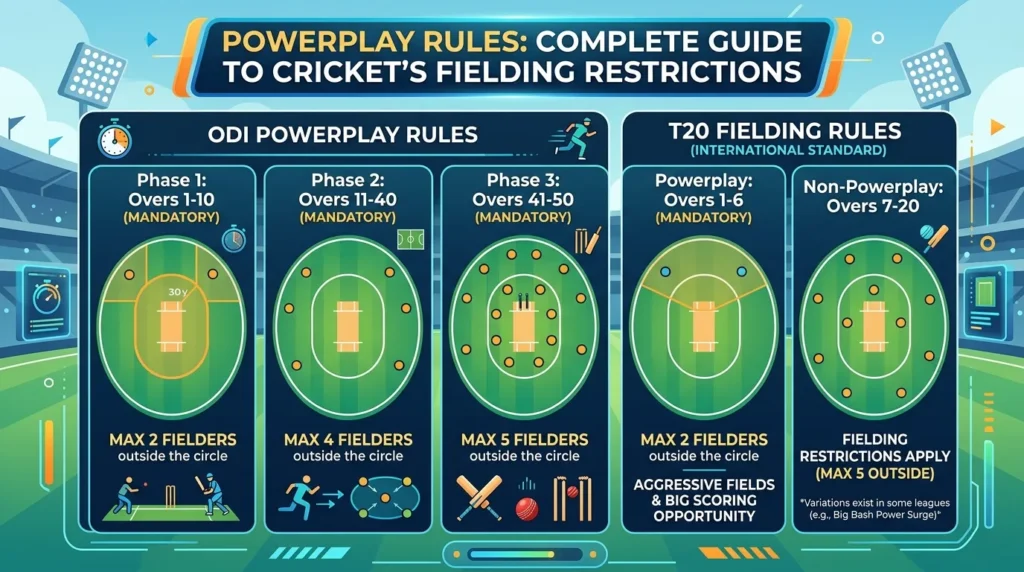
The modern powerplay system is one of the most important tactical features in limited-overs cricket, especially in One Day Internationals (ODIs) and T20 matches. Powerplays are special overs during which fielding restrictions apply, limiting the number of fielders allowed outside the 30-yard circle. These rules are designed to encourage attacking cricket, faster scoring, and more entertainment for fans. The International Cricket Council has updated the powerplay system several times to create a better balance between bat and ball. In modern ODI cricket, the innings are divided into different phases. During the first 10 overs, only two fielders are allowed outside the circle, encouraging aggressive batting at the start. From overs 11 to 40, teams can place four fielders outside the circle, allowing captains to use defensive strategies. In the final 10 overs, five fielders are permitted outside the circle because batsmen usually play attacking shots during the death overs. In T20 cricket, the modern powerplay system is simpler but highly impactful. The first six overs are called the powerplay overs, where only two fielders can stay outside the circle. This creates scoring opportunities for opening batsmen and often leads to explosive starts. After the powerplay ends, captains can spread fielders around the ground to control runs and create wicket-taking chances. The modern powerplay system has completely changed white-ball cricket tactics. Teams now focus heavily on aggressive opening partnerships, specialized death bowling, and flexible captaincy strategies. Powerplays make cricket faster, more entertaining, and strategically challenging for both batsmen and bowlers.
Powerplay Rules in ODI Cricket
One Day International matches consist of 50 overs per innings.
ODI cricket uses three different Powerplay phases.
First Powerplay
The first Powerplay lasts from overs 1 to 10.
The first official powerplay system in ODI cricket was introduced by the International Cricket Council in 2005 to make limited-overs cricket more exciting and aggressive. Before this, ODI matches already had basic fielding restrictions, but the ICC officially gave the name “Powerplay” to these special overs. Under the original powerplay rules, the first 10 overs of every innings were mandatory field restriction overs, where only two fielders were allowed outside the 30-yard circle. In addition to these 10 overs, two extra five-over powerplays were introduced, and the bowling team could choose when to use them during the innings. The purpose of this system was to encourage attacking batting, create more boundaries, and increase entertainment for cricket fans worldwide. The first ODI played under official powerplay rules took place between England cricket team and Australia national cricket team on 7 July 2005. Over time, the ICC continued changing the rules to create a better balance between bat and ball. Later versions included batting powerplays and revised fielding restrictions. The introduction of powerplays completely transformed ODI cricket by increasing scoring rates, changing captaincy tactics, and promoting aggressive opening batsmen. Today, powerplays remain one of the most important strategic elements in modern white-ball cricket. (thecricscope.com)
Fielding Restrictions
During this phase:
- Only two fielders are allowed outside the 30-yard circle
- Fielding restrictions are special rules in limited-overs cricket that control how many fielders can stand outside the 30-yard circle during certain overs of a match. These rules were introduced to make cricket more exciting, encourage attacking batting, and increase scoring opportunities. Fielding restrictions are mainly used in One Day International (ODI) and T20 cricket. The International Cricket Council created these rules to maintain a balance between batsmen and bowlers while improving entertainment for fans. During restriction overs, captains cannot place too many fielders near the boundary line, which gives batsmen more open spaces to hit boundaries. In modern ODI cricket, the first 10 overs are the main powerplay overs, where only two fielders are allowed outside the 30-yard circle. From overs 11 to 40, four fielders can stay outside the circle, while in the final 10 overs, five fielders are permitted outside. In T20 cricket, the first six overs are played under fielding restrictions, with only two fielders allowed outside the circle. After the powerplay, up to five fielders can be placed near the boundary. These rules force bowlers and captains to use smart strategies because attacking batsmen often try to score quickly during restriction periods. Fielding restrictions have completely changed modern limited-overs cricket by increasing aggressive batting, improving match excitement, and creating faster scoring rates. Today, they are considered one of the most important tactical elements in white-ball cricket.
Batting Approach
Batters usually play aggressively because gaps exist near the boundary.
Batting approach in cricket refers to the strategy, mindset, and style a batsman uses while facing bowlers and building an innings. A good batting approach depends on the match format, pitch conditions, target score, bowling attack, and game situation. In Test cricket, batsmen usually adopt a patient and defensive approach because matches are played over five days. They focus on protecting their wicket, leaving dangerous balls, and scoring slowly with proper shot selection. In contrast, One Day International (ODI) and T20 cricket require a more aggressive batting approach, where players score quickly and take calculated risks to increase the run rate. Modern cricket has made attacking batting very important, especially during powerplay overs when fielding restrictions create scoring opportunities. Successful batsmen know when to defend, rotate strike, and attack bowlers according to the situation. Great players like Virat Kohli, Babar Azam, and AB de Villiers are famous for adapting their batting approach in different formats and conditions. A strong batting approach also includes concentration, footwork, confidence, and proper timing rather than only power hitting. Batsmen must carefully observe field placements, bowler variations, and match pressure before choosing their shots. Strike rotation through singles and doubles is another important part of batting strategy because it keeps the scoreboard moving and creates pressure on bowlers. In difficult situations, batsmen may play cautiously to stabilize the innings, while in the final overs they often attack aggressively to maximize runs. Mental strength is equally important because batsmen must remain calm under pressure and recover from mistakes quickly. Overall, a proper batting approach helps players build partnerships, score consistently, and contribute to team success in all formats of cricket.
Bowling Challenges
Fast bowlers aim to swing the ball early and take wickets before batters settle.
Bowling challenges in cricket refer to the difficulties and pressures bowlers face while trying to stop batsmen from scoring runs and taking wickets. Bowling is considered one of the most demanding skills in cricket because bowlers must maintain accuracy, speed, control, and strategy throughout the match. Different match formats such as Test cricket, One Day Internationals (ODIs), and T20 cricket create different challenges for bowlers. In modern limited-overs cricket, aggressive batting, powerplay rules, and shorter boundaries have made bowling even more difficult. Bowlers must constantly adapt their plans according to pitch conditions, match situations, and batsmen’s strengths. One of the biggest challenges is maintaining line and length. If a bowler delivers too short or too full, skilled batsmen can easily score boundaries. Fast bowlers also face physical challenges because bowling at high speed requires great stamina, fitness, and strength. Long spells in hot weather can cause fatigue and increase injury risks. Swing bowlers struggle when weather conditions do not support movement, while spin bowlers face difficulties on flat batting pitches with little turn. Another major challenge is handling pressure during death overs in T20 and ODI cricket, where batsmen attack aggressively to score maximum runs. Bowlers often use yorkers, slower balls, bouncers, and variations to control scoring during these situations. Legendary bowlers like Glenn McGrath, Shane Warne, and Jasprit Bumrah became successful because of their discipline, skill, and ability to perform under pressure. Mental strength is another important challenge for bowlers because they must stay confident even after conceding runs or missing wicket opportunities. Modern cricket technology, video analysis, and batting-friendly rules have further increased bowling difficulties. Despite these challenges, bowling remains one of the most exciting and strategic parts of cricket because skilled bowlers can completely change the outcome of a match through smart tactics, consistency, and controlled aggression.
Middle Overs Powerplay (Overs 11–40): Strategy, Fielding Rules & Importance
The Middle Overs Powerplay covers overs 11 to 40 in a One Day International (ODI) cricket match. This phase is all about maintaining the right balance between scoring runs and protecting wickets. Since the fielding restrictions are relaxed compared to the opening powerplay, teams must play smarter and build partnerships while keeping the scoreboard moving.
Fielding Rules
During the middle overs:
- A maximum of four fielders are allowed outside the 30-yard circle.
- At least five fielders must remain inside the circle at all times.
- Captains can spread the field to limit boundaries and create wicket-taking opportunities.
Strategic Importance
The middle overs often decide the direction of the innings. Batting teams aim to:
- Build strong partnerships.
- Rotate the strike with singles and doubles.
- Punish loose deliveries without taking unnecessary risks.
- Preserve wickets for an aggressive finish in the final overs.
Bowling teams focus on:
- Controlling the run rate.
- Breaking key batting partnerships.
- Forcing batters into mistakes through disciplined bowling and smart field placements.
Spin bowlers usually play a major role during this phase because they can slow the scoring rate, create pressure, and take wickets. However, captains may also use medium pacers or fast bowlers with variations to keep batters guessing. A successful middle overs strategy often lays the foundation for a strong finish in the death overs.
Final Powerplay in Cricket (Overs 41–50): Death Overs Rules, Fielding Restrictions & Winning Strategies (2026)
The Final Powerplay is the last phase of a One Day International (ODI) innings and is played during overs 41 to 50. This period is commonly known as the Death Overs because it represents the batting team’s final opportunity to score as many runs as possible before the innings ends. Every delivery becomes crucial, and even a single over can significantly change the match. Teams often score 50 to 100 or more runs during this phase if they have wickets in hand, making the final powerplay one of the most exciting and game-changing parts of ODI cricket.
Unlike the earlier powerplays, the final powerplay allows captains to place more fielders on the boundary. However, aggressive batting, intelligent bowling, and tactical field placements remain the keys to success. Players with strong finishing abilities often dominate this stage, while bowlers rely on variations and accuracy to control the scoring rate.
Fielding Restrictions During the Final Powerplay
According to the ODI playing conditions:
- A maximum of five fielders are allowed outside the 30-yard circle.
- The remaining five fielders and the bowler must stay inside the circle at the time of delivery.
- Captains usually spread boundary fielders strategically to protect the most likely scoring areas.
- Field placements are adjusted depending on the batter’s strengths, match situation, and required run rate.
Although more boundary fielders are permitted than in earlier powerplays, scoring opportunities still exist because batters often take calculated risks.
Batting Strategy in the Final Powerplay
The batting team aims to maximize the total score during the final ten overs. If enough wickets remain, batters attack almost every scoring opportunity while balancing aggression with smart shot selection.
Common batting strategies include:
- Playing aggressive shots to score fours and sixes.
- Targeting the shorter boundaries whenever possible.
- Rotating the strike to keep the scoreboard moving.
- Using specialist finishers who can score quickly under pressure.
- Taking calculated risks based on the match situation.
- Exploiting weaker bowlers or favorable field placements.
- Converting singles into doubles to maintain momentum.
A successful final powerplay can dramatically increase a team’s total and place significant pressure on the opposition during the chase.
Bowling Strategy in the Final Powerplay
Death-over bowling is one of the most challenging skills in cricket. Bowlers must combine accuracy, variation, and tactical awareness to prevent batters from scoring freely.
Effective bowling strategies include:
- Bowling accurate yorkers at the batter’s feet.
- Mixing slower balls with faster deliveries to disrupt timing.
- Using wide yorkers to keep batters away from their hitting zones.
- Bowling well-directed bouncers when conditions allow.
- Varying line, length, and pace to remain unpredictable.
- Targeting the base of the stumps to reduce boundary opportunities.
- Working closely with the captain to adjust field placements based on the batter’s strengths.
Experienced fast bowlers often specialize in death-over bowling because they can consistently execute these deliveries under pressure.
Why the Final Powerplay Is So Important
The Final Powerplay frequently determines the outcome of an ODI innings. A batting team that finishes strongly can add 50 to 100 or even more runs in the last ten overs, creating a challenging target for the opposition. On the other hand, disciplined death bowling, accurate execution, and smart field settings can restrict scoring, take crucial wickets, and shift momentum toward the bowling side.
For this reason, the final powerplay is regarded as one of the most decisive phases of ODI cricket, where tactical decisions, individual skill, and handling pressure often make the difference between winning and losing.
Powerplay Rules in T20 Cricket: Overs, Fielding Restrictions & Winning Strategies (2026)
The Powerplay in T20 cricket is one of the most exciting and influential phases of a match. Since each team has only 20 overs to score as many runs as possible, the opening six overs often determine the direction of the innings. During this period, strict fielding restrictions allow batters to play attacking cricket, while bowlers use the new ball to search for early wickets. A successful powerplay can build momentum for a big total, whereas early wickets can put the batting side under immediate pressure.
Modern T20 cricket places great importance on maximizing the powerplay. Teams carefully plan their batting order, bowling changes, and field placements to gain an early advantage. Players who perform well during these six overs often have a significant impact on the final result.
T20 Powerplay Overs
In T20 Internationals (T20Is), franchise leagues such as the IPL, and most domestic T20 tournaments, the Powerplay covers the first six overs (Overs 1–6) of each innings.
This is the only mandatory powerplay in T20 cricket and is designed to encourage attacking cricket during the early stages of the match. Once the sixth over is completed, normal fielding rules apply for the remaining 14 overs.
Fielding Restrictions During the T20 Powerplay
According to the official playing conditions:
- A maximum of two fielders are allowed outside the 30-yard circle.
- The remaining seven fielders, along with the bowler and wicketkeeper, must stay inside the circle at the moment the ball is delivered.
- Captains usually position close-catching fielders to create wicket-taking opportunities while protecting the most likely scoring areas.
- These restrictions leave large gaps in the outfield, making it easier for batters to score boundaries.
The limited number of boundary fielders encourages aggressive stroke play and increases the chances of high-scoring starts.
Batting Strategy During the T20 Powerplay
The batting team’s primary objective during the powerplay is to score quickly without losing too many wickets. Because only two fielders are allowed outside the circle, batters look to take advantage of the open spaces and maintain a high run rate.
Common batting strategies include:
- Playing positive and attacking shots from the first ball.
- Targeting boundaries and sixes whenever scoring opportunities arise.
- Rotating the strike to keep the scoreboard moving.
- Taking calculated risks instead of reckless shots.
- Using aggressive opening batters who can capitalize on the fielding restrictions.
- Building momentum for the middle overs while preserving wickets.
A strong powerplay often gives the batting side confidence and creates a solid platform for a competitive total.
Bowling Strategy During the T20 Powerplay
For bowlers, the powerplay is an opportunity to make early breakthroughs and slow the opposition’s scoring rate. Since the new ball can swing or seam, disciplined bowling becomes extremely important.
Successful bowling strategies include:
- Bowling a consistent line and length.
- Using the new ball to generate swing or seam movement.
- Targeting the stumps to increase wicket-taking opportunities.
- Avoiding loose deliveries that are easy to hit for boundaries.
- Mixing pace and bounce when conditions allow.
- Working closely with the captain to set attacking field placements.
- Applying continuous pressure to force batting mistakes.
Fast bowlers usually begin the innings because they can exploit the new ball and challenge the opening batters.
Why the T20 Powerplay Is So Important
The T20 Powerplay is often the most decisive stage of the innings. Teams that score 50–70 or more runs while losing very few wickets usually build strong momentum and are well-positioned to post a competitive total or successfully chase a target. Conversely, teams that lose multiple early wickets often struggle to recover, as the middle-order batters must spend valuable deliveries rebuilding the innings.
For bowlers, taking two or three wickets during the powerplay can completely shift the momentum of the match and put the batting side under pressure. This is why captains, coaches, and players devote significant attention to powerplay tactics, making these first six overs one of the most exciting and strategically important phases of T20 cricket.
Why Powerplay Rules Are Important in Cricket
Powerplay rules are one of the most important parts of modern cricket because they create a fair balance between batting and bowling. By limiting the number of fielders outside the 30-yard circle during specific overs, Powerplays encourage attacking cricket while giving bowlers opportunities to take early wickets. Teams must carefully plan their approach during each Powerplay, making these overs crucial in determining the outcome of a match.
Creates More Exciting Cricket
Powerplays make the game faster and more entertaining by encouraging:
- Aggressive stroke play.
- Higher scoring rates.
- More boundaries and sixes.
- Positive and attacking cricket.
- Exciting contests between batters and bowlers.
These action-packed overs often produce game-changing moments that keep spectators engaged from the very beginning.
Improves the Fan Experience
Powerplays add excitement and unpredictability to every match. Fans enjoy watching:
- Explosive batting performances.
- Big sixes and powerful boundaries.
- Early wickets and dramatic breakthroughs.
- High-pressure situations that can quickly change the momentum of the game.
This combination of aggressive batting and tactical bowling makes cricket more enjoyable for audiences around the world.
Adds Strategic Depth
Powerplay rules require teams to think beyond individual performances. Captains, coaches, and players develop detailed plans to maximize scoring opportunities while minimizing risks. Every decision during the Powerplay can have a significant impact on the final result.
Tactical Planning
Before and during a match, teams carefully analyze several factors, including:
- Pitch conditions to determine how the ball is likely to behave.
- Batters’ strengths and weaknesses to build effective partnerships.
- Bowler matchups to exploit favorable conditions.
- Field placements to restrict boundaries and create wicket-taking chances.
- Match situation and required run rate to choose the right level of aggression.
A well-executed Powerplay strategy often provides the foundation for success. Teams that score quickly while preserving wickets—or bowl tightly while taking early wickets—gain a significant advantage and increase their chances of winning the match.
Important Batting Strategies During the Powerplay
The Powerplay is one of the most important phases for batters because fielding restrictions create more opportunities to score quickly. With fewer fielders allowed outside the 30-yard circle, batters aim to build momentum while making the most of the available gaps. A successful Powerplay can provide a strong foundation for the rest of the innings and put the bowling team under immediate pressure.
Aggressive Shot Selection
During the Powerplay, batters play positive cricket by attacking loose deliveries and finding gaps in the field. Since boundary protection is limited, well-timed shots are more likely to reach the fence. However, successful batters balance aggression with smart shot selection to avoid losing early wickets.
Common Powerplay Shots
Some of the most effective shots played during the Powerplay include:
- Cover drives to score through the off-side.
- Pull shots against short-pitched deliveries.
- Lofted drives over the infield to clear fielders.
- Square cuts and late cuts to exploit gaps behind point.
- Flick shots through the leg side using the bowler’s pace.
- Straight drives for controlled boundary scoring down the ground.
Building a Strong Start
In addition to playing attacking shots, successful batters also focus on:
- Rotating the strike with quick singles and doubles.
- Punishing loose deliveries while respecting good balls.
- Building partnerships to maintain momentum.
- Preserving wickets for the middle and death overs.
- Reading the pitch and adjusting their approach accordingly.
A well-executed batting strategy during the Powerplay allows teams to score at a healthy run rate without taking unnecessary risks. The right balance of aggression, smart shot selection, and strike rotation often sets the platform for a competitive total or a successful run chase.
Running Between the Wickets During the Powerplay
Fast and intelligent running between the wickets is just as important as hitting boundaries during the Powerplay. While fielding restrictions create scoring opportunities, quick singles and doubles help maintain a healthy run rate without taking unnecessary risks. Effective communication and quick decision-making between batting partners can put additional pressure on the fielding side.
Strike Rotation
Rotating the strike is a key strategy during the Powerplay because it keeps both batters involved and prevents bowlers from settling into a consistent rhythm. By taking quick singles and converting singles into doubles, batters can:
- Keep the scoreboard moving.
- Build pressure on bowlers and fielders.
- Reduce the number of dot balls.
- Create more scoring opportunities.
- Build valuable partnerships.
Smart Risk Management
Although aggressive batting is essential during the Powerplay, losing early wickets can damage the team’s chances of posting a competitive total or chasing a target. Successful batters combine attacking intent with disciplined shot selection, choosing the right deliveries to attack while respecting good bowling. This balanced approach helps maintain momentum without sacrificing wickets.
Powerplay Bowling Strategies in Cricket: Swing, Accuracy & Variations (2026)
The Powerplay is one of the most challenging phases for bowlers because strict fielding restrictions give batters greater freedom to attack. With only a limited number of fielders allowed outside the 30-yard circle, even a small mistake can result in a boundary. Therefore, bowlers must combine skill, accuracy, patience, and smart tactics to control the run rate while creating opportunities to take early wickets.
Successful teams often dominate the Powerplay by executing disciplined bowling plans rather than relying solely on speed. Fast bowlers use the new ball to generate swing and seam movement, while captains support them with attacking field placements designed to pressure the opening batters.
Swing Bowling During the Powerplay
Swing bowling is one of the most effective weapons during the early overs because the new ball moves more through the air. Under favorable weather and pitch conditions, fast bowlers can make the ball swing both into and away from the batter, making stroke play much more difficult.
Early swing can force batters to play outside the line of the ball, increasing the chances of edges, catches behind the wicket, or bowled dismissals.
Goals of Swing Bowlers
A swing bowler aims to:
- Take early wickets before batters settle.
- Build pressure by bowling dot balls.
- Force batters into making mistakes.
- Exploit swing and seam movement.
- Prevent easy boundary-scoring opportunities.
- Give the team an early advantage in the match.
Line and Length Control
Maintaining a consistent line and length is one of the most important skills during the Powerplay. Even aggressive batters struggle to score freely when bowlers repeatedly hit the right areas.
Rather than chasing wickets with risky deliveries, experienced bowlers focus on accuracy and patience, forcing batters to take unnecessary risks.
Avoiding Easy Boundaries
Powerplay bowlers try to avoid:
- Loose full tosses.
- Half-volleys that invite drives.
- Short deliveries that are easy to pull or hook.
- Wide balls that provide free runs.
- Predictable bowling lengths.
- Poorly executed yorkers.
- Slower balls delivered too early or too obviously.
Accurate bowling combined with intelligent field placements can significantly reduce scoring opportunities during the first few overs.
Variation Bowling During the Powerplay
Modern cricket demands more than raw pace. Today’s fast bowlers use a variety of deliveries to keep batters guessing and prevent them from settling into a rhythm.
Changing pace, angle, and length at the right moment disrupts the batter’s timing and creates wicket-taking opportunities.
Common Bowling Variations
Powerplay bowlers frequently use:
- Slower balls to deceive attacking batters.
- Off-cutters and leg-cutters for extra movement.
- Cross-seam deliveries for unpredictable bounce.
- Conventional swing and seam bowling with the new ball.
- Occasional short-pitched deliveries to surprise aggressive batters.
- Wide yorkers to limit scoring areas.
- Back-of-a-length deliveries to create uncertainty.
Using the correct variation at the right time often makes the difference between an economical over and an expensive one.
Captaincy & Field Placements During the Powerplay (2026)
The captain plays a crucial role during the Powerplay by selecting bowlers, setting attacking field placements, and making tactical adjustments according to the match situation. Good captaincy can create pressure, force mistakes, and produce early wickets that change the momentum of the game.
Every field placement is carefully planned based on the batter’s strengths, the bowler’s style, pitch conditions, and the overall game strategy.
Attacking Field Placements
During the opening overs, captains generally prefer attacking field settings because the new ball offers the greatest chance of taking wickets through swing and seam movement.
Close-catching fielders increase the chances of dismissing batters who edge the ball while attempting attacking shots.
Common Powerplay Fielding Positions
Some of the most commonly used positions include:
- Slip to catch outside edges.
- Gully for thick edges from fast bowlers.
- Point to stop square cuts.
- Cover to prevent extra-cover drives.
- Mid-off for straight drives.
- Mid-on to support full-length bowling.
- Fine Leg to cover leg-side deflections.
- Third Man when required to protect edges.
Captains continuously adjust these positions depending on the batter’s scoring areas and the bowler’s plan.
Defensive Adjustments
If the batting side starts scoring quickly, captains immediately modify the field to reduce boundary opportunities while still maintaining wicket-taking options.
Common defensive adjustments include:
- Placing additional fielders near the boundary.
- Protecting the batter’s strongest scoring areas.
- Rotating bowlers to introduce a different challenge.
- Changing the bowling angle around the wicket.
- Using slower deliveries and cutters more frequently.
- Encouraging bowlers to bowl fuller or wider depending on the batter’s strengths.
Successful captains constantly balance attacking intent with defensive awareness throughout the Powerplay.
Player Roles During the Powerplay (2026)
Every player has a specific responsibility during the Powerplay, and teamwork is essential for success. Whether batting, bowling, or fielding, each player’s contribution helps determine how the first few overs unfold.
Opening Batters
Opening batters play a critical role because they face the new ball under fielding restrictions. Their objective is to score quickly while minimizing unnecessary risks.
Responsibilities of Opening Batters
Successful openers aim to:
- Build a strong opening partnership.
- Score boundaries whenever opportunities arise.
- Rotate the strike consistently.
- Handle swing and seam bowling confidently.
- Maintain a healthy run rate.
- Preserve wickets for the middle overs.
- Put pressure back on the bowlers through positive stroke play.
A productive opening partnership often creates the perfect platform for a competitive total.
Fast Bowlers
Fast bowlers usually begin the bowling attack because the new ball provides the best chance for swing and seam movement.
Their discipline during the opening overs often determines whether the batting side starts confidently or comes under immediate pressure.
Main Goals of Fast Bowlers
Fast bowlers focus on:
- Taking early wickets.
- Restricting the scoring rate.
- Bowling consistent line and length.
- Exploiting swing and seam conditions.
- Building pressure through dot balls.
- Forcing batters into poor shot selection.
- Supporting the captain’s tactical plans.
Even one early breakthrough can completely change the momentum of an innings.
All-Rounders
All-rounders provide valuable balance during the Powerplay because they can contribute with both bat and ball while also strengthening the team’s fielding.
Their versatility gives captains greater flexibility in different match situations.
How All-Rounders Contribute
A quality all-rounder can:
- Accelerate the scoring rate when batting.
- Bowl medium pace or spin to control runs.
- Take important wickets.
- Build pressure through economical overs.
- Save crucial runs with outstanding fielding.
- Take difficult catches in pressure situations.
- Adapt quickly to changing match conditions.
Because of their ability to influence every aspect of the game, all-rounders are among the most valuable players during the Powerplay and throughout the entire match.
Wicketkeeper’s Role During the Powerplay in Cricket (2026)
The wicketkeeper is one of the most important players during the Powerplay because they are involved in almost every delivery. Positioned directly behind the stumps, the wicketkeeper supports the bowlers, communicates with the captain, and reacts instantly to every edge, deflection, or run-out opportunity. During the opening overs, when fast bowlers are generating swing and seam movement with the new ball, the wicketkeeper’s quick reflexes, safe hands, and sharp judgment become even more valuable.
An experienced wicketkeeper not only prevents unnecessary runs but also creates wicket-taking opportunities through catches, stumpings, and direct-hit run-outs. Their constant communication helps bowlers maintain the correct line and length while assisting the captain in adjusting field placements according to the batter’s strengths and match situation.
Key Responsibilities of the Wicketkeeper
During the Powerplay, the wicketkeeper is responsible for:
- Taking catches from edges caused by swing and seam bowling.
- Completing quick stumpings when batters leave their crease.
- Collecting the ball cleanly to prevent byes and extra runs.
- Assisting in run-out opportunities with fast and accurate throws.
- Communicating with bowlers about movement and bounce.
- Helping the captain adjust field placements based on the batter’s approach.
- Maintaining energy and encouraging teammates throughout the innings.
- Reading the batter’s movements to anticipate scoring shots and dismissal opportunities.
A skilled wicketkeeper can save valuable runs, support the bowling attack, and influence the outcome of the Powerplay through quick reactions and smart decision-making.
Equipment Used During the Powerplay in Cricket (2026)
Modern cricket is played with advanced equipment that improves both performance and player safety. During the Powerplay, when aggressive batting and high-speed bowling are at their peak, using high-quality equipment becomes even more important. From powerful cricket bats to professionally manufactured balls and protective gear, every piece of equipment contributes to the fast-paced nature of the game.
Cricket Bats Used During the Powerplay
The cricket bat is the most important piece of equipment for a batter during the Powerplay. Since fielding restrictions create more scoring opportunities, batters prefer bats that offer maximum power while maintaining excellent balance and control.
Modern bats are carefully designed to help players clear the infield, find gaps, and score boundaries with confidence during the first six overs.
Key Features of Modern Cricket Bats
Popular features include:
- Thick edges for greater power on off-center shots.
- A large sweet spot for improved timing.
- Lightweight construction for faster bat speed.
- High-quality English Willow or Kashmir Willow.
- Balanced weight distribution for better stroke control.
- Strong handles with shock-absorbing grips.
- Durable construction for long-term performance.
A well-balanced cricket bat allows players to play aggressive shots confidently while maintaining excellent control under pressure.
Cricket Balls Used During the Powerplay
The cricket ball has a significant impact on the Powerplay because its condition directly affects swing, seam movement, and overall bowling performance. In ODI and T20 cricket, a white cricket ball is used, while Test cricket uses a traditional red ball.
During the opening overs, the new white ball retains its shine, allowing fast bowlers to generate movement through the air and off the pitch. As the innings progresses, the ball gradually loses its shine, making swing bowling less effective and allowing batters to play more freely.
Characteristics of the White Cricket Ball
During the Powerplay, the white ball typically:
- Swings more due to its polished surface.
- Produces greater seam movement on supportive pitches.
- Offers excellent visibility under floodlights.
- Helps fast bowlers create early wicket-taking opportunities.
- Is manufactured to provide consistent bounce and durability.
- Gradually loses swing as it becomes older and softer.
The condition of the ball plays a major role in determining whether bowlers or batters dominate the early overs.
Protective Equipment Used During the Powerplay
Powerplay overs often feature fast bowling above 140 km/h (87 mph), making protective equipment essential for player safety. Modern protective gear allows batters to play attacking shots with greater confidence while reducing the risk of serious injuries.
Advancements in cricket equipment have made protective gear lighter, stronger, and more comfortable without limiting player movement.
Essential Protective Equipment
Professional cricketers commonly wear:
- Helmet to protect the head and face from fast deliveries.
- Batting gloves for grip, comfort, and hand protection.
- Batting pads (leg guards) to protect the knees and lower legs.
- Arm guard to shield the forearm from rising deliveries.
- Thigh guard to protect the upper leg during aggressive stroke play.
- Chest guard for additional protection against short-pitched bowling.
- Abdominal guard (box) to protect sensitive areas.
- Cricket shoes with spikes for better grip and stability while running and batting.
High-quality protective equipment enables players to face fast bowlers with greater confidence, reducing injury risks while allowing them to play positive, attacking cricket throughout the Powerplay.
Major Tournaments That Use Powerplay Rules
Powerplay rules are an important feature of modern limited-overs cricket and are used in many of the world’s biggest international and domestic competitions. Teams carefully plan their Powerplay strategies because these overs often have a significant impact on the final result.
ICC Cricket World Cup (ODI)
The ICC Cricket World Cup follows ODI Powerplay rules, making the first 10 overs, middle overs, and death overs critical phases of every match. Teams focus on maximizing fielding restrictions while managing wickets and scoring opportunities.
ICC Men’s T20 World Cup
In the ICC Men’s T20 World Cup, the first six overs form the Powerplay. Strong performances during these overs often determine the momentum of the innings, with batters looking to score quickly and bowlers aiming for early breakthroughs.
Popular Domestic T20 Leagues
Many professional T20 leagues around the world also use Powerplay rules, making them a key part of match strategy. Some of the most popular competitions include:
- Indian Premier League (IPL)
- Big Bash League (BBL)
- Pakistan Super League (PSL)
- Caribbean Premier League (CPL)
- SA20
- Major League Cricket (MLC)
Across these tournaments, teams invest significant time in planning Powerplay tactics, including batting order, bowling combinations, and field placements. A successful Powerplay often provides the momentum needed to win matches at the highest level of cricket.
International Bilateral Series and Powerplay Rules
Powerplay rules are a standard part of international bilateral cricket series, including both One Day Internationals (ODIs) and Twenty20 Internationals (T20Is). Whether two nations play a single match or a multi-match series, teams use Powerplay strategies to gain an early advantage. Captains, coaches, and players carefully plan batting orders, bowling combinations, and field placements to make the most of these crucial overs.
Role of Powerplay in International Matches
During international bilateral series, teams use the Powerplay to:
- Score quickly while fielding restrictions are in place.
- Take early wickets with the new ball.
- Build momentum at the start of the innings.
- Apply pressure through aggressive batting or disciplined bowling.
- Set the foundation for a competitive total or successful run chase.
A strong Powerplay performance often plays a key role in deciding the outcome of international matches.
Benefits of Playing Cricket
Cricket is more than just a popular sport—it offers a wide range of physical, mental, and social benefits. Regular participation helps players improve their fitness, develop valuable life skills, and enhance overall well-being. Whether played professionally or recreationally, cricket promotes an active and healthy lifestyle.
Physical Benefits of Playing Cricket
Cricket involves running, sprinting, throwing, catching, batting, and bowling, making it an excellent full-body activity. Regular practice helps improve:
- Cardiovascular fitness through continuous movement.
- Muscular strength in the legs, arms, shoulders, and core.
- Hand-eye coordination for better batting and catching.
- Stamina and endurance during long matches and training sessions.
- Speed and agility through quick running and fielding movements.
- Balance and flexibility while batting, bowling, and fielding.
These physical benefits help players perform better on the field while supporting long-term health and overall fitness.
Mental and Personal Benefits
In addition to physical fitness, cricket also develops important mental skills. Playing regularly helps improve:
- Strategic thinking and decision-making.
- Concentration and focus under pressure.
- Teamwork and communication.
- Leadership and responsibility.
- Confidence and self-discipline.
- Patience and resilience during challenging situations.
By combining physical activity with tactical decision-making, cricket helps players develop both athletic ability and valuable life skills that extend beyond the game.
Mental Benefits of Playing Cricket
Cricket is not only a physical sport but also a mental game that requires concentration, planning, and teamwork. Every match challenges players to make quick decisions, stay calm under pressure, and adapt to changing situations. These experiences help develop valuable life skills that benefit players both on and off the field.
Key Mental Benefits
Playing cricket helps improve:
- Leadership skills by making tactical decisions and guiding teammates.
- Teamwork through effective communication and cooperation.
- Focus and concentration during long periods of play.
- Confidence by building skills and handling pressure successfully.
- Strategic thinking through planning batting, bowling, and fielding tactics.
- Decision-making in fast-changing match situations.
- Discipline and patience, which are essential for consistent performance.
These mental skills contribute to better performance in cricket while also supporting personal and professional development.
Interesting Facts About Powerplay Rules
Powerplay rules have transformed limited-overs cricket by making matches faster, more exciting, and strategically challenging. Here are some interesting facts about the Powerplay:
- Powerplay rules were introduced to encourage attacking cricket and increase spectator excitement.
- The rise of T20 cricket has made Powerplay overs one of the most important phases of the game.
- Many successful teams score a large percentage of their total runs during the Powerplay.
- Fast bowlers often generate the most swing with the new ball during the opening Powerplay overs.
- Modern teams use data analytics and video analysis to plan Powerplay batting, bowling, and fielding strategies.
- Winning the Powerplay battle often gives a team a significant advantage for the rest of the innings.
Common Mistakes Teams Make During the Powerplay
The Powerplay can determine the direction of an innings, but even experienced teams sometimes make costly mistakes. Avoiding these errors can improve a team’s chances of success.
Batting Too Aggressively
While attacking cricket is encouraged, reckless shot selection can result in multiple early wickets.
Common problems include:
- Playing risky shots too early.
- Ignoring match conditions.
- Failing to build partnerships.
- Losing wickets in quick succession.
Successful teams balance aggression with smart decision-making.
Poor Bowling Discipline
Fielding restrictions leave little room for bowling errors. Loose deliveries are often punished by skilled batters.
Bowlers should avoid:
- Full tosses and half-volleys.
- Short deliveries that are easy to hit.
- Wide balls that increase scoring opportunities.
- Inconsistent line and length.
Accurate bowling helps control the run rate and creates pressure.
Weak Field Placements
Incorrect field settings can leave gaps that batters exploit for easy boundaries and quick singles.
Captains should adjust field placements based on:
- Batter strengths and weaknesses.
- Bowling style.
- Pitch conditions.
- Match situation.
Flexible field settings are essential during the Powerplay.
Lack of Communication
Clear communication between the captain, bowlers, wicketkeeper, and fielders is vital during high-pressure overs. Poor communication can lead to:
- Missed catching opportunities.
- Fielding mistakes.
- Run-out chances being wasted.
- Confusion over field changes.
Strong teamwork and constant communication improve overall performance.
The Evolution of Powerplay Cricket
Powerplay cricket has evolved significantly since its introduction. Advances in coaching, technology, and player development have changed how teams approach the opening overs in both ODI and T20 cricket.
Data Analytics in Powerplay Strategy
Modern teams rely heavily on advanced statistics and performance analysis to prepare for every match. Analysts study large amounts of data to help captains and coaches make informed tactical decisions.
Key Areas of Analysis
Teams analyze:
- Batters’ scoring zones to identify preferred shot areas.
- Bowler effectiveness during different Powerplay situations.
- Player matchups based on historical performance.
- Field placements to reduce scoring opportunities.
- Pitch conditions and opposition strategies before every match.
This data-driven approach helps teams maximize their chances of success during the Powerplay.
Improved Fitness and Athleticism
Modern cricketers follow specialized training programs designed to handle the high intensity of Powerplay cricket. Fitness training focuses on:
- Speed and acceleration.
- Agility and quick movement.
- Explosive power for batting and bowling.
- Fast reflexes in the field.
- Endurance for maintaining performance throughout the match.
Improved athleticism allows players to perform at a consistently high level during crucial Powerplay overs.
Innovative Batting Techniques
Today’s batters use a wide range of creative shots to take advantage of Powerplay fielding restrictions. These modern techniques help score quickly while placing pressure on bowlers.
Popular Innovative Shots
Some of the most effective attacking shots include:
- Reverse sweep to exploit gaps on the off side.
- Scoop shot over the wicketkeeper.
- Ramp shot over short fine leg or slip.
- Switch hit to surprise bowlers and fielders.
- Upper cut against short-pitched deliveries.
Combined with powerful stroke play and intelligent strike rotation, these innovative batting techniques have made modern Powerplay cricket faster, more entertaining, and increasingly tactical than ever before.
Conclusion
Powerplay rules have transformed modern limited-overs cricket by creating exciting batting opportunities, tactical challenges, and high-pressure gameplay moments. Whether in ODIs or T20 matches, Powerplay overs often decide the momentum and outcome of games.
From aggressive opening batters and skilled fast bowlers to strategic captains and athletic fielders, every player has an important role during Powerplay phases. Combined with modern equipment, data analysis, and evolving tactics, Powerplay cricket continues entertaining millions of fans worldwide.
Understanding Powerplay rules helps cricket fans appreciate the strategy, skill, and excitement behind every over. As cricket continues evolving globally, Powerplay cricket will remain one of the sport’s most thrilling and important elements.