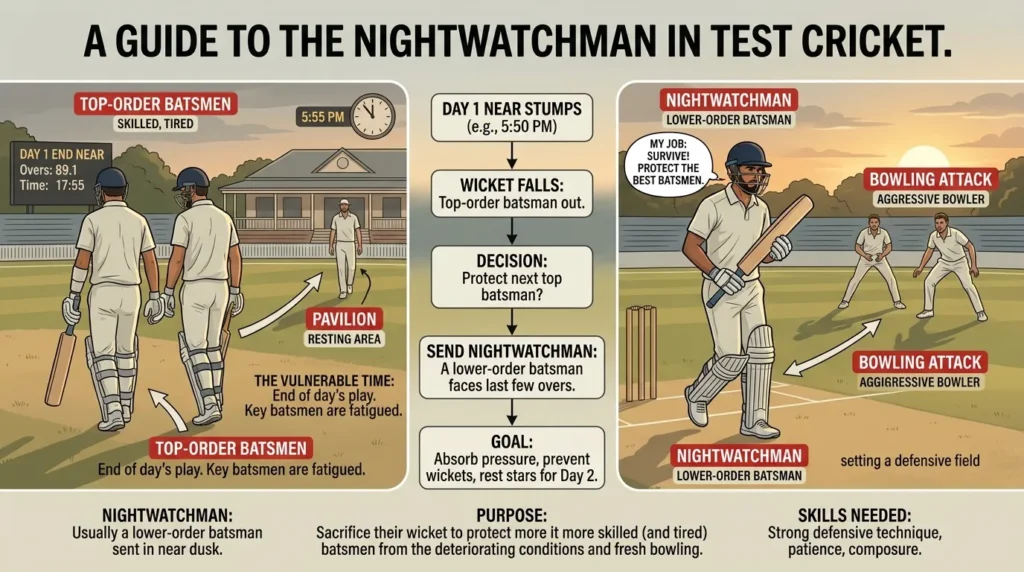
Cricket is a game of strategy as much as skill. Teams often make tactical decisions to protect their best batters and improve their chances of winning. One such tactic is the nightwatchman, a unique role that often confuses new cricket fans. Although a nightwatchman is not a specialist batter, this player can have a significant impact on a match by protecting top-order batters during difficult playing conditions.
In this complete guide, you’ll learn what a nightwatchman is, why teams use one, how the strategy works, its advantages and disadvantages, famous examples, and interesting facts about one of cricket’s most fascinating tactical decisions.
What Is a Nightwatchman?
A nightwatchman is a lower-order batter, usually a bowler, who is sent in to bat near the end of a day’s play after a wicket falls instead of sending a specialist batter.
The main purpose of a nightwatchman is to protect the team’s top-order batters from facing a few dangerous overs before stumps. Since conditions late in the day can favor fast bowlers due to fading light, tired players, or a new ball, teams prefer risking a lower-order batter rather than an important batter.
If the nightwatchman survives until the end of the day’s play, the specialist batter can begin batting the following morning under fresher conditions.
History of the Nightwatchman
Origin of the Strategy
The nightwatchman tactic has been part of Test cricket for many decades. Although no one knows exactly when it first appeared, it became increasingly common during the early twentieth century as captains looked for ways to protect their best batters.
Why the Strategy Became Popular
Test matches last up to five days, making player management extremely important. Losing a top batter just before the close of play can hurt a team’s chances significantly. Sending a lower-order player instead became a practical tactical solution.
Today, the nightwatchman remains a common feature in Test cricket, although some teams choose not to use the tactic depending on match conditions.
How the Nightwatchman Strategy Works
The strategy is relatively simple.
- A wicket falls shortly before stumps.
- The captain and coach decide not to send the next specialist batter.
- A lower-order batter, usually a fast bowler, walks in instead.
- The nightwatchman attempts to survive the remaining overs.
- On the following morning, if still unbeaten, the nightwatchman continues batting until dismissed.
This approach allows the team’s strongest batters to begin their innings in better conditions.
When Is a Nightwatchman Used?
Captains usually use a nightwatchman in specific situations.
Near the End of the Day
The strategy is most common when fewer than 10–15 overs remain before stumps.
Difficult Batting Conditions
Conditions such as:
- Swing-friendly weather
- Fast bowling under fading light
- A new ball
- Moist pitch conditions
make batting more difficult.
Protecting Key Batters
If an important batter is due next, teams often prefer delaying their innings until the following day.
Rules Related to the Nightwatchman
Interestingly, there are no official cricket rules about a nightwatchman.
The tactic is completely legal because batting order decisions are entirely up to the team’s captain and management.
Any player listed in the playing XI can bat at any position during the innings.
Responsibilities of a Nightwatchman
A successful nightwatchman has several important responsibilities.
Protect Specialist Batters
The primary objective is to shield experienced batters from difficult conditions.
Survive Until Stumps
Rather than scoring quickly, survival is the main goal.
Build Partnerships
Sometimes the nightwatchman stays at the crease long enough to build useful partnerships.
Frustrate Opposition Bowlers
Remaining unbeaten can reduce the bowling team’s momentum heading into the next day.
Skills Required for a Good Nightwatchman
Although nightwatchmen are not specialist batters, they still require certain abilities.
Defensive Technique
Good defensive batting helps them survive quality bowling.
Patience
Nightwatchmen often leave many deliveries and focus only on safe scoring opportunities.
Courage
Facing fast bowlers with a new ball requires bravery.
Concentration
Maintaining focus during difficult conditions is essential.
Which Players Usually Become Nightwatchmen?
The role is commonly given to:
- Fast bowlers
- Medium pacers
- Bowling all-rounders
- Lower-order batters
Spin bowlers are occasionally used, although bowling all-rounders often perform better because of their batting ability.
Advantages of Using a Nightwatchman
The strategy offers several benefits.
Protects Star Batters
Top-order players avoid facing dangerous evening conditions.
Reduces Pressure
Specialist batters can begin fresh the following morning.
Improves Team Strategy
The tactic helps teams manage risk effectively during long Test matches.
Builds Team Confidence
A successful nightwatchman can boost morale by surviving challenging overs.
Creates Unexpected Runs
Some nightwatchmen score valuable runs and frustrate opponents.
Disadvantages of Using a Nightwatchman
Despite its benefits, the tactic has some drawbacks.
Possible Early Wicket
The nightwatchman may get out quickly, making the strategy ineffective.
Delays Better Batters
Sometimes a specialist batter could have survived comfortably.
Loss of Momentum
If batting conditions improve unexpectedly, delaying an experienced batter may not be beneficial.
Limited Scoring Ability
Lower-order batters often struggle to score freely against quality bowling.
Famous Nightwatchman Performances
Several players have become famous for outstanding nightwatchman innings.
Jason Gillespie
One of the greatest examples came when Australian fast bowler Jason Gillespie scored an unbeaten 201 against Bangladesh after being promoted as a nightwatchman.
Tony Mann
Australian spinner Tony Mann scored an impressive 105 as a nightwatchman against India in 1977.
Alex Tudor
England fast bowler Alex Tudor also played memorable innings after being used as a nightwatchman.
These performances proved that nightwatchmen can sometimes become unexpected heroes.
Formats Where Nightwatchmen Are Used
Test Cricket
This is where the strategy is most common because matches last five days.
First-Class Cricket
Domestic first-class matches frequently use the same tactic.
One-Day Cricket
Nightwatchmen are almost never used because innings are limited.
T20 Cricket
The strategy is unnecessary due to the short format and aggressive batting approach.
Equipment Used by a Nightwatchman
A nightwatchman uses the same protective equipment as every batter.
Batting Equipment
- Cricket bat
- Helmet
- Batting gloves
- Batting pads
- Thigh guard
- Arm guard
- Chest guard
- Abdominal guard
- Cricket shoes
Proper protective equipment is especially important because nightwatchmen often face fast bowlers immediately.
Role of the Captain and Coach
The decision to use a nightwatchman usually involves:
- Match situation
- Overs remaining
- Pitch conditions
- Weather
- Strength of opposition bowlers
- Confidence of lower-order batters
Experienced captains carefully evaluate these factors before making the decision.
Major Cricket Competitions Where the Strategy Is Seen
The nightwatchman tactic is commonly used in:
- ICC World Test Championship
- Test series between international teams
- County Championship
- Sheffield Shield
- Ranji Trophy
- Other first-class cricket tournaments
Because these competitions involve multi-day matches, tactical batting decisions become much more important.
Benefits of Learning About the Nightwatchman
Understanding this strategy helps fans appreciate cricket more deeply.
Better Understanding of Test Cricket
Viewers learn why captains make tactical batting decisions.
Improves Cricket Knowledge
The concept highlights the strategic side of the game.
Helpful for Young Players
Aspiring cricketers can understand team tactics beyond batting and bowling skills.
Enhances Match Analysis
Knowing the role of a nightwatchman makes commentary and match situations easier to understand.
Interesting Facts About the Nightwatchman
- The nightwatchman is one of cricket’s oldest tactical strategies.
- There is no official ICC rule requiring or restricting its use.
- Some nightwatchmen have scored centuries.
- Many successful nightwatchmen are fast bowlers.
- The strategy is almost exclusive to Test and first-class cricket.
- Some modern teams rarely use the tactic, preferring specialist batters instead.
- A successful nightwatchman can completely change the momentum of a Test match.
Common Questions About the Nightwatchman
Why is the player called a nightwatchman?
The term comes from the idea of “guarding” the team’s specialist batters overnight by facing the final overs of the day.
Can a nightwatchman score a century?
Yes. Several players have scored centuries after being promoted as nightwatchmen.
Is a nightwatchman always a bowler?
Usually, yes. However, any lower-order batter or bowling all-rounder can perform the role.
Is the strategy used in T20 cricket?
No. T20 matches are too short for the tactic to provide any strategic advantage.
Conclusion
The nightwatchman is one of cricket’s most distinctive tactical roles, reflecting the strategic depth of the game, particularly in Test and first-class cricket. By sending a lower-order batter to face the final overs of the day, teams aim to protect their specialist batters from challenging conditions and give them the best chance to succeed when play resumes. While the tactic does not always work, it has produced some unforgettable performances and remains an important part of cricket strategy. Understanding the role of the nightwatchman gives players, fans, and aspiring cricketers a greater appreciation of the planning and decision-making that make cricket such a fascinating sport.

Green Benn is a dedicated sports writer specializing in cricket, including IPL and international formats. Known for clear, engaging, and informative content, Green simplifies complex match analysis and player statistics for all readers. Passionate about sports storytelling, Green delivers reliable, SEO-friendly articles that keep fans updated and informed