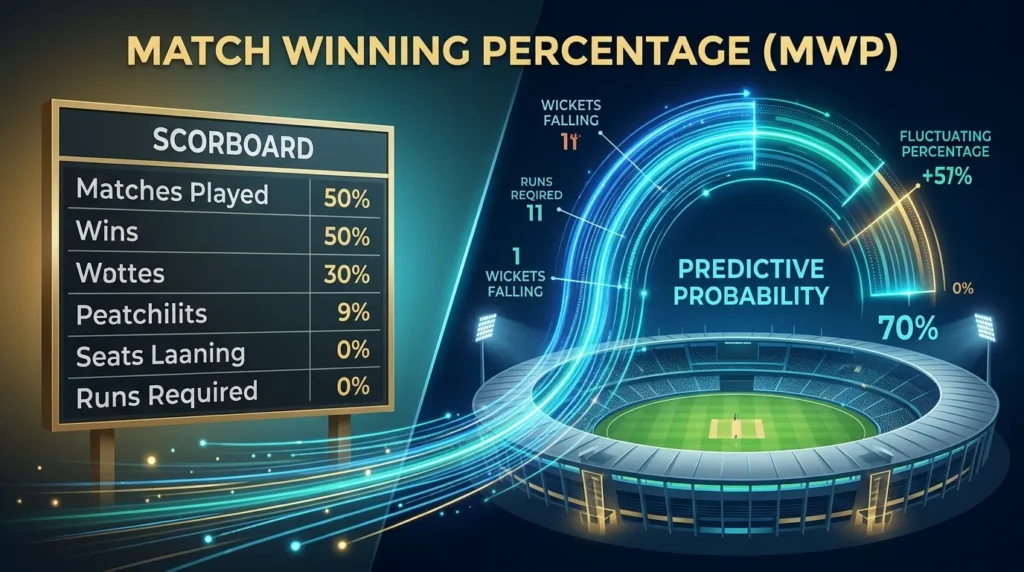
Modern cricket is no longer judged only by runs, wickets, and final scores. Today, advanced statistics and data analysis help players, coaches, commentators, and fans understand how a match is changing from ball to ball. One of the most exciting statistics shown during live cricket broadcasts is the Match Winning Percentage. This graphic estimates which team has the better chance of winning at any stage of the match based on current conditions and historical data.
Many cricket fans ask, “What is Match Winning Percentage?” You may have noticed television graphics showing Team A with a 65% chance of winning while Team B has a 35% chance. These percentages are not guarantees. Instead, they are calculated predictions that change throughout the match as wickets fall, runs are scored, overs decrease, or weather conditions change.
Understanding Match Winning Percentage helps viewers follow the game more closely and appreciate how momentum shifts during an innings. This guide explains the history, calculation methods, influencing factors, player roles, technology, major tournaments, advantages, limitations, interesting facts, and frequently asked questions in simple, beginner-friendly English.
History of Match Winning Percentage
For many years, cricket fans relied on personal judgment to predict which team would win a match. As sports analytics developed, statisticians began using historical match data to estimate winning probabilities.
With the growth of computers, artificial intelligence, and ball-by-ball databases, broadcasters introduced Match Winning Percentage graphics during live matches. Today, major cricket boards and television companies use advanced statistical models to update winning chances after nearly every delivery.
These systems have become especially popular in One Day Internationals (ODIs) and Twenty20 (T20) cricket, where match situations change rapidly.
What is Match Winning Percentage?
Match Winning Percentage is a statistical prediction that estimates each team’s probability of winning a cricket match at a particular moment.
It uses match conditions, historical data, and real-time information to calculate the likely outcome.
The percentage changes continuously throughout the game.
Simple Example
Team A needs 40 runs from 30 balls with 8 wickets remaining.
The prediction model may show:
- Team A: 75% chance of winning
- Team B: 25% chance of winning
If Team A loses two quick wickets, the percentages may change immediately.
How Does Match Winning Percentage Work?
The system combines live match information with historical statistics.
Step 1: Collect Match Data
The system records:
- Runs scored
- Wickets lost
- Overs remaining
- Required run rate
Step 2: Compare Historical Matches
Computers analyze thousands of similar match situations.
Step 3: Apply Statistical Models
Algorithms estimate the probability of each team winning.
Step 4: Update After Every Ball
Each delivery changes the available data.
Step 5: Display Winning Percentage
The updated percentages appear during live broadcasts.
Factors That Affect Match Winning Percentage
Several match conditions influence the prediction.
Current Score
Higher scores generally improve winning chances.
Wickets Remaining
More wickets usually increase the batting team’s probability.
Overs Remaining
Time available greatly affects the prediction.
Required Run Rate
A lower required run rate improves chasing chances.
Pitch Conditions
Batting-friendly pitches often increase successful run chases.
Weather
Rain interruptions may affect predictions.
Team Strength
Some models consider player quality and team performance.
How Match Winning Percentage Changes During a Match
Strong Batting Partnership
Winning percentage increases.
Quick Wickets
The batting team’s chances often decrease.
Expensive Bowling Overs
The chasing team’s probability usually rises.
Maiden Overs
The bowling team’s chances often improve.
Rain Delays
Duckworth-Lewis-Stern (DLS) adjustments may significantly change predictions.
Match Winning Percentage in Different Cricket Formats
Test Cricket
Predictions consider:
- Time remaining
- Pitch deterioration
- Possibility of a draw
One Day International (ODI)
The model focuses on:
- Runs required
- Overs left
- Wickets remaining
Twenty20 Cricket
Winning percentages change rapidly because every ball has a major impact.
Technology Behind Match Winning Percentage
Several technologies support prediction systems.
Ball-by-Ball Databases
Provide historical match information.
Statistical Software
Processes thousands of previous matches.
Artificial Intelligence
Improves prediction accuracy.
Machine Learning
Learns from new match data over time.
Live Data Feeds
Update the model after every delivery.
Player Roles That Influence Winning Percentage
Batters
Score runs and build partnerships.
Bowlers
Take wickets and control the scoring rate.
Captain
Makes tactical decisions affecting momentum.
Wicketkeeper
Supports bowlers and contributes to dismissals.
Fielders
Save runs and create wicket opportunities.
Coaches and Analysts
Use statistical information for strategy planning.
Equipment Used in Cricket
Although Match Winning Percentage is a statistical tool, players continue using standard cricket equipment.
Cricket Bat
Used for scoring runs.
Cricket Ball
Used by bowlers.
Helmet
Protects batters from fast deliveries.
Batting Gloves
Provide grip and hand protection.
Batting Pads
Protect the legs.
Cricket Shoes
Improve balance and movement.
Stumps and Bails
Essential match equipment.
Major Cricket Tournaments Using Match Winning Percentage
Winning probability graphics are commonly shown during major competitions.
ICC Cricket World Cup
Displays live winning predictions throughout the match.
ICC World Test Championship
Estimates win, draw, and loss probabilities.
ICC Champions Trophy
Used during international broadcasts.
ICC T20 World Cup
Updates rapidly after every over.
Indian Premier League (IPL)
Frequently shown during live television coverage.
Domestic Cricket Leagues
Many broadcasters now include winning probability graphics.
Advantages of Match Winning Percentage
Helps Fans Understand the Match
Explains changing match situations visually.
Supports Strategic Analysis
Teams study similar match scenarios.
Enhances Television Coverage
Makes broadcasts more engaging.
Shows Momentum Changes
Illustrates how quickly cricket matches can change.
Supports Data-Driven Decisions
Teams increasingly use analytics alongside experience.
Limitations of Match Winning Percentage
It Is Only a Prediction
Unexpected performances can change the result.
Human Performance Cannot Be Fully Predicted
Players often exceed expectations.
Weather Can Change Everything
Rain interruptions may affect outcomes.
Emotional Pressure Is Difficult to Measure
Statistics cannot fully predict player reactions under pressure.
Benefits of Playing Cricket
Physical Benefits
- Improves coordination
- Builds endurance
- Develops agility
- Strengthens muscles
- Improves reflexes
Mental Benefits
- Enhances concentration
- Builds confidence
- Develops teamwork
- Improves decision-making
- Encourages strategic thinking
Interesting Facts About Match Winning Percentage
- The percentage changes after almost every ball.
- Advanced computer models analyze thousands of previous matches.
- Winning probability is not a guarantee of victory.
- T20 matches usually show the fastest percentage changes.
- Test cricket predictions often include draw probability.
- Modern broadcasters use artificial intelligence to improve prediction accuracy.
- Even teams with less than a 10% chance have occasionally won remarkable matches.
Frequently Asked Questions
What is Match Winning Percentage in cricket?
Match Winning Percentage is a statistical estimate showing each team’s probability of winning based on the current match situation.
How is Match Winning Percentage calculated?
It uses historical match data, current score, wickets, overs remaining, run rate, and computer-based statistical models.
Does Match Winning Percentage guarantee the winner?
No. It is only a prediction and can change quickly during the match.
Why does the percentage change after every ball?
Each delivery changes the match situation, affecting the statistical prediction.
Which cricket formats use Match Winning Percentage?
It is commonly used in Test matches, One Day Internationals, T20 Internationals, IPL, and other major tournaments.
Who creates Match Winning Percentage?
Broadcasters and sports analytics companies use statistical software, artificial intelligence, and historical databases.
Why is Match Winning Percentage important?
It helps fans understand momentum, supports match analysis, and makes live broadcasts more informative.
Conclusion
Understanding what is Match Winning Percentage helps cricket fans appreciate the growing role of technology and data analysis in the modern game. Instead of simply predicting a winner, this statistic shows how each ball, wicket, partnership, and tactical decision influences the likely outcome of a match. Coaches and analysts use similar models to study strategies, while broadcasters use winning probability graphics to explain momentum shifts during live coverage. Although Match Winning Percentage is not always correct because cricket remains unpredictable, it provides valuable insight into changing match situations. As artificial intelligence and sports analytics continue to advance, Match Winning Percentage will become even more accurate and remain an important part of how players,

Green Benn is a dedicated sports writer specializing in cricket, including IPL and international formats. Known for clear, engaging, and informative content, Green simplifies complex match analysis and player statistics for all readers. Passionate about sports storytelling, Green delivers reliable, SEO-friendly articles that keep fans updated and informed