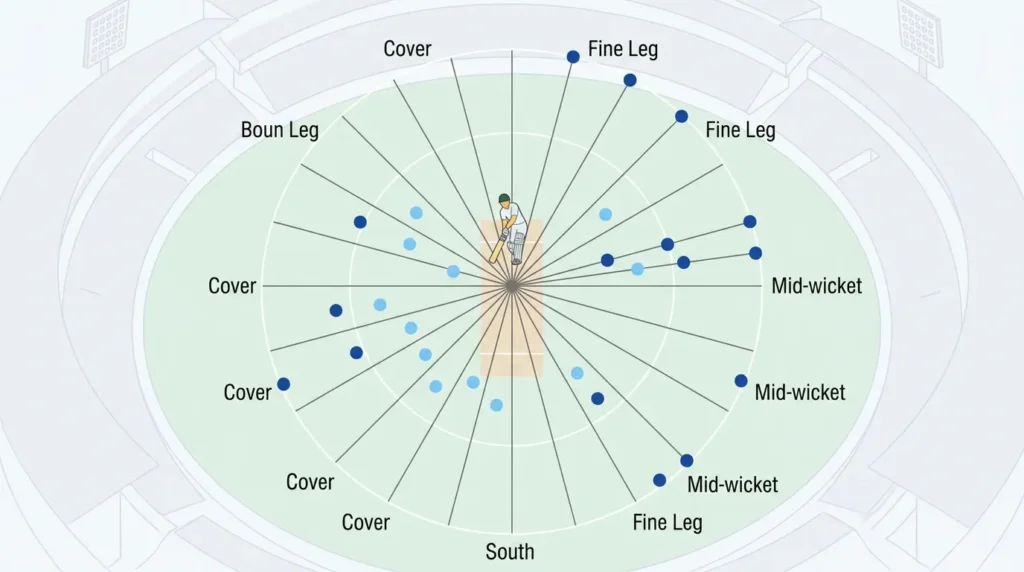

Cricket has evolved from a traditional bat-and-ball game into a sport that uses advanced statistics and technology to improve performance. Today, players, coaches, commentators, and fans rely on detailed match data to understand batting patterns and strategies. One of the most popular visual tools used in cricket analysis is the Wagon Wheel. It helps show where a batter scores runs by displaying the direction of every shot played during an innings.
Many cricket fans and beginners ask, “What is Wagon Wheel in Cricket?” If you have watched an international match, you may have seen a circular graphic with lines spreading across the field after a batter completes an innings. This graphic is called the Wagon Wheel. It provides valuable information about a batter’s scoring areas, strengths, and shot selection.
The Wagon Wheel is widely used in international cricket, domestic tournaments, and television broadcasts. It helps teams develop strategies, identify scoring opportunities, and plan field placements. This guide explains the history, working principle, components, uses, player roles, equipment, major tournaments, benefits, interesting facts, and frequently asked questions about the Wagon Wheel in simple and easy-to-understand language.
History of the Wagon Wheel in Cricket
As cricket statistics became more detailed during the late twentieth century, analysts looked for better ways to display batting performance.
Television broadcasters and cricket analysts introduced the Wagon Wheel as a visual representation of where batters scored their runs. With improvements in ball-tracking technology and computer graphics, the Wagon Wheel became a regular feature during live broadcasts.
Today, professional teams use Wagon Wheel data for performance analysis, coaching, opposition planning, and player development.
What is Wagon Wheel in Cricket?
A Wagon Wheel is a graphical chart that shows the direction of every scoring shot played by a batter during an innings.
Each line starts from the batting crease and extends toward the area where the ball was hit. The collection of these lines forms a wheel-like pattern, which gives the graphic its name.
Simple Example
If a batter hits several boundaries through the cover region and only a few runs on the leg side, the Wagon Wheel clearly shows most scoring shots on the off side.
Coaches can quickly understand the batter’s preferred scoring areas.
How Does the Wagon Wheel Work?
The Wagon Wheel uses ball-tracking data and shot analysis.
Step 1: Batter Plays a Shot
The batter strikes the ball during the match.
Step 2: Ball Direction Is Recorded
Technology tracks where the ball travels after leaving the bat.
Step 3: Runs Are Added
Each scoring shot is linked with the number of runs scored.
Step 4: Graphic Is Created
A line is drawn from the batting position toward the scoring area.
Step 5: Performance Is Analyzed
Coaches, commentators, and fans study the batter’s scoring patterns.
Main Components of a Wagon Wheel
Batting Position
The center of the wheel represents the batter’s position.
Shot Direction
Each line shows where the ball was hit.
Run Value
Different shots represent singles, doubles, boundaries, or sixes.
Field Areas
The graphic divides scoring into standard cricket regions.
Statistical Summary
Many Wagon Wheels include:
- Total runs
- Number of boundaries
- Strike rate
- Percentage of runs by region
Common Fielding Areas Shown on a Wagon Wheel
Cover
One of the most common scoring areas for technically strong batters.
Point
Shows square shots on the off side.
Third Man
Represents late cuts and edges.
Mid-Off
Straight drives often travel through this region.
Mid-On
Powerful straight shots on the leg side.
Midwicket
A common scoring area for pull and flick shots.
Square Leg
Shows horizontal-bat shots on the leg side.
Fine Leg
Displays glances and deflections.
Why is the Wagon Wheel Important?
Helps Analyze Batting Style
Shows where a batter scores most runs.
Supports Team Strategy
Teams prepare field placements based on scoring patterns.
Improves Coaching
Coaches identify strengths and weaknesses.
Enhances Television Broadcasts
Fans gain a better understanding of batting performance.
Wagon Wheel Strategies
Identifying Strong Scoring Areas
Batters focus on their strongest regions.
Exploiting Field Gaps
Players target open spaces identified through previous analysis.
Opposition Planning
Bowling teams study Wagon Wheels before matches.
Improving Shot Selection
Batters work on scoring in more areas around the ground.
Player Roles Related to the Wagon Wheel
Batter
Creates the scoring pattern through shot selection.
Bowler
Attempts to restrict scoring areas.
Captain
Adjusts field placements based on batting patterns.
Coach
Uses Wagon Wheel data for training sessions.
Data Analyst
Studies player statistics and performance trends.
Commentator
Explains the graphic to viewers during broadcasts.
Equipment Used in Cricket
The Wagon Wheel is an analysis tool, but players still rely on standard cricket equipment.
Cricket Bat
Used to score runs.
Cricket Ball
Used by bowlers.
Helmet
Protects the batter.
Batting Gloves
Provide grip and protection.
Batting Pads
Protect the legs.
Cricket Shoes
Provide stability while running and batting.
Stumps and Bails
Essential equipment used throughout the match.
Major Cricket Tournaments Using Wagon Wheel Analysis
The Wagon Wheel is commonly displayed during major cricket competitions.
ICC Cricket World Cup
Shows batting patterns during important innings.
ICC World Test Championship
Analyzes scoring areas over long innings.
ICC Champions Trophy
Provides tactical insights during international matches.
ICC T20 World Cup
Highlights aggressive batting strategies.
Indian Premier League (IPL)
Frequently used during live television broadcasts.
Domestic Cricket Leagues
Professional analysts use Wagon Wheels to evaluate player performance.
Benefits of Using the Wagon Wheel
Improves Batting Analysis
Helps understand scoring habits.
Supports Better Coaching
Identifies areas needing improvement.
Assists Bowlers
Helps bowlers develop bowling plans.
Improves Field Placements
Captains position fielders more effectively.
Enhances Fan Experience
Viewers better understand player performance.
Limitations of the Wagon Wheel
Shows Direction Only
It does not fully explain shot quality.
Match Conditions Matter
Pitch and weather affect scoring patterns.
Different Bowlers Create Different Results
Scoring areas may change against different bowling attacks.
Requires Technology
Professional tracking systems are needed for accurate graphics.
Benefits of Playing Cricket
Physical Benefits
- Improves coordination
- Builds endurance
- Increases agility
- Develops reflexes
- Strengthens muscles
Mental Benefits
- Improves concentration
- Develops strategic thinking
- Builds confidence
- Encourages teamwork
- Enhances decision-making
Interesting Facts About the Wagon Wheel
- The Wagon Wheel gets its name from its wheel-like appearance.
- It is one of the most popular graphics used in cricket broadcasting.
- Professional coaches use Wagon Wheels to prepare match strategies.
- Modern ball-tracking technology has improved its accuracy.
- Every batter has a unique Wagon Wheel pattern.
- Aggressive batters often have scoring areas covering the entire ground.
- Television commentators frequently use Wagon Wheels to explain batting strengths.
Frequently Asked Questions
What is Wagon Wheel in cricket?
The Wagon Wheel is a graphical chart that shows the direction of every scoring shot played by a batter during an innings.
How does the Wagon Wheel work?
It records where each scoring shot travels and displays the information in a circular graphic.
Why is the Wagon Wheel important?
It helps coaches, captains, analysts, and fans understand batting patterns and scoring areas.
Who uses Wagon Wheel data?
Players, coaches, analysts, commentators, broadcasters, and cricket fans all use Wagon Wheel information.
Does the Wagon Wheel show every ball faced?
No. It mainly displays scoring shots rather than every delivery.
Which tournaments use the Wagon Wheel?
It is commonly used in ICC tournaments, the IPL, international matches, and many domestic competitions.
Can bowlers benefit from Wagon Wheel analysis?
Yes. Bowlers use it to identify a batter’s favorite scoring areas and develop better bowling strategies.
Conclusion
Understanding what is Wagon Wheel in Cricket helps players and fans appreciate the growing role of technology and data analysis in the modern game. The Wagon Wheel provides a simple yet powerful visual representation of where a batter scores runs, making it easier to identify strengths, weaknesses, and scoring patterns. Coaches use it to improve training, captains rely on it for smarter field placements, and bowlers study it to develop effective plans against opposition batters. Broadcasters also use the graphic to help viewers understand a batter’s innings more clearly. As cricket continues to embrace advanced analytics, the Wagon Wheel will remain one of the most valuable and widely recognized tools for batting analysis at every level of the sport.