Modern cricket has become more accurate and fair thanks to advanced technology. In the past, umpires had to rely only on their eyesight and experience to decide whether a batter had edged the ball before it reached the wicketkeeper or slips. In close matches, these decisions were often difficult because the edge could be extremely faint. To improve decision-making, cricket introduced several technologies, one of the most important being the Snickometer.
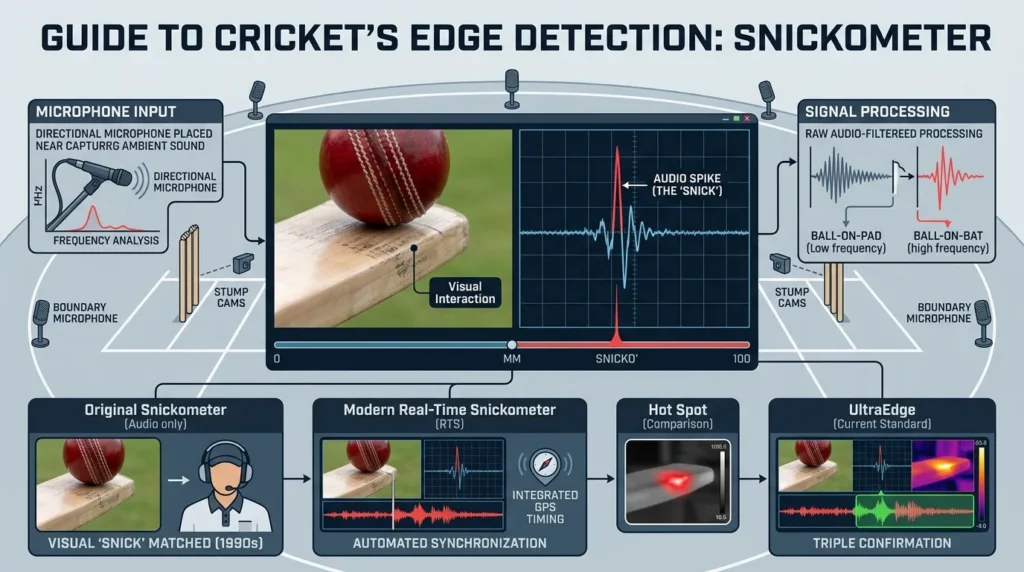
Many cricket fans, beginners, students, and aspiring players ask, “What is Snickometer?” The Snickometer is an edge detection system that helps umpires determine whether the cricket ball touched the bat before being caught or reaching the wicketkeeper. It combines sensitive audio equipment with slow-motion video to detect tiny sounds made when the ball makes contact with the bat.
Today, the Snickometer is widely used alongside the Decision Review System (DRS) in international cricket. It has become an essential tool for reducing umpiring errors and increasing confidence in close decisions. This guide explains the history, working principle, components, uses, advantages, limitations, player roles, major tournaments, interesting facts, and frequently asked questions about the Snickometer.
History of the Snickometer
The Snickometer was developed in the 1990s by British computer scientist Allan Plaskett. It was created to help television broadcasters analyze disputed catches and improve the accuracy of umpiring decisions.
Initially, the technology was used mainly during television replays. As cricket embraced technology, the Snickometer became part of the Decision Review System (DRS) and is now regularly used in international matches.
Over time, improvements in audio sensors, digital signal processing, and high-speed cameras have made the Snickometer more reliable and accurate.
What is Snickometer?
A Snickometer is a cricket technology that detects whether the ball has made contact with the bat or another object by analyzing sound waves and synchronized video footage.
It is commonly used when deciding:
- Caught behind appeals
- Edges to slip fielders
- Bat and pad contact
- Close wicketkeeper catches
The Snickometer helps the third umpire make more accurate decisions during reviews.
Simple Example
A fast bowler appeals for a caught-behind dismissal. The batter claims the ball hit the pad instead of the bat.
The third umpire checks the Snickometer. A clear spike appears exactly when the ball passes the bat, confirming an edge. The batter is given out.
How Does the Snickometer Work?
The Snickometer combines audio analysis with slow-motion video.
Step 1: Ball Is Delivered
The bowler delivers the ball to the batter.
Step 2: Sensitive Microphones Record Sound
Highly sensitive microphones around the field capture every sound.
Step 3: Video Is Synchronized
High-speed cameras record the exact movement of the ball.
Step 4: Sound Wave Analysis
Computer software converts recorded sounds into waveforms.
Step 5: Third Umpire Reviews the Evidence
The audio waveform and video are examined together to determine whether the ball touched the bat.
Main Components of the Snickometer
Sensitive Microphones
Capture very small sounds during play.
High-Speed Cameras
Provide slow-motion video from multiple angles.
Computer Software
Processes and synchronizes audio and video.
Audio Waveform Display
Shows sound spikes that may indicate contact.
Replay System
Allows the third umpire to review the incident several times.
How the Snickometer Helps Umpires
Detecting Bat Edges
Confirms whether the ball touched the bat.
Reviewing Caught-Behind Appeals
Provides additional evidence during close catches.
Supporting DRS Decisions
Works alongside other review technologies.
Improving Accuracy
Reduces incorrect dismissals.
Snickometer and the Decision Review System (DRS)
The Snickometer is an important part of the Decision Review System.
It works together with:
UltraEdge
An improved edge detection technology used in many international matches.
Ball Tracking
Predicts the future path of the ball.
Hot Spot (where available)
Uses infrared imaging to detect contact.
Slow-Motion Cameras
Provide detailed visual evidence.
The third umpire considers all available evidence before making a final decision.
Player Roles During Snickometer Reviews
Bowler
Appeals after believing the batter edged the ball.
Batter
May request a review if given out.
Wicketkeeper
Often hears or sees the possible edge.
Slip Fielders
Attempt catches following faint edges.
On-Field Umpire
Makes the original decision.
Third Umpire
Uses Snickometer and other technologies to review the appeal.
Equipment Used in Cricket
Although the Snickometer is a technology system, players continue using standard cricket equipment.
Cricket Bat
Used for batting.
Cricket Ball
Produces the sound detected by the Snickometer.
Wicketkeeping Gloves
Used for catches behind the stumps.
Cricket Helmet
Protects the batter.
Batting Gloves
Protect the hands and may also produce sounds that require careful analysis.
Cricket Stumps and Bails
Used during wicket decisions.
Major Cricket Tournaments Using the Snickometer
The Snickometer is commonly used in elite cricket competitions.
ICC Cricket World Cup
Used during television reviews and DRS.
ICC World Test Championship
Supports third-umpire decisions.
ICC Champions Trophy
Helps review close catching appeals.
ICC T20 World Cup
Provides additional evidence during reviews.
Bilateral International Series
Many international Test, ODI, and T20 matches use Snickometer or UltraEdge.
Advantages of the Snickometer
Improves Decision Accuracy
Helps identify faint edges.
Supports Fair Play
Provides objective evidence.
Reduces Human Error
Assists umpires during difficult decisions.
Builds Player Confidence
Players trust technology-backed decisions.
Enhances Television Coverage
Viewers better understand close decisions.
Limitations of the Snickometer
Not Perfect
Background noise can sometimes affect analysis.
Requires Multiple Camera Angles
Poor camera positioning may reduce accuracy.
Interpretation Needed
The third umpire must carefully analyze both audio and video.
Expensive Technology
Professional equipment is costly to install and maintain.
Benefits of Cricket
Physical Benefits
- Improves coordination
- Builds endurance
- Increases agility
- Develops reflexes
- Strengthens muscles
Mental Benefits
- Improves concentration
- Builds patience
- Enhances teamwork
- Develops strategic thinking
- Increases confidence
Interesting Facts About the Snickometer
- The Snickometer was invented by Allan Plaskett.
- It first appeared during television cricket broadcasts.
- It analyzes both sound and video together.
- It is often used with UltraEdge and DRS.
- Tiny bat edges that are invisible to the eye can sometimes be detected.
- The technology has significantly reduced controversial dismissals.
- Modern versions provide much faster and clearer analysis than earlier systems.
Frequently Asked Questions
What is Snickometer in cricket?
The Snickometer is an edge detection technology that helps determine whether the cricket ball touched the bat by analyzing synchronized sound and video.
How does the Snickometer work?
It records sound through sensitive microphones and combines it with slow-motion video to detect possible contact between the bat and ball.
Is Snickometer part of DRS?
Yes. It is commonly used as part of the Decision Review System to assist the third umpire.
Is Snickometer the same as UltraEdge?
UltraEdge is an advanced version of edge detection technology and is widely used in modern international cricket.
Can Snickometer make the final decision?
No. The third umpire reviews the Snickometer along with other available evidence before making a final decision.
Which matches use the Snickometer?
It is commonly used in international Test matches, One Day Internationals, T20 Internationals, ICC tournaments, and other major competitions.
Why is Snickometer important?
It improves the accuracy of close catching decisions, supports fair play, and reduces umpiring errors.
Conclusion
Understanding what is Snickometer helps cricket fans appreciate how technology has transformed modern umpiring. By combining highly sensitive audio recording with synchronized slow-motion video, the Snickometer assists officials in detecting faint edges that may otherwise go unnoticed. As an important part of the Decision Review System, it supports fair decisions, reduces human error, and increases confidence among players, umpires, and spectators. Although it is not used alone and must be considered alongside other technologies such as UltraEdge and ball tracking, the Snickometer remains one of cricket’s most valuable innovations. As technology continues to improve, tools like the Snickometer will play an even greater role in making cricket more accurate, transparent, and enjoyable for everyone.

Green Benn is a dedicated sports writer specializing in cricket, including IPL and international formats. Known for clear, engaging, and informative content, Green simplifies complex match analysis and player statistics for all readers. Passionate about sports storytelling, Green delivers reliable, SEO-friendly articles that keep fans updated and informed