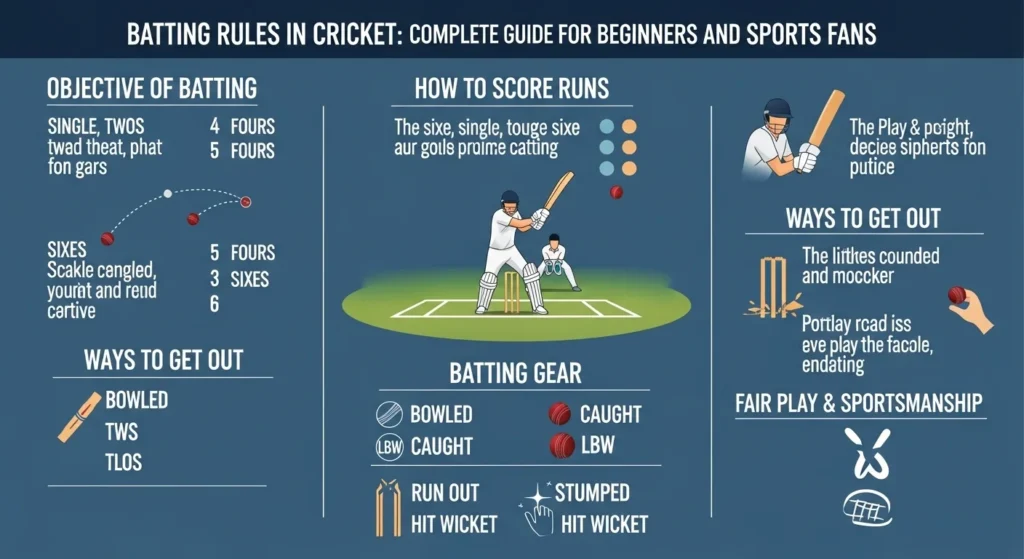

Batting rules in cricket are the set of guidelines that explain how a batsman scores runs, stays on the field, and contributes to the team’s total score. Batting is one of the most exciting and important parts of cricket because it is the main way teams earn runs and compete to win the match.
In cricket, the batting team tries to score as many runs as possible while the bowling and fielding team tries to stop them and dismiss the batsmen. A batsman must follow specific batting rules such as staying within the crease, hitting the ball with the bat, and running between the wickets correctly.
Understanding batting rules is essential for players, beginners, sports students, and cricket fans because these rules determine how the game progresses. From scoring runs to avoiding dismissal, batting requires skill, concentration, and knowledge of the laws of cricket.
In this complete guide, we will explain the batting rules in cricket, their history, techniques, player roles, equipment used in batting, and important strategies that help batsmen succeed in the game.
History of Batting in Cricket
Early Development of Batting
The early development of batting in cricket is closely linked with the history of the sport itself. In the beginning, cricket was a very simple game played in rural areas of England during the 16th and 17th centuries. Batting at that time was not as technical or structured as it is today. Players used basic wooden bats that were shaped more like hockey sticks, mainly designed to defend the wicket rather than play attacking shots.
In early cricket, the main goal of a batter was to stop the ball from hitting the stumps, not to score runs aggressively. Bowling styles were also underarm, meaning the ball was rolled or skimmed along the ground. Because of this, batting technique focused more on blocking and simple deflections rather than powerful strokes. There was no concept of modern footwork, backlift, or shot selection strategies.
As cricket became more organized in the 18th century, batting started to evolve. The introduction of round-arm and later overarm bowling changed the way batters played the game. Players had to develop better timing, stronger defense, and improved hand-eye coordination. The shape of the bat also changed from curved to a straighter design, which allowed players to play both defensive and attacking shots more effectively.
In countries like Australia and later India, batting techniques developed further as international cricket expanded. Players began to learn different strokes such as drives, cuts, pulls, and hooks. Coaching systems also improved, helping batters understand pitch conditions, bowlers’ variations, and match situations.
By the time modern cricket arrived, batting had become a highly skilled art form. Today, batters use advanced techniques, fitness training, video analysis, and strategic planning to perform at the highest level. From defensive blocking in early cricket to aggressive T20 batting, the evolution of batting shows how the sport has grown into a global and highly competitive game.
Cricket began in England during the 16th century, and batting was initially very simple. Early bats looked more like curved sticks because bowlers used to roll the ball along the ground.
As the sport evolved, bowlers started delivering the ball in the air. Because of this change, bats were redesigned into the straight cricket bat used today.
Evolution of Batting Techniques
The evolution of batting techniques in cricket shows how the game has developed from a simple pastime into a highly technical and professional sport. In the early days of cricket in England during the 16th and 17th centuries, batting was very basic. Players mainly focused on defending the wicket because bowling was underarm and slow. The bat was curved like a hockey stick, and shots were mostly simple blocks and gentle pushes rather than attacking strokes.
As cricket evolved in the 18th and 19th centuries, bowling styles changed from underarm to round-arm and then overarm. This forced batters to improve their techniques. The straight bat was introduced, allowing players to play more controlled and accurate shots. Defensive technique became more important, and batters started learning footwork to handle faster deliveries and different angles of bowling.
In countries like Australia and India, batting techniques developed further as international matches became more competitive. Players began to master a variety of strokes such as the drive, cut, pull, and hook. Coaching systems improved, helping batters understand timing, balance, and shot selection according to pitch conditions.
In modern cricket, batting has become highly advanced. Players use video analysis, fitness training, and data-driven strategies to improve performance. Different formats like Test, ODI, and T20 require different batting approaches. Test cricket focuses on patience and technique, while T20 cricket demands aggressive and innovative shots like the scoop, reverse sweep, and switch hit.
Today’s batters are not only technically strong but also mentally sharp, adapting quickly to bowlers, pitch behavior, and match pressure. The evolution of batting techniques reflects how cricket has transformed into a fast, strategic, and globally competitive sport.
Over time, batting techniques became more advanced. Players developed different strokes, defensive skills, and scoring strategies.
Modern batting now includes:
- Aggressive power hitting
- Technical defensive play
- Strategic run scoring
These developments made batting one of the most skilled parts of cricket.
What Are Batting Rules in Cricket?
Batting rules in cricket define how a batsman plays the ball, scores runs, and avoids getting out.
The main objective of the batsman is to:
- Score runs for the team
- Protect the wicket
- Build partnerships with other batsmen
A batting team continues to play until:
- All batsmen are dismissed, or
- The allotted overs are completed (in limited-overs cricket).
Basic Batting Rules in Cricket
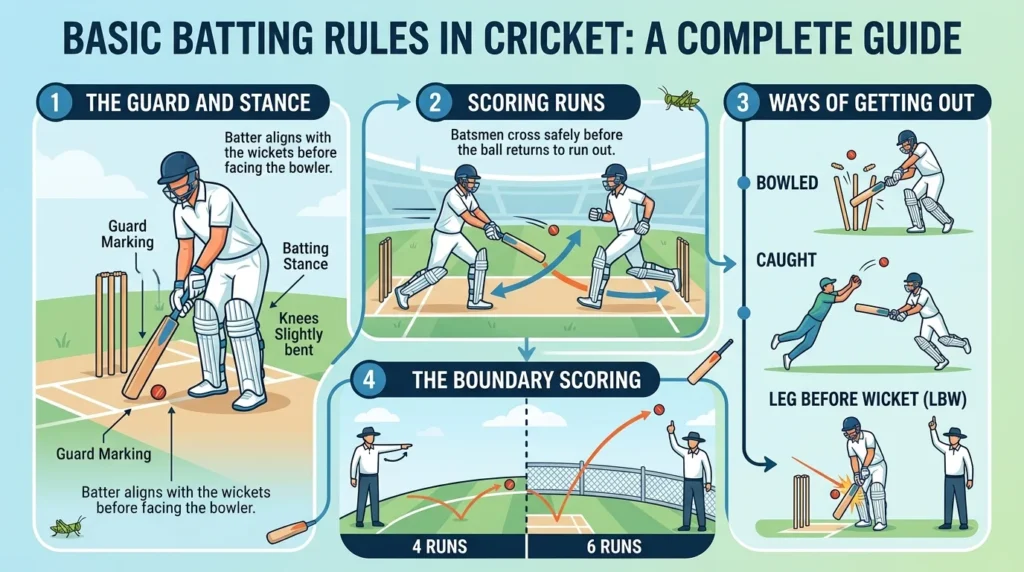
Rule 1: Two Batsmen on the Field
In cricket, two batsmen on the field is one of the most important and basic concepts of the game. At any moment during an innings, there are always two batters active at the crease: one is the striker, and the other is the non-striker. This pair works together to score runs, face bowlers, and build partnerships that help the team reach a strong total. The entire batting system in cricket depends on coordination between these two players, making their understanding extremely important for success.
The striker is the batsman who faces the bowler’s delivery. He is responsible for playing shots, defending the wicket, and scoring runs through boundaries or singles. The non-striker stands at the opposite end of the pitch near the bowler’s end and does not face the ball directly unless the batsmen change ends. However, the non-striker plays a very important supporting role by watching the bowler, preparing for quick running, and communicating with his partner. In countries like England and Australia, coaches strongly emphasize the importance of understanding both roles because modern cricket demands smart running and strong partnerships.
Batting partnerships between two batsmen are often the key to winning matches. When two players stay together for a long time at the crease, they reduce pressure on the team and build a solid foundation. For example, in Test cricket, long partnerships can tire bowlers and control the game for days. In countries like India and Pakistan, many famous partnerships have changed the outcome of international matches and tournaments.
Communication between the two batsmen is extremely important. They use simple calls like “yes,” “no,” and “wait” to decide whether to run. A small mistake in communication can lead to a run-out, which is one of the most common ways of getting out in cricket. Trust and understanding between partners help avoid confusion and improve scoring efficiency. In modern cricket, players also use signals and pre-planned strategies for rotating strike.
Running between the wickets is another major responsibility shared by both batsmen. Quick decision-making, speed, and awareness are required to convert singles into doubles and keep the scoreboard moving. Good running puts pressure on fielders and creates more scoring opportunities. Fitness and agility play a big role in this aspect of batting, especially in fast formats like ODI and T20 cricket.
Overall, the concept of two batsmen on the field is the backbone of cricket batting strategy. The striker and non-striker must work as a team, combining skill, communication, and smart thinking. Their partnership can build big scores, rescue innings after early wickets, and control the pace of the match. Without strong coordination between these two players, it becomes very difficult for any team to succeed at the highest level of cricket.
At the start of a batting innings:
- Two batsmen stand on the pitch.
- One batsman faces the bowler (striker).
- The other waits at the opposite end (non-striker).
The striker plays the ball delivered by the bowler.
Rule 2: Staying Inside the Crease
In cricket, staying inside the crease is one of the most fundamental and important skills for a batsman. The crease is a marked line on the pitch that defines the safe area for batting. A batsman is considered safe only when some part of his body or bat is grounded inside or behind this line. If the batsman is outside the crease and the wicket is broken by the fielding side, he can be declared out through a run-out or stumping. Because of this rule, awareness of the crease position is essential for every player at every level of cricket.
The crease plays a major role during both batting and running between the wickets. When a batsman faces a delivery, he must ensure he is properly inside the batting crease to avoid any chance of being stumped by the wicketkeeper. In fast-paced cricket, especially in countries like England and Australia, coaches emphasize early training on foot placement and bat grounding techniques. This helps players develop strong habits that reduce dismissal risks in professional matches.
One of the most important situations where staying inside the crease matters is during running between the wickets. Batsmen constantly leave the crease to take runs and must return safely before the ball reaches the stumps. A small delay or misjudgment can result in a run-out, even if the batsman has completed most of the run. In countries like India and Pakistan, many close matches have been decided by run-outs caused by poor crease awareness, making this skill even more important in high-pressure situations.
Staying inside the crease also requires good coordination between both batsmen. Since two players are always involved in running, they must communicate clearly and decide quickly whether to run or not. If one batsman hesitates or misjudges the situation, both players can end up at risk. Professional cricketers use verbal calls like “yes,” “no,” and “wait” to manage these situations effectively and avoid confusion.
Wicketkeepers and fielders often try to take advantage when a batsman leaves the crease too early. Spinners, in particular, can create stumping opportunities by drawing the batsman out of his safe zone. This makes crease awareness even more important against slow bowlers. Many experienced players focus on keeping their bat grounded in the crease as much as possible when facing spin to reduce dismissal chances.
In modern cricket, staying inside the crease is not just about safety but also about smart gameplay. Players are trained to slide their bat over the crease line while completing runs and to watch the ball until the very last moment before committing to a run. These small technical improvements can make a big difference in performance.
Overall, staying inside the crease is a basic but crucial part of cricket that every batsman must master. It ensures safety from run-outs and stumpings, improves running efficiency, and builds confidence at the crease. Good awareness, quick reflexes, and consistent practice help players avoid mistakes and perform better in all formats of the game.
A batsman must stay within the batting crease to avoid certain types of dismissal.
If a batsman leaves the crease too early, they may be dismissed through:
- Run out
- Stumping
The crease helps umpires decide whether a batsman is safe.
Rule 3: Hitting the Ball with the Bat
In cricket, hitting the ball with the bat is the most important skill of batting because it is the main way to score runs and control the game. A batsman uses a wooden bat to strike the ball delivered by the bowler, with the aim of either defending the wicket or scoring runs through well-timed shots. This basic action looks simple, but it requires strong technique, timing, balance, and focus.
When a batsman prepares to hit the ball, he must first judge the line and length of the delivery. Good players watch the ball closely from the bowler’s hand until it reaches the bat. Countries like England and Australia have produced many skilled batsmen who are trained to play with soft hands and perfect timing. The key is not always power, but proper contact between bat and ball.
Types of Bat Shots
There are different ways to hit the ball depending on the situation:
- Defensive shots: Used to protect the wicket
- Attacking shots: Used to score runs quickly
- Ground shots: Played along the ground to reduce risk
- Aerial shots: Hit in the air to clear fielders
Each shot requires different timing and foot movement.
Importance of Timing
Timing is the most important part of hitting the ball. A well-timed shot can travel to the boundary even without much force. Poor timing can lead to catches or missed shots. In countries like India and Pakistan, batting coaching strongly focuses on improving timing through practice drills.
Role of Footwork
Footwork helps a batsman reach the correct position to hit the ball. Good foot movement allows better balance and shot selection. Players move forward or backward depending on the ball’s length.
Bat and Ball Contact
Clean contact between bat and ball is essential. The middle of the bat gives the best power and control. Modern players practice hitting with precision to improve consistency.
Overall, hitting the ball with the bat is the foundation of cricket batting. With proper technique, timing, and practice, a batsman can turn simple deliveries into scoring opportunities and build strong innings for the team.
The batsman should hit the ball using the cricket bat to score runs.
If the ball hits the bat and travels across the field, the batsmen can run between the wickets.
The aim is to place the ball in areas where fielders cannot stop it quickly.
Rule 4: Running Between the Wickets
Running between the wickets is one of the most important skills in cricket because it helps batsmen convert singles into doubles, rotate strike, and build pressure on the fielding team. It involves both batsmen working together to run from one end of the pitch to the other after hitting or tapping the ball. This skill is not just about speed, but also about communication, judgment, awareness, and teamwork. Good running between the wickets can change the entire flow of a match by increasing the scoring rate and keeping bowlers under pressure.
When a batsman hits the ball into the field, both players decide whether to take a run or stay in their crease. This decision must be made in a fraction of a second. In countries like England and Australia, coaches train players to focus on quick decision-making and sharp calling techniques. The striker and non-striker use simple calls like “yes,” “no,” and “wait” to communicate clearly and avoid confusion. A single wrong call can lead to a run-out, which is one of the most common dismissals in cricket.
Importance of Quick Decision-Making
Running between the wickets depends heavily on decision-making. Batsmen must quickly judge:
- How hard the ball is hit
- Where the fielders are positioned
- Whether there is enough time to complete the run
- Risk of a direct hit from fielders
In countries like India and Pakistan, many close matches are decided by quick singles and smart running decisions under pressure.
Role of Communication
Clear communication is essential between both batsmen. They must trust each other completely. Even a small hesitation can cause confusion and lead to dismissal. Experienced players develop signals and understanding over time, which helps them run efficiently without hesitation.
Speed and Fitness
Running between the wickets requires high fitness levels. Players must sprint quickly, turn sharply, and slide their bat inside the crease to complete the run safely. Modern cricket demands excellent endurance because players often run dozens of runs in a single innings.
Fielding Pressure
Good fielding teams try to stop quick singles and create run-out chances. That is why batsmen must always watch the ball carefully and judge fielders’ speed and throwing ability.
Running between the wickets is a vital part of cricket batting that combines speed, intelligence, and teamwork. It helps teams score consistently and maintain momentum throughout the innings. Players who master this skill become more valuable because they can turn simple shots into important runs and build strong partnerships that often decide the outcome of matches.
After hitting the ball, batsmen can run to score runs.
One complete run is scored when:
- Both batsmen run to the opposite crease safely.
Batsmen may attempt multiple runs if the ball travels far enough.
Rule 5: Boundary Rules
Boundary rules in cricket define how runs are awarded when the ball reaches or crosses the boundary line of the field. The boundary is the outer edge of the playing area, marked by a rope or line. Whenever a batsman hits the ball to this area, extra runs are given depending on how the ball reaches the boundary. These rules are very important because they directly affect scoring, match strategy, and the outcome of games in all formats of cricket.
In cricket, there are two main types of boundary scores: four runs and six runs. If the ball touches the ground before crossing the boundary rope, it is called a “four.” This usually happens when a batsman plays a well-timed ground shot that travels through the field without being stopped. On the other hand, if the batsman hits the ball over the boundary rope without it touching the ground, it is called a “six,” which is the highest scoring shot in cricket.
The boundary rules are applied in all cricket formats, including Test, ODI, and T20 matches. In countries like England and Australia, boundary sizes may vary from ground to ground, which also affects scoring patterns. Smaller grounds usually produce higher scores, while larger grounds make boundary hitting more difficult.
How a Boundary is Scored
A boundary is awarded when:
- The ball crosses the boundary rope after bouncing → 4 runs
- The ball crosses the boundary without bouncing → 6 runs
- A fielder accidentally touches the boundary while saving the ball → boundary is still awarded
Even if the ball is stopped near the rope but the fielder’s foot touches it, it is still considered a boundary.
Role of Field Size
Ground size plays a major role in boundary scoring. Smaller grounds favor batsmen because hitting sixes becomes easier. Larger grounds require more power and timing. In countries like India, many stadiums are known for high-scoring matches due to shorter boundary distances.
Importance in Modern Cricket
In modern T20 cricket, boundaries are extremely important because they quickly increase the run rate. Teams often build their innings around boundary-hitting strategies. Players practice power hitting to maximize fours and sixes, especially in leagues like the IPL.
Boundary rules are a key part of cricket scoring. They reward skillful batting and powerful hitting while adding excitement to the game. Understanding how fours and sixes work helps fans better enjoy match situations and appreciate how quickly the score can change in modern cricket.
Runs can also be scored without running if the ball reaches the boundary.
There are two types of boundaries:
- Four Runs – when the ball touches the ground before crossing the boundary rope.
- Six Runs – when the ball crosses the boundary without touching the ground.
Boundaries are one of the fastest ways to increase the team’s score.
Types of Batting Dismissals
A batsman must follow the batting rules to avoid getting out.
Bowled
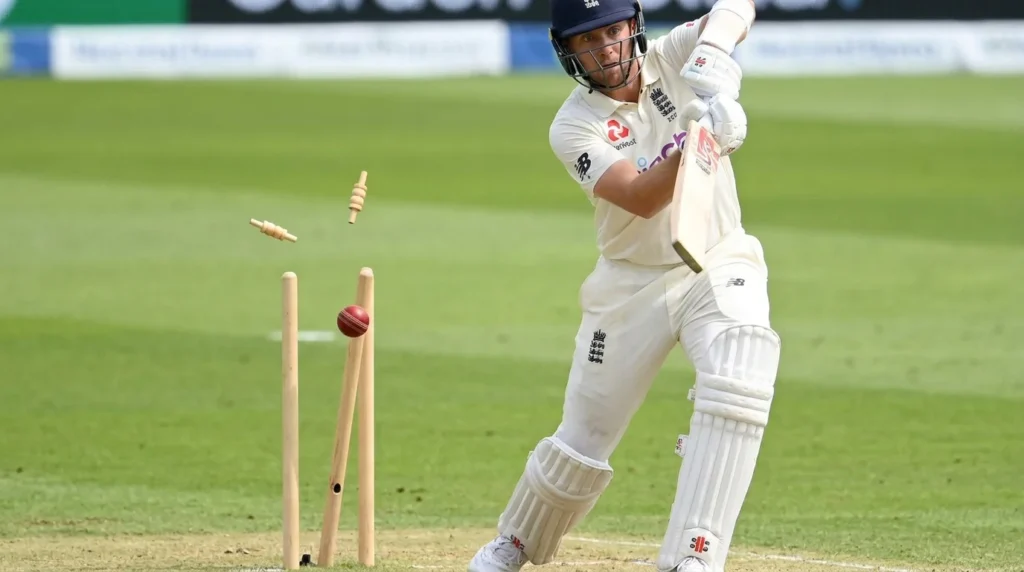
Bowled in Cricket: Meaning, Rules, Technique, and Importance
In cricket, “bowled” is one of the most common and important ways a batsman gets out. It happens when the bowler delivers the ball and it directly hits the stumps, causing at least one bail to fall. This dismissal is considered very clean and straightforward because it does not involve any fielder. The bowler gets full credit for the wicket, and the batsman must leave the field immediately. Understanding the bowled dismissal is essential for beginners as it forms the foundation of cricket rules and bowling strategy.
The basic rule of being bowled is simple: if the ball is delivered legally and it hits the wicket while the batsman fails to stop it, the batsman is out. Even if the ball touches the bat, pad, or glove before hitting the stumps, the batsman is still out bowled as long as no other rule interferes. This makes it one of the most direct forms of dismissal in cricket and one that bowlers always aim for.
Bowled dismissals can happen in many different situations. The most common is when a batsman misses a straight delivery and the ball goes through the gap between bat and pad. Fast bowlers often use speed and swing to confuse the batsman, while spin bowlers use turn and variation to beat the bat. In countries like England, swing bowling conditions often help bowlers hit the stumps more frequently due to cloudy and humid weather.
Fast bowlers play a major role in getting batsmen bowled. They use techniques like yorkers, inswingers, and outswingers to target the stumps directly. A yorker is especially dangerous because it is a full-length delivery aimed at the batsman’s feet and stumps, making it very difficult to defend. Countries like Australia are known for producing fast bowlers who consistently attack the stumps with pace and accuracy.
Spin bowlers also contribute significantly to bowled dismissals. On turning pitches, especially in subcontinent conditions like India, spinners can make the ball turn sharply after pitching. This can mislead the batsman and cause the ball to hit the stumps unexpectedly. Variations in flight, speed, and angle also increase the chances of getting a batsman bowled.
From a batting perspective, avoiding being bowled requires strong technique and concentration. A batsman must watch the ball carefully, keep his bat close to the pads, and play straight when facing threatening deliveries. Poor foot movement or misjudgment of line and length often results in losing the wicket. Defensive batting is especially important when conditions favor bowlers.
Being bowled also has a psychological impact on the batsman because it usually indicates a clear mistake in judgment or timing. It can affect confidence, especially in longer innings. However, experienced players learn from such dismissals and improve their technique to avoid similar mistakes in future matches.
Different famous bowlers are known for regularly taking bowled wickets. For example, James Anderson uses swing and movement, while Mitchell Starc is known for deadly yorkers. Spin bowlers like Ravichandran Ashwin also use skillful variations to break the stumps.
Overall, the bowled dismissal is one of the purest and most satisfying ways to take a wicket in cricket. It highlights the skill of the bowler and the importance of solid batting technique. For bowlers, it is a sign of accuracy and control, while for batsmen, it is a reminder of the need for focus and discipline. This simple yet powerful rule continues to play a major role in all formats of cricket.
A batsman is bowled out if the ball hits the wicket and dislodges the bails.
Caught in Cricket: Meaning, Rules, Techniques, and Importance
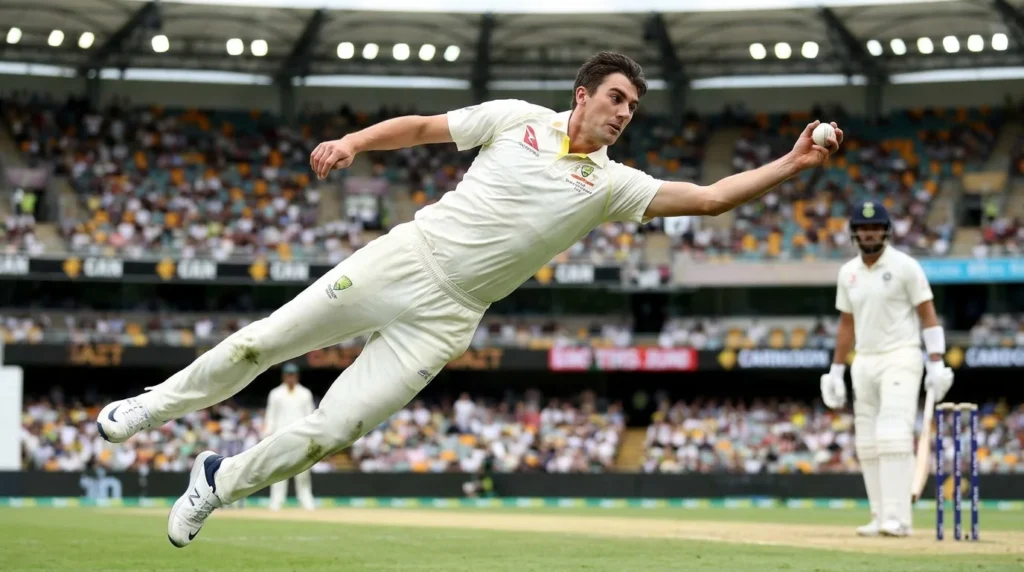
In cricket, “caught” is one of the most common and important ways a batsman gets out. It happens when the batsman hits the ball with the bat or glove and a fielder, wicketkeeper, or bowler catches it before it touches the ground. This dismissal is very important because it rewards good fielding, smart bowling, and alert catching skills. A “caught out” dismissal is seen in all formats of cricket, including Test, ODI, and T20 matches.
The basic rule of being caught is simple: if the batsman hits the ball and it is caught cleanly without bouncing, the batsman is out. It does not matter whether the ball touches the bat’s edge, middle, or glove (if the glove is holding the bat). As long as the catch is legal and controlled, the batsman must leave the field immediately. This makes “caught” one of the most frequent dismissals in cricket.
Caught dismissals can happen in many different ways depending on the shot and field placement. A batsman may mistime a shot and hit the ball in the air, making it easy for fielders to take a catch. Sometimes edges from fast bowlers go to the slips or wicketkeeper. In countries like England, swinging conditions often produce many catches behind the wicket due to movement of the ball.
Fast bowlers play a major role in creating caught chances. They use pace, bounce, and swing to force mistakes from batsmen. When the ball moves slightly off the pitch or in the air, batsmen often edge it to slip fielders or the wicketkeeper. Countries like Australia are famous for producing fast bowlers and sharp slip fielders who take difficult catches regularly.
Spin bowlers also create catching opportunities, especially in subcontinent conditions like India. Spinners tempt batsmen into attacking shots, which often lead to mistimed hits in the air. Fielders placed around the bat, such as short cover, mid-wicket, and slip, are ready to take quick catches.
Fielding plays a very important role in caught dismissals. A good fielder must have sharp reflexes, strong concentration, and good hand-eye coordination. Wicketkeepers also take many important catches, especially on edges from fast bowlers or spinners. Modern cricket places great importance on fielding skills because matches are often decided by small moments like catches.
From a batting perspective, avoiding getting caught requires patience and good shot selection. Batsmen must avoid playing risky shots early in their innings and must keep the ball along the ground when fielders are close. Proper timing and footwork help reduce the chances of mistimed shots. Experienced players learn to respect good deliveries and wait for scoring opportunities.
Being caught also has a psychological effect on the batsman. It often happens due to poor judgment or pressure, especially in big matches. However, professional players study their mistakes and improve their technique to reduce such dismissals in future games.
Many famous bowlers are known for creating caught chances. For example, James Anderson often produces edges to slips, while Glenn McGrath built pressure for catches through consistent line and length. Spinners like Ravichandran Ashwin also create many catching opportunities through clever variations.
Overall, the “caught” dismissal is one of the most important parts of cricket. It highlights teamwork between bowlers and fielders and rewards smart bowling and sharp fielding. It also teaches batsmen the importance of patience, technique, and shot selection. Because of its frequency and importance, “caught out” plays a major role in deciding matches across all formats of cricket.
If a fielder catches the ball before it touches the ground, the batsman is out.
Run Out in Cricket: Meaning, Rules, Techniques, and Importance
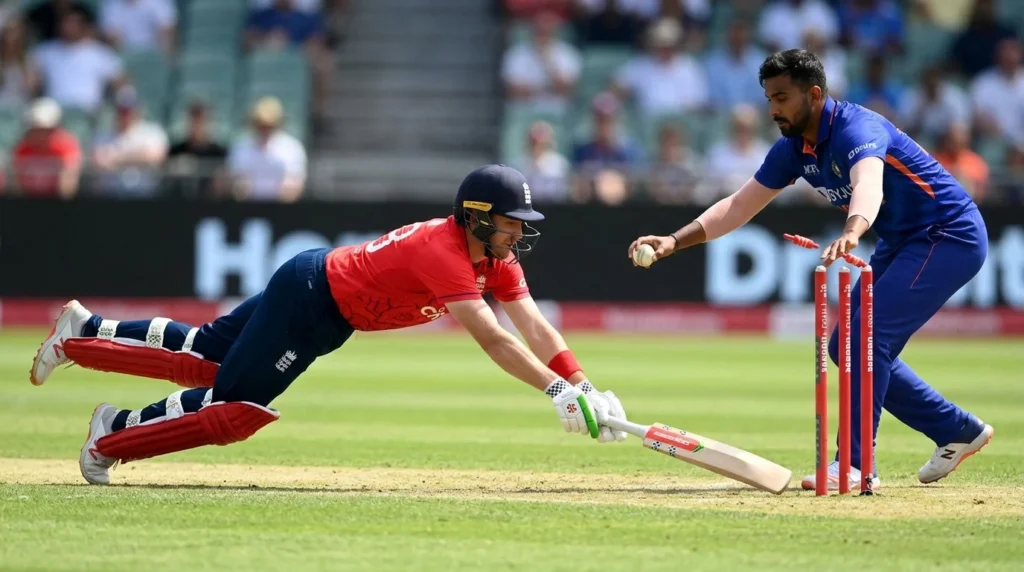
In cricket, a run out is one of the most exciting and dramatic ways a batsman can be dismissed. It usually happens during running between the wickets when the batsman fails to reach the crease before the fielding team breaks the stumps. A run out shows how important speed, communication, and awareness are in modern cricket. It can change the momentum of a match instantly because it often results from a small mistake or misunderstanding between two batsmen.
A run out occurs when the ball is in play and a fielder successfully breaks the wicket with the ball while the batsman is outside his crease. The key rule is simple: the batsman must have at least part of his bat or body grounded inside the crease to be safe. If he is short of the line when the stumps are broken, he is declared out. This makes running between the wickets a high-risk but important part of scoring runs.
Run outs can happen in many situations. The most common situation is poor communication between two batsmen while attempting a run. If one batsman hesitates or misjudges the call, both players can end up stranded. In countries like India and Pakistan, many close matches have been decided by run outs caused by confusion or pressure during fast-paced games.
Fielders play a very important role in creating run-out chances. A good fielder must be quick, accurate, and alert. They try to collect the ball as quickly as possible and aim directly at the stumps. A strong and accurate throw can easily beat the batsman’s speed and result in a dismissal. In countries like Australia, fielding standards are very high, and run outs are often created by sharp ground fielding and direct hits.
The wicketkeeper also plays a key role in run outs. The keeper stands close to the stumps and can quickly break the wicket if the batsman is out of his crease. In many situations, wicketkeepers act as the final line of defense and complete the dismissal with fast hands and good awareness.
Communication between batsmen is one of the most important factors in avoiding run outs. They use clear calls like “yes,” “no,” and “wait” to decide whether to run. Trust and understanding between partners help reduce mistakes. A single wrong call or hesitation can result in a wicket, especially in high-pressure matches.
Running speed and fitness are also crucial. Modern cricket demands quick sprinting, fast turning, and sliding the bat inside the crease at the right moment. Players must practice these skills regularly to avoid getting run out. Even experienced players can get dismissed if they misjudge the situation or lose focus.
Run outs are not always caused by batsmen’s mistakes; sometimes brilliant fielding leads to unexpected dismissals. Direct hits from long distance or quick reflex throws can surprise even set batsmen. This is why run outs are considered one of the most exciting moments in cricket, often celebrated by fielders and teams.
Being run out can have a psychological impact on players because it often results from small errors rather than skillful bowling. However, professional cricketers learn from these mistakes and improve their communication and running techniques over time.
Many great fielders such as Jonty Rhodes and modern players from teams like Australia and India have made run outs a key part of their fielding strength. Their speed, anticipation, and accuracy have changed the way teams approach fielding in modern cricket.
Overall, run out is a very important and exciting part of cricket. It highlights the importance of teamwork, communication, fitness, and quick decision-making. A single run-out moment can change the entire direction of a match, making it one of the most thrilling dismissals in the game.
A batsman is run out when the fielding team breaks the wicket before the batsman reaches the crease during a run.
Stumped in Cricket: Meaning, Rules, Technique, and Importance
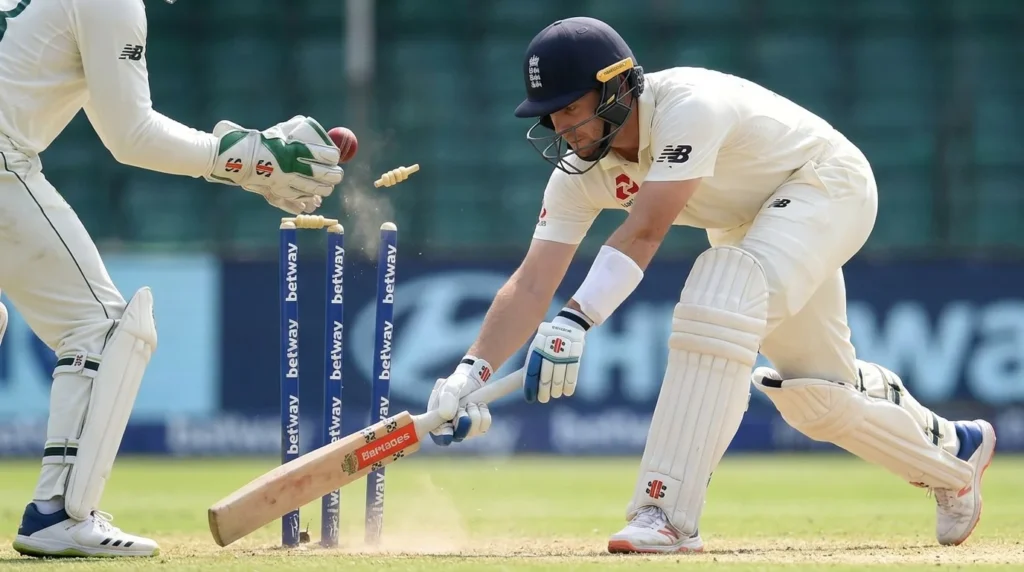
In cricket, stumped is a special type of dismissal that mainly involves the wicketkeeper and the batsman. It happens when the batsman steps out of his crease to play a shot and misses the ball, and the wicketkeeper quickly breaks the stumps before the batsman returns to the crease. This dismissal is very common in spin bowling situations and is considered a result of quick reflexes, smart bowling, and excellent wicketkeeping skills.
A batsman is given “stumped” out when the wicketkeeper collects the ball cleanly and removes the bails while the batsman is still outside his crease. The key condition is that the batsman must not be attempting a run. If he is not trying to complete a run and is simply out of his crease while missing the ball, he can be stumped. This rule makes it a very important dismissal against spin bowlers who often lure batsmen out of their safe zone.
Stumping usually happens when a batsman tries to attack a spin bowler but misjudges the flight or turn of the ball. In countries like India, spin bowling is highly effective due to dry pitches, and many stumpings occur in Test and limited-overs matches. Wicketkeepers in such conditions must stay alert and be ready to act within milliseconds.
The role of the wicketkeeper is extremely important in stumping. A good wicketkeeper must have fast hands, sharp eyesight, and excellent balance. As soon as the ball passes the batsman, the keeper collects it and breaks the stumps in one quick movement. In countries like England and Australia, wicketkeeping is considered a specialist skill, and players train heavily to improve speed and coordination.
Spin bowlers play a big role in creating stumping chances. They often use flight, turn, and variation in pace to tempt batsmen into coming forward. When the batsman leaves the crease early, he becomes vulnerable to being stumped. Bowlers like to set traps by changing speed or spinning the ball sharply after pitching.
Footwork mistakes are the main reason behind stumpings. If a batsman steps too far out or misjudges the ball, he loses balance and cannot return quickly enough to the crease. This is why footwork and timing are very important skills in cricket batting, especially against spin bowling.
Communication between bowler and wicketkeeper is also important. They work as a team to create stumping opportunities. The bowler may slow down the pace or change angles to confuse the batsman, while the wicketkeeper stays ready behind the stumps.
Stumping is different from other dismissals like run out because it only involves the wicketkeeper and happens when the batsman is not attempting a run. It is a very clean and skill-based dismissal that shows teamwork between the bowler and keeper.
Famous wicketkeepers like MS Dhoni and Adam Gilchrist are known for their lightning-fast stumpings. Their ability to remove bails in a fraction of a second has changed many matches and created unforgettable moments in cricket history.
Overall, stumping is one of the most exciting dismissals in cricket. It highlights the importance of wicketkeeping skill, spin bowling strategy, and batsman awareness. Quick reflexes and sharp judgment are essential for both creating and avoiding stumpings, making it a key part of modern cricket.
A wicketkeeper can stump the batsman if the batsman steps out of the crease and misses the ball.
LBW (Leg Before Wicket) in Cricket: Meaning, Rules, Technique, and Importance
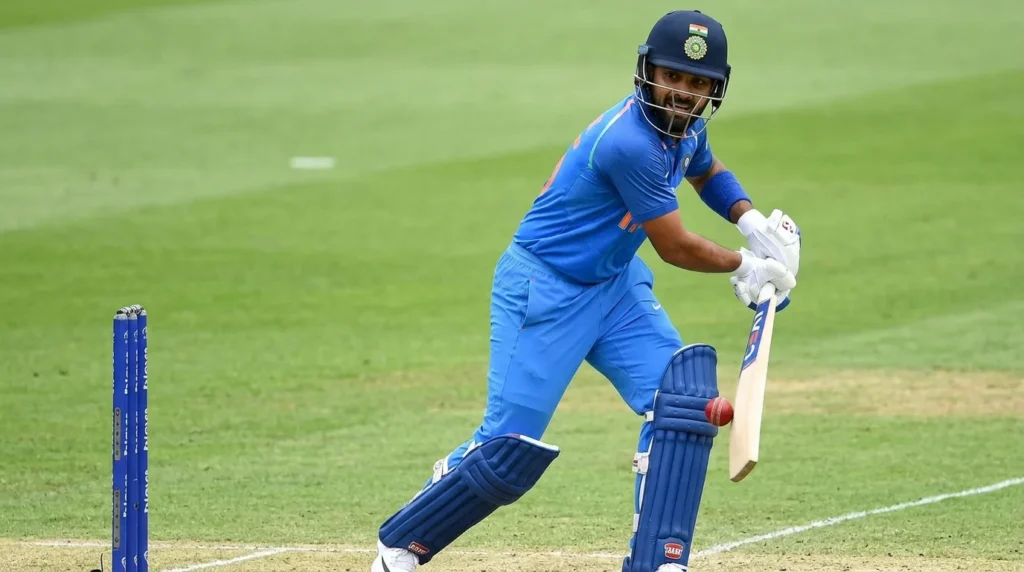
In cricket, LBW (Leg Before Wicket) is one of the most complex and important ways a batsman can be dismissed. It happens when the ball hits the batsman’s body (usually the leg) instead of the bat, and the umpire decides that the ball would have gone on to hit the stumps. LBW is designed to stop batsmen from using their body to block the wicket and to ensure fair competition between bat and ball.
The basic idea of LBW is simple, but the rules behind it are detailed. A batsman can be given out LBW if the ball is not hit by the bat first, it strikes the body in line with the stumps, and the umpire believes it would have hit the wicket. If all conditions are met, the batsman is declared out. This dismissal requires careful judgment from umpires and is often reviewed using technology in modern cricket.
LBW decisions depend heavily on the ball’s path and pitch conditions. In countries like England, swing bowling conditions often increase LBW chances because the ball moves in the air and hits the pads in front of the stumps. Fast bowlers use this movement to trap batsmen in front of the wicket and create pressure.
Spin bowlers also play a major role in LBW dismissals, especially on turning pitches. In countries like India, where pitches often assist spin, the ball can turn sharply after pitching and strike the pads while aiming at the stumps. This makes LBW a very common dismissal in subcontinent conditions.
For a batsman, avoiding LBW requires good technique and footwork. Players must ensure they are playing the ball in line, using proper pad positioning, and offering a bat shot whenever possible. Poor shot selection or lack of foot movement often leads to being trapped in front of the wicket. Defensive technique is very important when facing threatening deliveries.
The Decision Review System (DRS) has made LBW decisions more accurate in modern cricket. Technology such as ball tracking helps umpires determine whether the ball would have hit the stumps. This has reduced errors and made the game more fair. However, LBW decisions are still considered challenging because small margins can change the outcome.
LBW is different from other dismissals like bowled or caught. In bowled, the ball directly hits the stumps, while in LBW the batsman is out even if the ball does not touch the bat but would have hit the wicket. This makes LBW a unique and technical rule in cricket.
Famous bowlers such as James Anderson, Pat Cummins, and Ravichandran Ashwin are known for trapping batsmen LBW with swing, pace, and spin variations.
Overall, LBW is one of the most important and skill-based dismissals in cricket. It balances the game between bat and ball, rewards good bowling, and punishes poor batting technique. Understanding LBW helps players improve their game awareness and helps fans better understand the strategic depth of cricket.
A batsman can be dismissed LBW if the ball hits their leg and would have hit the stumps.
Batting Positions in Cricket
Different batsmen play different roles depending on their position in the batting order.
Opening Batsmen
Opening batsmen cricket team ke sab se important players hote hain kyun ke yeh innings ki shuruaat karte hain aur new ball ko face karte hain. In ka main role hota hai ke team ko strong start dena, wickets bachana, aur bowlers ke pressure ko handle karna. Opening batsmen ko “openers” bhi kaha jata hai, aur in ka kaam sirf runs banana nahi hota balki pitch aur conditions ko samajh kar innings ko set karna bhi hota hai. Start mein ball hard aur fresh hoti hai, is liye fast bowlers ko swing, seam aur bounce milta hai, jis ki wajah se opening batting sab se difficult phase hota hai.
Opening batsmen ko bohat strong technique aur patience ki zaroorat hoti hai. Inhein achi footwork, defensive shots, aur ball ko judge karne ki ability honi chahiye. Countries jaise England mein opening batsmen ko swing conditions ke against specially train kiya jata hai, jab ke Australia mein bouncy pitches ke liye power aur control dono sikhaya jata hai. India mein openers ko spin aur pace dono conditions ke liye prepare kiya jata hai.
Opening batsmen ka ek aur important role partnership banana hota hai. Dono openers mil kar team ko solid foundation dete hain taake middle order pressure mein na aaye. Agar opening stand strong ho jaye to team large score bana sakti hai, especially Test aur ODI cricket mein. Communication between openers bhi bohat zaroori hoti hai, kyun ke running between the wickets aur quick decision-making match ka flow change kar sakta hai.
Modern cricket mein opening batsmen ka style bhi change ho gaya hai. Ab T20 aur ODI formats mein openers aggressive approach use karte hain, powerplay overs ka faida uthate hue fast scoring karte hain. Lekin Test cricket mein ab bhi patience aur technique sab se important cheez hai.
Overall, opening batsmen team ki backbone hote hain jo match ki foundation banate hain. In ki performance aksar puri innings aur match ke result par direct asar dalti hai, is liye in ka role cricket mein bohat critical mana jata hai.
Opening batsmen face the first ball of the innings.
Their responsibilities include:
- Handling new fast bowlers
- Building a solid start
- Protecting the wicket early in the innings
Middle-Order Batsmen
Middle-order batsmen cricket team ke bohat important players hote hain jo usually top order ke baad batting karte hain. In ka main role hota hai innings ko stabilize karna, pressure situations ko handle karna, aur team ko strong total tak le jana. Jab opening batsmen early wickets kho dete hain, to middle-order batsmen ka kaam hota hai ke wo innings ko rebuild karein aur collapse se bachayein. Isi wajah se inhein “backbone of batting lineup” bhi kaha jata hai.
Middle-order batsmen ko different situations mein batting karni padti hai, is liye in ki skills versatile hoti hain. Kabhi inhein slow start karna hota hai aur innings set karni hoti hai, aur kabhi quick runs bana kar run rate increase karna hota hai. Countries jaise England mein middle-order players ko swing aur seam conditions ke against strong technique sikhayi jati hai, jab ke Australia mein unhein bouncy pitches aur aggressive bowling ka samna karna hota hai. India mein middle-order batsmen ko spin bowling aur pressure situations handle karne ki training di jati hai.
Middle-order batsmen ka ek aur important role partnership banana hota hai. Yeh players lower order ke sath mil kar runs add karte hain aur team ko stable position mein le jate hain. Agar top order fail ho jaye to middle-order par bohat zyada responsibility aa jati hai ke wo match ko save karein ya competitive total banayein. Isi liye inhein mentally strong aur patient hona zaroori hota hai.
Modern cricket mein middle-order batsmen ka role aur bhi important ho gaya hai. T20 aur ODI cricket mein inhein finishing skills bhi aani chahiye taake wo last overs mein fast scoring kar saken. Power hitting, strike rotation, aur smart shot selection middle-order batsmen ki pehchan ban chuki hai.
Overall, middle-order batsmen team ke stabilizers hote hain jo har situation mein balance maintain karte hain. In ki performance match ka turning point ban sakti hai, is liye cricket mein in ka role bohat critical aur valuable hota hai.
Middle-order batsmen play after the openers.
Their roles include:
- Stabilizing the innings
- Scoring runs steadily
- Building partnerships
Finisher
Finisher cricket team ka wo specialist batsman hota hai jo match ke aakhri overs mein game ko end tak le ja kar team ko victory dilata hai. Finisher ka main role hota hai pressure situations mein calm rehna, required run rate ko manage karna, aur last overs mein maximum runs score karna. Yeh players usually innings ke end mein batting karte hain jab match ka result tight hota hai aur har ball important hoti hai.
Finisher ko strong temperament, quick decision-making aur powerful hitting skills ki zaroorat hoti hai. Inhein pata hota hai ke kab single lena hai, kab boundary lagani hai, aur kab strike rotate karni hai. Countries jaise India mein finishers ko death overs batting ke liye specially train kiya jata hai, jab ke Australia aur England mein bhi modern cricket mein finishing skills bohat important samjhi jati hain.
Finisher ka sab se important skill pressure handle karna hota hai. Jab team ko last overs mein zyada runs chahiye hote hain, to finisher ko cool mind ke sath shots play karne hote hain. Unhein field placements ko samajh kar smart shots lagane hote hain, jaise yorker ko hit karna, scoop shots, aur straight boundaries. Death overs mein un ka performance match ka result change kar sakta hai.
Finisher aksar lower-middle order mein batting karte hain aur un ka role hota hai ke wo not out reh kar team ko target tak le jayein. Is ke liye fitness, timing, aur game awareness bohat important hoti hai. Aaj ke modern T20 cricket mein finishers ki demand bohat zyada barh gayi hai kyun ke matches short aur high-pressure hote hain.
Overall, finisher cricket ka ek highly specialized role hai jo sirf runs banane tak limited nahi hota balki match ko intelligently end karne ka skill hota hai. Achi finishing ability wali players team ko har situation mein advantage deti hai aur kai matches sirf ek strong finisher ki wajah se jeete jate hain.
Finishers usually bat toward the end of the innings.
Their job is to:
- Score quick runs
- Hit boundaries and sixes
- Finish the innings strongly
Batting Techniques in Cricket
Defensive Batting
Defensive batting cricket mein ek bohot important skill hai jo har batsman ko aani chahiye, especially jab match ka situation difficult ho ya team ko wickets bachane ki zarurat ho. Defensive batting ka basic purpose run banana nahi hota, balki wicket ko protect karna hota hai aur bowler ko control karna hota hai. Jab pitch difficult ho, jaise ke fast swing ya spin zyada ho rahi ho, tab batsman apni technique ko strong rakh kar ball ko safely play karta hai. Defensive batting mein footwork ka role bohot important hota hai. Batsman ko hamesha ball ke line mein aana hota hai aur head position stable rakhni hoti hai taake balance bigde nahi. Straight bat use karna defensive batting ka main principle hota hai, jisse ball ground par safely drop ho jaye aur catching chance na bane. Isme timing se zyada focus technique aur patience par hota hai. Defensive shot usually soft hands ke sath khela jata hai taake ball slip ya close fielders tak na jaye. Jab batsman crease par zyada time guzarta hai, to wo apni team ke liye valuable runs ka base banata hai, especially Test matches ya long format games mein. Defensive batting ka ek aur important aspect shot selection hai. Har ball ko hit karna zaroori nahi hota, balki sahi ball ko chhorna bhi ek skilled batsman ki nishani hoti hai. Good defensive batsman apni ego ko control karta hai aur unnecessary risky shots se bachta hai. Is technique mein mental strength bhi bohot important hoti hai kyun ke bowler continuously pressure create karta hai, aur batsman ko patience ke sath us pressure ko handle karna hota hai. Defensive batting se partnership build hoti hai aur team ko stability milti hai. Jab wickets gir rahe hote hain, defensive batting match ko stabilize kar sakti hai aur later attacking players ko run banane ka mauka deti hai. Is tarah defensive batting sirf survival nahi balki strategy ka ek essential part hai jo match ke outcome ko directly influence kar sakta hai.
Defensive batting focuses on protecting the wicket.
Techniques include:
- Blocking the ball
- Playing with soft hands
- Leaving dangerous deliveries
This approach is often used in Test cricket.
Attacking Batting
Attacking batting cricket ka ek aggressive style hai jisme batsman ka main focus runs ko tezi se score karna hota hai aur bowler par pressure create karna hota hai. Is style mein batsman har loose ball ko boundary ya maximum runs mein convert karne ki koshish karta hai. Attacking batting especially limited overs formats jaise ODI aur T20 cricket mein bohot important hoti hai, jahan run rate maintain karna ya badhana zaroori hota hai. Isme batsman strong mindset ke sath crease par aata hai aur shuru se hi scoring shots khelne ki strategy rakhta hai.
Attacking batting mein timing, power aur shot selection teenon ka strong combination hota hai. Batsman cover drive, pull shot, cut shot aur lofted shots jaise aggressive strokes ka use karta hai. Is style mein footwork fast hota hai aur batsman ball ki line aur length ko quickly read karta hai. Attacking batsman bowler ko dominate karne ki koshish karta hai taake fielding side defensive ho jaye aur mistakes kare.
Lekin attacking batting ke sath risk bhi hota hai, kyun ke aggressive shots mein wicket girne ka chance zyada hota hai. Is liye experienced batsman situation ke hisaab se attacking aur smart cricket combine karta hai. Jab pitch easy ho ya powerplay overs ho, tab attacking batting team ko strong start deti hai. Is tarah attacking batting match ka momentum change kar sakti hai aur opposition par psychological pressure bhi create karti hai.
Attacking batting focuses on scoring runs quickly.
Common attacking shots include:
- Cover drive
- Pull shot
- Hook shot
- Straight drive
Aggressive batting is common in T20 cricket.
Strike Rotation
Strike Rotation cricket mein ek bohot important skill hoti hai jo batting partnership ko stable aur effective banati hai. Is ka simple matlab yeh hota hai ke batsmen continuously strike (ball face karna) apne beech change karte rehte hain taake scoreboard chalti rahe aur pressure kam ho jaye. Jab do batsmen crease par hote hain, un ka sirf goal boundary lagana nahi hota balki singles aur doubles le kar run rate ko steady rakhna bhi hota hai. Strike rotation ka main focus yeh hota hai ke har over mein zyada se zyada runs “running between the wickets” ke zariye hasil kiye jayein, jisse fielding team ko set hone ka mauka kam mile. Is technique mein batsmen smart shot selection karte hain, jaise soft hands se ball ko gap mein play karna, quick singles lena, aur risk-free doubles complete karna. Good strike rotation se bowlers par pressure barhta hai kyun ke unhein har ball par field set karni padti hai aur batsmen ko rokna mushkil ho jata hai. Yeh strategy especially ODI aur T20 cricket mein bohot zyada important hoti hai jahan scoreboard pressure game ka turning point ban sakta hai. Strike rotation sirf physical running nahi hoti balki communication bhi bohot zaroori hoti hai, jisme dono batsmen clear calls (yes, no, wait) use karte hain taake run-out ka risk kam ho. Experienced batsmen hamesha field gaps ko read karte hain aur bowler ki line aur length ke hisaab se shots adjust karte hain. Is tarah woh boundaries ke baghair bhi steady scoring maintain rakhte hain. Achi strike rotation se partnership strong hoti hai, innings control mein rehti hai aur team ko winning position tak le jaya ja sakta hai. Is liye modern cricket mein strike rotation ko ek basic aur essential batting skill mana jata hai jo har professional batsman ke paas honi chahiye.
Strike rotation means scoring singles and keeping the scoreboard moving.
This technique helps maintain pressure on the fielding team.
Equipment Used in Batting
Several pieces of equipment help batsmen play safely and effectively.
Cricket Bat
The bat is the most important batting tool.
It is made of willow wood and designed to hit the ball powerfully.
Batting Gloves
Gloves protect the batsman’s hands from fast deliveries.
They also improve grip on the bat.
Batting Pads
Pads protect the legs from injury when the ball strikes the batsman.
Helmet
Helmets protect the head from fast bowlers.
Modern helmets include strong metal grills for safety.
Abdominal Guard
This protective equipment protects sensitive body areas.
Major Cricket Tournaments Featuring Great Batting
Batting skills are showcased in major cricket competitions around the world.
International Tournaments
Famous tournaments include:
- ICC Cricket World Cup
- ICC T20 World Cup
- ICC Champions Trophy
- World Test Championship
Domestic Cricket Leagues
Top leagues where batting performances are highlighted include:
- Indian Premier League (IPL)
- Big Bash League (BBL)
- Pakistan Super League (PSL)
- Caribbean Premier League (CPL)
Many world-famous batsmen gain recognition through these competitions.
Benefits of Playing Cricket
Physical Benefits
Cricket improves physical health in several ways:
- Increases stamina
- Improves hand-eye coordination
- Builds muscle strength
- Enhances agility and reflexes
Running between wickets provides excellent exercise.
Mental Benefits
Cricket also improves mental skills.
Players develop:
- Strategic thinking
- Focus and patience
- Team communication
- Leadership skills
Batting especially requires strong concentration.
Interesting Facts About Batting in Cricket
Here are some fascinating facts about batting:
- The highest individual score in Test cricket is 400 runs.
- Some batsmen specialize in playing spin bowling.
- A perfect batting innings may include many boundaries and partnerships.
- Modern bats are thicker and more powerful than older bats.
- T20 cricket has changed batting styles with more aggressive play.
Common Mistakes Beginners Make in Batting
New players often make mistakes while learning batting.
Common errors include:
- Poor footwork
- Playing risky shots too early
- Not watching the ball carefully
- Running between wickets without communication
Practicing proper techniques helps improve batting performance.
Conclusion
Batting rules in cricket are essential for understanding how the game works. These rules explain how batsmen score runs, protect their wickets, and work together to build the team’s total score.
From the early history of cricket to modern professional tournaments, batting has evolved into a highly skilled art that requires technique, concentration, and strategy. Batsmen must follow important rules such as staying inside the crease, running safely between wickets, and avoiding dismissals.
Different batting positions, techniques, and equipment help players perform effectively on the field. Whether in international tournaments or local matches, batting remains one of the most exciting aspects of cricket.
By understanding batting rules, fans and players can better appreciate the skill, strategy, and excitement that make cricket one of the most popular sports in the world.

Jon Smith is a passionate sports writer specializing in cricket and global sporting events. With a keen eye for match analysis and player performance, he creates clear, engaging, and informative content. His work focuses on simplifying complex sports insights, making them accessible for beginners and experienced fans alike worldwide.