Cricket is a game heavily influenced by weather conditions, especially rain. Unlike many indoor sports, cricket matches can be interrupted, delayed, or even abandoned due to bad weather. When rain affects a limited-overs match such as a One Day International (ODI) or Twenty20 (T20), officials need a fair way to adjust the target score for the team batting second. This is where the Duckworth Lewis Method comes into play.
The Duckworth Lewis Method, commonly called the D/L Method, is a mathematical formula used to recalculate target scores in rain-affected cricket matches. It aims to ensure fairness by considering the resources available to both teams during the match. Over the years, this system has become an essential part of international and domestic cricket.
For many fans, the Duckworth Lewis Method can seem confusing because it involves calculations and resource percentages. However, the basic concept is straightforward. The system evaluates how many overs and wickets remain and then adjusts the target accordingly. This guide explains the Duckworth Lewis Method in simple terms, covering its history, working principles, rules, examples, advantages, limitations, and its role in modern cricket.
What Is the Duckworth Lewis Method?
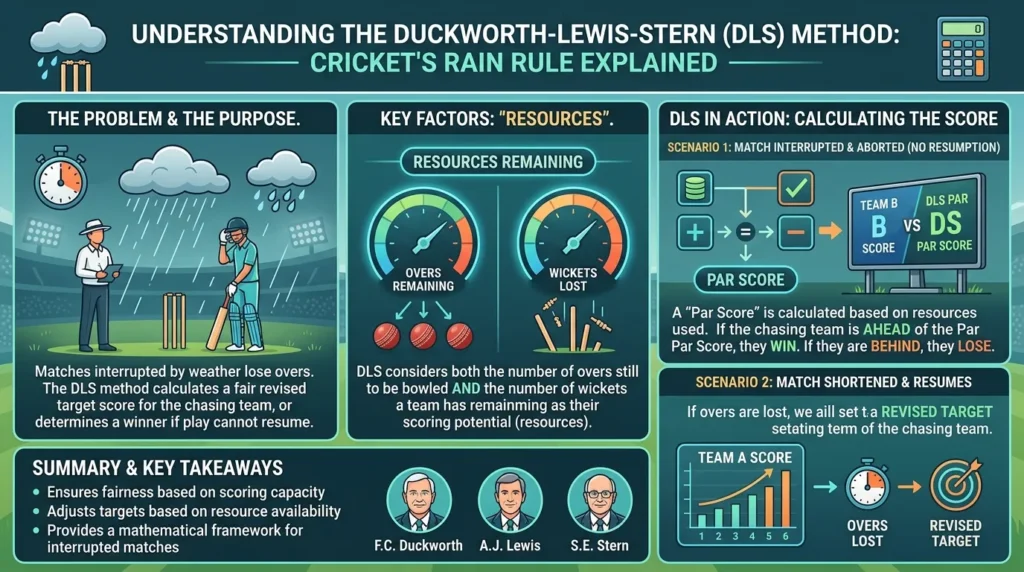
The Duckworth Lewis Method is a mathematical system used to determine a revised target score when a limited-overs cricket match is interrupted by rain or other circumstances.
The method assumes that a batting team has two primary resources:
- Overs remaining
- Wickets in hand
When overs are lost due to rain, a team loses some of its scoring resources. The D/L Method calculates how much of those resources remain and adjusts the target score fairly.
The method is primarily used in:
- One Day Internationals (ODIs)
- Twenty20 Internationals (T20Is)
- Domestic limited-overs competitions
- Major ICC tournaments
History of the Duckworth Lewis Method
Why Was the Method Created?
Before the introduction of the Duckworth Lewis Method, cricket used simpler rain rules that often produced unfair results.
In some matches:
- Teams were given unrealistic targets
- Rain interruptions favored one side
- Results were controversial
Cricket needed a more scientific approach to handling weather interruptions.
The Inventors
The system was developed by:
- Frank Duckworth
- Tony Lewis
Both were statisticians from England who specialized in mathematical analysis.
Their method was officially adopted by the International Cricket Council (ICC) in 1999.
Evolution into DLS
In 2014, Professor Steven Stern modified and improved the formula.
As a result, the system became known as the Duckworth-Lewis-Stern (DLS) Method.
Today, DLS is the official rain rule used in international cricket.
Why Is the Duckworth Lewis Method Important?
Rain can significantly change the nature of a cricket match.
Without a proper adjustment system:
- Teams batting first may gain an unfair advantage
- Teams batting second may have easier or harder targets
- Match outcomes could become controversial
The Duckworth Lewis Method helps maintain fairness and competitive balance.
Its primary goals are:
- Fair target adjustment
- Accurate resource assessment
- Consistent match outcomes
- Reduced controversy
Understanding Resources in Cricket
Overs as Resources
Overs represent opportunities to score runs.
The more overs available:
- The more scoring chances a team has
- The greater its potential total
When rain reduces overs, scoring opportunities decrease.
Wickets as Resources
Wickets are equally important.
A team with more wickets remaining can:
- Bat more aggressively
- Take greater risks
- Score faster in later overs
A team that has lost many wickets has fewer scoring resources available.
Resource Percentage
The D/L Method converts overs and wickets into a resource percentage.
For example:
- 50 overs and 10 wickets may equal 100% resources
- 25 overs and 5 wickets may represent a lower percentage
Targets are adjusted based on these percentages.
How the Duckworth Lewis Method Works
Step 1: Calculate Team One’s Resources
The team batting first uses a certain percentage of available resources.
Example:
- 50-over match
- Team scores 280 runs
- Uses 100% resources
Step 2: Determine Team Two’s Resources
Rain may reduce the second team’s overs.
Example:
- Match reduced to 40 overs
- Team two has fewer resources available
Step 3: Compare Resources
The D/L formula compares:
- Resources used by Team One
- Resources available to Team Two
Step 4: Set Revised Target
A new target is calculated based on the resource difference.
The revised target ensures fairness for both teams.
Simple Example of the Duckworth Lewis Method
Consider this scenario:
Team One
- Scores 300 runs
- Uses full 50 overs
Rain Interruption
The second innings is reduced from:
- 50 overs
- To 40 overs
Since Team Two has fewer overs available, a revised target is calculated.
Instead of chasing 301 runs, Team Two may receive a target adjusted according to remaining resources.
The exact figure depends on official DLS resource tables.
Resource Tables Explained
The D/L Method relies on resource tables developed through statistical analysis.
These tables estimate:
- Expected scoring potential
- Available overs
- Remaining wickets
Match officials use software to perform calculations instantly.
Modern cricket no longer relies on manual calculations.
Situations Where DLS Is Used
Rain Delays
The most common use occurs when rain interrupts play.
Bad Light
Poor visibility may cause temporary suspension of the match.
Wet Outfield
Unsafe field conditions can delay play.
Other Interruptions
Any significant interruption that reduces overs may require DLS calculations.
Duckworth Lewis Method in ODI Cricket
ODI matches typically consist of:
- 50 overs per team
When rain interrupts:
- Overs may be reduced
- Targets may be revised
Because ODI matches are longer, resource calculations are generally more detailed.
Many famous World Cup matches have used DLS adjustments.
Duckworth Lewis Method in T20 Cricket
T20 matches consist of:
- 20 overs per side
Rain interruptions can have a major impact because fewer overs are available.
In T20 cricket:
- Every over is valuable
- Aggressive scoring is common
- Resource calculations become critical
DLS is frequently used in T20 leagues around the world.
Major Tournaments Using DLS
ICC Cricket World Cup
The DLS Method plays a crucial role in rain-affected World Cup matches.
ICC T20 World Cup
Many knockout matches have required DLS calculations.
ICC Champions Trophy
Target revisions often occur due to weather interruptions.
Indian Premier League (IPL)
The IPL regularly uses DLS during rain-affected games.
The Hundred and Domestic Leagues
Various domestic competitions also adopt the same system.
Advantages of the Duckworth Lewis Method
Fairness
The system aims to treat both teams equally.
Scientific Approach
It is based on statistical data rather than guesswork.
Consistency
The same formula is applied worldwide.
Widely Accepted
Most cricket boards and governing bodies trust the method.
Quick Calculations
Modern software provides instant results during matches.
Criticisms and Limitations
Despite its success, the method has some critics.
Complexity
Many fans find the calculations difficult to understand.
Unexpected Targets
Revised targets can sometimes appear confusing.
Dependence on Models
The formula relies on statistical assumptions that may not match every situation.
Aggressive Modern Batting
Cricket has evolved, and some experts believe resource models occasionally struggle to reflect modern scoring trends.
Despite these concerns, DLS remains the most widely accepted solution.
Impact on Team Strategy
Rain interruptions can significantly influence tactics.
Batting Strategy
Teams may:
- Accelerate scoring before expected rain
- Preserve wickets for later overs
- Adjust risk levels
Bowling Strategy
Bowlers may:
- Attack early
- Protect boundaries
- Focus on wicket-taking opportunities
Captaincy Decisions
Captains must constantly monitor:
- Weather forecasts
- Resource percentages
- Match situations
Strategic planning becomes even more important in rain-affected matches.
Interesting Facts About the Duckworth Lewis Method
- The system was created by two English statisticians.
- It officially replaced older rain rules in international cricket.
- The method is now called DLS (Duckworth-Lewis-Stern).
- Advanced computer software performs calculations instantly.
- ICC tournaments regularly rely on DLS to determine match results.
- The formula uses resource percentages instead of simple run-rate calculations.
- Millions of cricket fans encounter DLS every year during rain-affected matches.
Benefits of Understanding the Duckworth Lewis Method
For Players
- Better tactical awareness
- Improved match planning
- Smarter decision-making
For Coaches
- More effective strategy development
- Better preparation for rain interruptions
For Fans
- Easier understanding of revised targets
- Greater appreciation of match situations
- Improved enjoyment of rain-affected games
For Analysts and Bloggers
- More accurate match analysis
- Better content creation and reporting
Conclusion
The Duckworth Lewis Method explained in simple terms is a system designed to maintain fairness when rain interrupts limited-overs cricket matches. By evaluating the two key resources of cricket—overs remaining and wickets in hand—the method calculates revised targets that give both teams an equal opportunity to compete. Developed by Frank Duckworth and Tony Lewis and later enhanced by Steven Stern, the DLS Method has become an essential part of modern cricket. Although the calculations may appear complex, its purpose is straightforward: ensuring fair results in weather-affected matches. Whether you are a player, coach, student, or cricket fan, understanding the Duckworth Lewis Method helps you better appreciate one of cricket’s most important rules.

Green Benn is a dedicated sports writer specializing in cricket, including IPL and international formats. Known for clear, engaging, and informative content, Green simplifies complex match analysis and player statistics for all readers. Passionate about sports storytelling, Green delivers reliable, SEO-friendly articles that keep fans updated and informed