Cricket is a game filled with unique rules that add excitement and strategy to every match. One such rule is the free hit, which has become one of the most thrilling moments in modern limited-overs cricket. Whether you are watching an international match, the Indian Premier League (IPL), or a local T20 competition, a free hit often creates anticipation among players and fans alike.
A free hit gives the batting team a significant advantage because the batter cannot be dismissed in most conventional ways on the next delivery. This rule was introduced to discourage bowlers from delivering illegal balls and to reward the batting side when a no-ball occurs.
For beginners, the concept of a free hit may seem confusing at first. Questions such as “What is a free hit in cricket?”, “When is a free hit awarded?”, and “Can a batter get out on a free hit?” are common among new cricket fans. Understanding this rule is important because it often influences match outcomes, batting strategies, and bowling tactics.
In this complete guide, you will learn everything about the free hit rule, including its history, purpose, regulations, strategic importance, examples, and impact on modern cricket.
What Is Free Hit in Cricket?
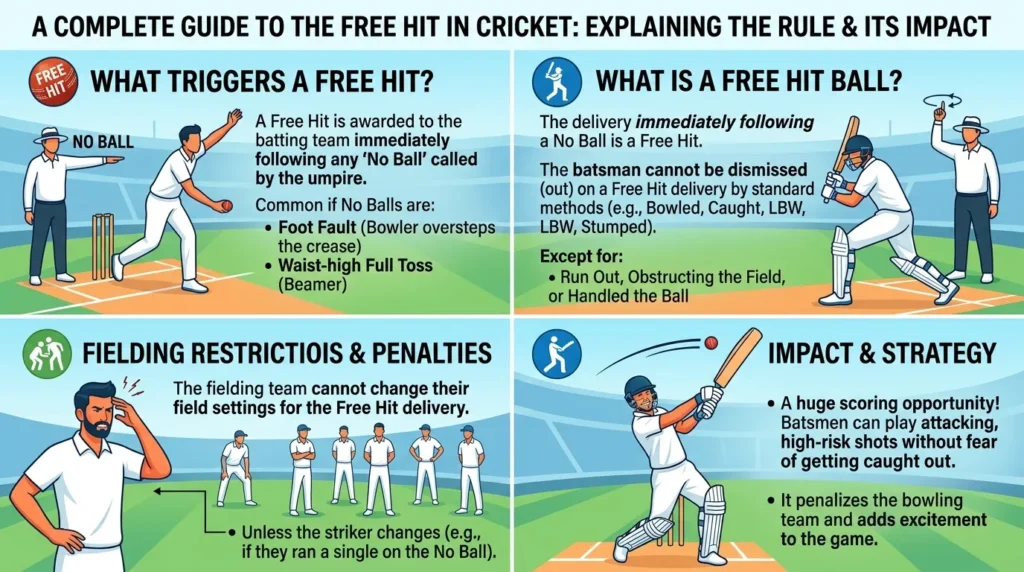
A free hit in cricket is a special delivery awarded to the batting team after a bowler delivers a no-ball in limited-overs cricket.
During a free hit:
- The batter can score runs normally.
- Most methods of dismissal do not apply.
- The batting side receives a major scoring opportunity.
This rule creates an advantage for the batting team while penalizing the bowler for delivering an illegal ball.
Free hits are commonly seen in:
- One Day Internationals (ODIs)
- Twenty20 Internationals (T20Is)
- IPL matches
- Domestic limited-overs tournaments
Quick Answer: What Is Free Hit in Cricket?
A free hit is the next delivery after a no-ball where the batter cannot be dismissed by most standard methods such as bowled, caught, LBW, or stumped.
The batter is free to play aggressive shots with reduced risk of dismissal.
History of the Free Hit Rule
Why Was the Rule Introduced?
Before the free hit rule existed, a no-ball only resulted in:
- One extra run
- An additional delivery
However, cricket authorities believed that this penalty was not always severe enough.
Fast bowlers occasionally overstepped the crease, gaining an unfair advantage.
To discourage illegal deliveries, officials introduced the free hit rule.
Introduction in International Cricket
The International Cricket Council (ICC) introduced free hits in One Day Internationals in 2007.
The rule later became part of T20 cricket and eventually spread throughout domestic competitions worldwide.
Modern Usage
Today, the free hit is a standard feature of limited-overs cricket and one of the most exciting moments in the game.
What Is a No-Ball?
To understand free hits, it is important to understand no-balls.
A no-ball is an illegal delivery by the bowler.
Common Reasons for a No-Ball
Overstepping the Crease
The bowler’s front foot lands beyond the popping crease.
Dangerous Bowling
A delivery that is considered unsafe for the batter.
Illegal Bowling Action
The bowler fails to comply with approved bowling regulations.
Too Many Fielders Outside the Circle
Certain fielding restrictions may result in a no-ball.
When a no-ball occurs, the batting side receives an extra run and, in most limited-overs formats, a free hit on the next delivery.
Rules of a Free Hit
What Happens During a Free Hit?
The next legal ball after a no-ball becomes a free hit.
The umpire signals the free hit by rotating one arm in a circular motion above the head.
What Can the Batter Do?
The batter can:
- Hit boundaries
- Run singles
- Take doubles and triples
- Score sixes
- Play aggressive shots
The scoring rules remain unchanged.
What Happens If the Free Hit Is Also a No-Ball?
If another no-ball is bowled:
- Another free hit is awarded
- Additional penalty runs apply
This can create significant pressure on the bowling team.
Can a Batter Get Out on a Free Hit?
This is one of the most common questions in cricket.
Dismissals That Do NOT Apply
A batter cannot be dismissed by:
- Bowled
- Caught
- Leg Before Wicket (LBW)
- Stumped
These dismissals are not valid on a free hit.
Dismissals That Still Apply
A batter can still be dismissed by:
Run Out
If the batter fails to complete a run safely.
Obstructing the Field
If the batter deliberately interferes with fielders.
Hit the Ball Twice
Under specific circumstances.
Retired Out
If applicable under competition rules.
Therefore, a batter is not completely immune from dismissal during a free hit.
Why Is a Free Hit Important?
The free hit rule serves multiple purposes.
Encourages Fair Bowling
Bowlers are penalized for illegal deliveries.
Rewards the Batting Team
The batting side gains a valuable scoring opportunity.
Increases Excitement
Fans often expect boundaries or sixes during free hits.
Creates Strategic Challenges
Both batters and bowlers must adapt their tactics.
Free Hit Strategy for Batters
Attack Aggressively
Most batters attempt big shots because the risk of dismissal is reduced.
Target Boundaries
Batters often aim for:
- Four runs
- Six runs
This maximizes the advantage of the free hit.
Use Innovative Shots
Players may attempt:
- Reverse sweeps
- Scoops
- Switch hits
- Ramp shots
These high-risk shots become more attractive during a free hit.
Rotate Strike
If a boundary is not possible, quick singles remain valuable.
Free Hit Strategy for Bowlers
Although bowlers are at a disadvantage, they still have options.
Bowl Yorkers
A precise yorker can restrict scoring.
Use Slower Deliveries
Variations may deceive the batter.
Change the Line and Length
Unexpected deliveries can reduce scoring opportunities.
Focus on Field Placement
Strategic field settings help limit boundaries.
Fielding Rules During a Free Hit
Fielding restrictions generally remain unchanged.
However, if the striker changes due to runs scored on the no-ball, field adjustments may be allowed according to playing conditions.
Captains often position fielders:
- Near boundary lines
- In deep catching positions
- To prevent sixes and fours
Good field placement can save valuable runs.
Free Hit in ODI Cricket
Importance in One Day Internationals
ODI matches consist of:
- 50 overs per side
A free hit can significantly influence momentum during an innings.
Impact on Match Outcomes
A single free hit may:
- Change scoring rates
- Shift pressure
- Build partnerships
Many ODI matches have seen crucial boundaries scored from free hits.
Free Hit in T20 Cricket
Greater Importance
In T20 cricket:
- Every ball matters
- Scoring rates are extremely high
A free hit often creates a major advantage.
High-Scoring Opportunities
Batters frequently attempt:
- Maximum sixes
- Aggressive boundary shots
This makes free hits especially exciting for spectators.
Major Tournaments Featuring Free Hits
ICC Cricket World Cup
Free hits often influence key moments during World Cup matches.
ICC T20 World Cup
The fast-paced nature of T20 cricket increases the importance of free hits.
Indian Premier League (IPL)
The IPL is famous for dramatic free-hit sixes and game-changing moments.
Champions Trophy
Teams regularly capitalize on free-hit opportunities.
Domestic T20 Leagues
Free hits are widely used in professional competitions worldwide.
Player Roles During a Free Hit
Batter
The batter seeks to maximize scoring opportunities.
Non-Striker
Supports quick running and communication.
Bowler
Attempts to limit damage through disciplined bowling.
Captain
Adjusts field placements and tactical plans.
Fielders
Work to prevent boundaries and save runs.
Equipment Used in Cricket
Free hits occur during standard gameplay using regular cricket equipment.
Essential equipment includes:
- Cricket bat
- Cricket ball
- Helmet
- Batting pads
- Gloves
- Stumps and bails
- Cricket shoes
Protective equipment remains essential regardless of match situation.
Benefits of Playing Cricket
Physical Benefits
- Improves fitness
- Builds stamina
- Enhances hand-eye coordination
- Develops agility
Mental Benefits
- Improves concentration
- Enhances strategic thinking
- Strengthens decision-making
- Builds confidence
Social Benefits
- Encourages teamwork
- Promotes communication
- Develops leadership skills
Interesting Facts About Free Hits
- Free hits are awarded after no-balls in limited-overs cricket.
- The rule was introduced by the ICC in 2007.
- Batters cannot be dismissed bowled on a free hit.
- Many famous IPL sixes have come from free-hit deliveries.
- Consecutive no-balls can result in multiple free hits.
- Umpires signal a free hit with a circular arm motion.
- Free hits are among the most anticipated moments in modern cricket.
Common Misconceptions About Free Hits
A Batter Cannot Get Out at All
Incorrect. Run-outs and certain other dismissals remain possible.
Every No-Ball Results in a Free Hit Everywhere
The rule primarily applies in limited-overs cricket.
Free Hits Guarantee Boundaries
Many free-hit deliveries still result in singles or dot balls.
Bowlers Have No Chance
Good bowling and fielding can still restrict scoring.
Conclusion
Understanding what a free hit in cricket is helps fans appreciate one of the game’s most exciting rules. Awarded after a no-ball, a free hit gives the batting side a valuable opportunity to score runs with reduced risk of dismissal. The rule promotes fair play, penalizes illegal bowling, and creates thrilling moments in ODI and T20 cricket. From international tournaments to domestic leagues like the IPL, free hits frequently influence match outcomes and add excitement for players and spectators alike. Whether you are a beginner or an experienced cricket follower, understanding the free hit rule provides deeper insight into modern cricket strategy and gameplay.

Green Benn is a dedicated sports writer specializing in cricket, including IPL and international formats. Known for clear, engaging, and informative content, Green simplifies complex match analysis and player statistics for all readers. Passionate about sports storytelling, Green delivers reliable, SEO-friendly articles that keep fans updated and informed