
Cricket is a sport that combines batting, bowling, and fielding skills to create an exciting and competitive game. While batting and bowling often receive the most attention, fielding plays an equally important role in determining the outcome of a match. A strong fielding side can stop runs, create pressure on the batting team, and take crucial wickets through catches, run-outs, and smart positioning.
The fielding rules in cricket ensure that fielders play fairly while maintaining the balance between bat and ball. These rules guide where fielders can stand, how they can handle the ball, and what actions are allowed or restricted during play. Understanding these rules helps players perform better and prevents penalties during the game.
Fielding also requires athletic ability, quick thinking, and teamwork. Modern cricket has raised the standard of fielding significantly, with players making incredible diving stops, lightning-fast throws, and spectacular catches.
In this article, you will learn everything about fielding rules in cricket, including the history of fielding, player positions, important rules, techniques, equipment used, and major cricket tournaments where fielding skills are showcased. Whether you are a beginner, sports fan, or aspiring cricketer, this guide will help you understand the importance and rules of fielding in cricket.
History of Fielding in Cricket
Fielding has been an essential part of cricket since the sport began in England during the 16th century. In the early days of cricket, fielding was relatively basic, and players mainly focused on stopping the ball and returning it to the bowler.
Over time, the importance of fielding grew as teams realized that good fielding could prevent runs and create opportunities to dismiss batsmen. As cricket evolved into professional competition, fielding techniques and strategies became more advanced.
Evolution of Modern Fielding
In modern cricket, fielding has become highly athletic and strategic. Players now practice specific skills such as:
- Diving stops
- Sliding saves
- Direct-hit run-outs
- High catches
Teams today place great emphasis on fitness, speed, and coordination, making fielding one of the most exciting parts of the game.
Basic Fielding Rules in Cricket
The fielding rules in cricket define how fielders should behave during a match and what actions are considered legal or illegal.
Number of Fielders
A cricket team has 11 players on the field, including the bowler and wicketkeeper.
During fielding:
- One player bowls the ball.
- One player acts as the wicketkeeper.
- The remaining nine players are positioned in various fielding positions.
Fielding Positions
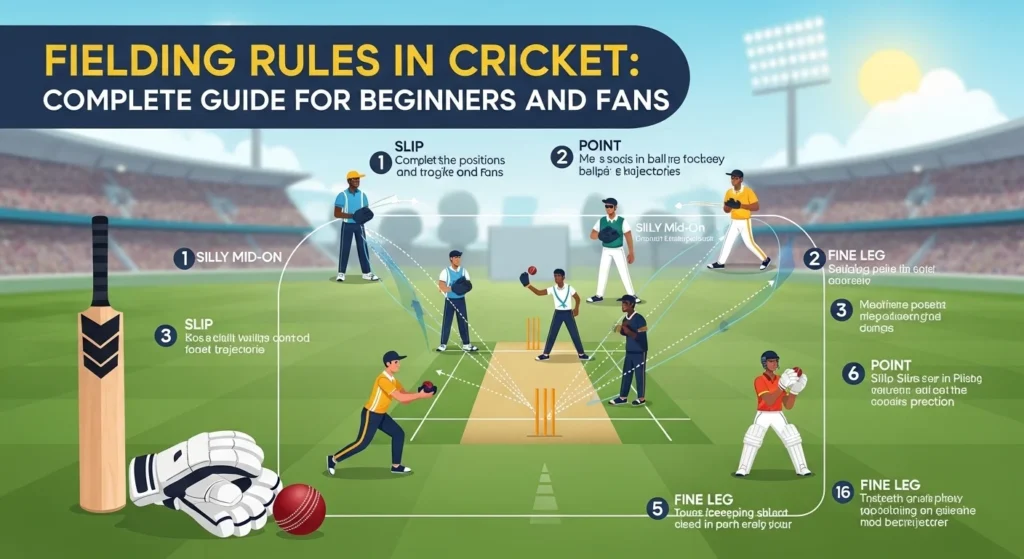
Fielders are placed around the ground to stop runs and catch the ball.
Common positions include:
- Slip
- Gully
- Point
- Cover
- Mid-off
- Mid-on
- Square leg
- Fine leg
- Third man
Each position serves a strategic purpose depending on the batsman’s style and the bowler’s plan.
Fielders Inside the Field
Fielders must remain inside the boundary line during play.
If a fielder touches the ball while stepping outside the boundary line, the batting team is awarded four runs.
Powerplay Fielding Rules
Modern limited-overs cricket uses special fielding restrictions known as powerplays.
Powerplay in One Day International (ODI)
In ODI cricket, fielding restrictions apply during certain overs.
During the first powerplay:
- Only two fielders are allowed outside the 30-yard circle.
This rule encourages aggressive batting early in the innings.
Powerplay in T20 Cricket
T20 cricket also uses fielding restrictions.
In the first six overs:
- Only two fielders can stand outside the circle.
After that period, more fielders are allowed near the boundary.
These rules create a balance between bat and ball.
Important Fielding Rules in Cricket
Several important rules guide how fielders handle the ball during play.
Catch Rule
A catch is valid when:
- A fielder catches the ball before it touches the ground.
- The ball remains under the fielder’s control.
If the catch is successful, the batsman is declared out.
Run-Out Rule
A run-out happens when:
- A fielder hits the stumps with the ball.
- The batsman is outside the crease while running.
Run-outs often occur due to quick fielding and accurate throws.
Boundary Rule
If the ball crosses the boundary:
- Four runs are awarded if the ball touches the ground before crossing.
- Six runs are awarded if the ball crosses the boundary without touching the ground.
Fielders try to stop the ball before it reaches the boundary.
Obstructing the Field
If a batsman deliberately blocks a fielder’s attempt to run them out, it may be considered obstructing the field, which can result in dismissal.
Important Fielding Techniques and Strategies
Fielding is not just about standing in position. It requires skill and technique.
Catching Technique
Good catching technique involves:
- Watching the ball closely
- Using soft hands
- Positioning the body correctly
Slip fielders especially need quick reflexes.
Ground Fielding
Ground fielding involves stopping balls hit along the ground.
Key techniques include:
- Sliding stops
- Quick pickup and throw
- Accurate aiming at the stumps
These skills help prevent runs.
Throwing Accuracy
A strong and accurate throw can create run-out opportunities.
Fielders practice:
- Direct-hit throws
- Quick releases
- Strong arm action
This skill is very valuable in modern cricket.
Player Roles in Fielding
Each player has a specific role while fielding.
Wicketkeeper
The wicketkeeper stands behind the stumps.
Responsibilities include:
- Catching edges from the bat
- Stumping batsmen
- Stopping fast deliveries
The wicketkeeper is one of the most important fielders.
Close Fielders
Close fielders stand near the batsman.
Common positions include:
- Slip
- Short leg
- Silly point
These players are ready to catch quick edges.
Outfielders
Outfielders stand near the boundary.
Their duties include:
- Stopping boundaries
- Catching high balls
- Throwing the ball back quickly
Speed and strong throwing ability are important for outfielders.
Equipment Used in Fielding
Fielders use several types of equipment during a cricket match.
Cricket Ball
The cricket ball is made from:
- Cork core
- Leather covering
- Raised seam
Fielders must handle the ball carefully for better grip.
Wicketkeeping Gloves
Wicketkeepers use special gloves designed to catch fast deliveries safely.
Protective Equipment
Close fielders sometimes wear:
- Helmets
- Leg guards
- Chest protectors
These help protect them from powerful shots.
Major Cricket Tournaments
Many international cricket tournaments showcase exceptional fielding skills.
ICC Cricket World Cup
The ICC Cricket World Cup is one of the biggest cricket tournaments in the world.
Players often produce spectacular fielding moments in this event.
ICC T20 World Cup
This format is fast-paced and demands quick fielding and sharp reflexes.
Many run-outs and boundary saves occur in T20 matches.
ICC Test Championship
Test cricket highlights patience and discipline, where fielders must remain alert for long periods.
Catches and field placements play a major role in this format.
Benefits of Playing Cricket Fielding
Fielding offers several physical and mental benefits.
Physical Benefits
Fielding improves:
- Speed and agility
- Hand-eye coordination
- Reflexes
- Endurance
It also helps maintain overall fitness.
Mental Benefits
Fielding also develops mental skills such as:
- Quick decision-making
- Focus and awareness
- Team communication
These abilities are valuable in both sports and everyday life.
Interesting Facts About Cricket Fielding
Here are some interesting facts about fielding in cricket.
- Some of the greatest cricketers are famous for their fielding skills.
- Direct-hit run-outs are among the most exciting moments in cricket.
- Modern fielders train with specialized drills and fitness programs.
- Some fielders can throw the ball more than 80 meters accurately.
- Fielding standards have improved dramatically in the last 30 years.
These facts show how important fielding has become in modern cricket.
Conclusion
Fielding is a vital part of cricket that often determines the outcome of matches. The fielding rules in cricket ensure fair play while allowing teams to use strategy and skill to stop runs and take wickets.
From understanding basic fielding positions to learning about catches, run-outs, and powerplay restrictions, these rules help maintain balance in the game. Modern cricket has raised the importance of athletic fielding, where quick reflexes, speed, and teamwork are essential.
For beginners and sports enthusiasts, learning the fielding rules helps build a deeper understanding of cricket and its strategies. Whether you are playing the game or watching professional matches, appreciating fielding skills adds excitement and respect for the players’ efforts.
As cricket continues to evolve, fielding will remain a key element that makes the sport dynamic, competitive, and thrilling for fans around the world.

Jon Smith is a passionate sports writer specializing in cricket and global sporting events. With a keen eye for match analysis and player performance, he creates clear, engaging, and informative content. His work focuses on simplifying complex sports insights, making them accessible for beginners and experienced fans alike worldwide.