
Cricket is one of the most popular sports in the world, enjoyed by millions of players and fans across different countries. The game revolves around two main teams competing to score more runs than their opponent. While batting is the primary way to score runs, the fielding team works hard to dismiss the batsmen and stop them from building a large total. This is where understanding the ways a batsman can get out becomes important.
In cricket, a batsman can be dismissed in several different ways, each governed by specific rules defined by the official Laws of Cricket. Some dismissals are common, such as caught, bowled, or leg before wicket (LBW), while others are rare and occur only under special circumstances.
For beginners and sports enthusiasts, learning about these dismissal methods helps in understanding the strategy and excitement of cricket. Bowlers, fielders, and captains all plan their tactics around these dismissal opportunities.
In this article, we will explore the ways a batsman can get out in cricket, explain the rules behind each dismissal, discuss strategies used by teams to take wickets, and highlight the role of players and equipment involved in the process.
History of Dismissals in Cricket
Cricket has a long history that dates back to the 16th century in England. In the early days of cricket, the rules were simple, and the ways a batsman could get out were limited.
Originally, batsmen could only be dismissed in a few ways such as:
- Bowled
- Caught
- Run out
As cricket evolved, more detailed laws were introduced to make the game fairer and more structured. Over time, additional dismissal methods were added, such as LBW, stumped, hit wicket, and obstructing the field.
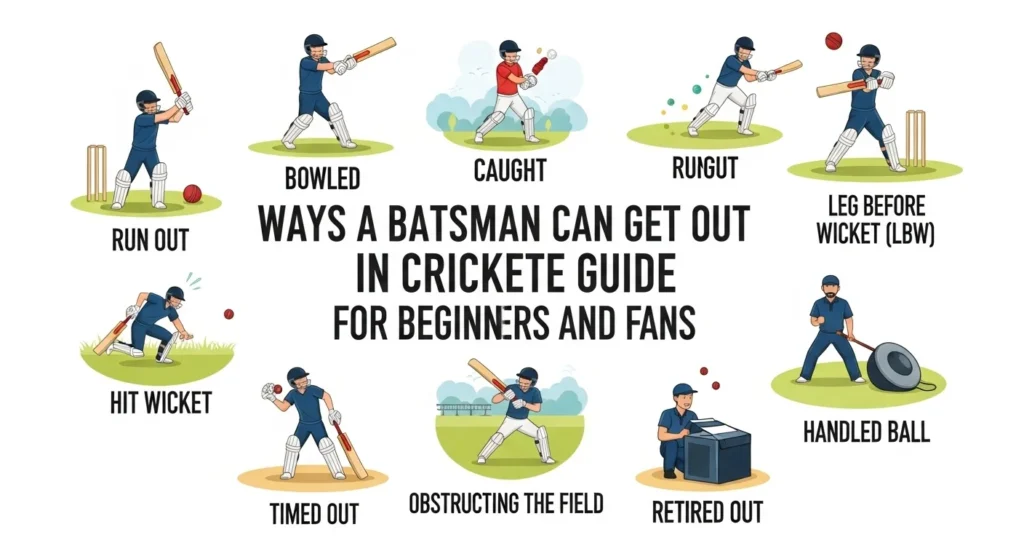
Today, the official Laws of Cricket recognize ten different ways a batsman can get out, although some are extremely rare.
Common Ways a Batsman Can Get Out in Cricket (2026)
In cricket, a batsman can be dismissed in several different ways under the Laws of Cricket. While there are ten official methods of dismissal, only a few occur regularly in international and domestic matches. Understanding these common dismissal methods helps beginners follow the game more easily and gives fans a better appreciation of the strategies used by bowlers and fielders.
The following are the most common ways a batsman gets out in cricket.
Bowled
A batsman is bowled when a legal delivery from the bowler hits the stumps and dislodges at least one bail. This is one of the most straightforward and satisfying dismissals for a bowler because it requires no assistance from the fielders.
To dismiss a batsman by being bowled:
- The delivery must be legal (not a no-ball).
- The ball must hit the stumps.
- At least one bail must be dislodged from the stumps.
A batsman can be bowled whether or not the ball touches the bat, glove, pad, or any other part of the body before hitting the stumps, provided the ball has not first touched another fielder.
Common Reasons for Being Bowled
- Missing a straight delivery.
- Misjudging the line or length of the ball.
- Playing an incorrect shot.
- Facing a swinging or spinning delivery.
- Underestimating the speed of the bowler.
Example: A fast bowler delivers a yorker that sneaks under the bat and crashes into the stumps, knocking the bails off. The batsman is bowled out.
Caught
Caught is the most common method of dismissal in cricket. A batsman is out if the ball touches the bat or the glove holding the bat and is caught by a fielder before it touches the ground.
The catch can be taken by:
- Any fielder.
- The wicketkeeper.
- The bowler.
The fielder must have complete control of the ball, and the catch must be completed without the ball touching the ground.
Conditions for a Valid Catch
- The delivery must be legal.
- The ball must touch the bat or the glove holding the bat.
- The ball must not touch the ground before being caught.
- The catcher must remain in control of the ball.
Common Types of Catches
- Slip catch
- Wicketkeeper catch
- Deep boundary catch
- Return catch by the bowler
- Outfield catch
Example: The batsman attempts a pull shot but mistimes it, and the ball is safely caught by a fielder at midwicket before it reaches the ground.
Leg Before Wicket (LBW)
LBW (Leg Before Wicket) is one of the most technical dismissal methods in cricket. A batsman is given out LBW when the ball strikes the leg or another part of the body instead of the bat, and the umpire believes the ball would have gone on to hit the stumps.
The LBW law prevents batsmen from unfairly using their legs to block deliveries that would otherwise hit the wicket.
Basic Conditions for LBW
- The delivery must be legal.
- The ball must not first touch the bat.
- The ball must strike the batsman’s body.
- The umpire must judge that the ball would have hit the stumps.
- The impact and pitching of the ball must satisfy the LBW laws.
Modern cricket also uses the Decision Review System (DRS), which helps umpires review close LBW decisions using ball-tracking technology.
Example: A spinner bowls a delivery that beats the bat and strikes the batsman’s front pad directly in line with the stumps. The umpire rules the batsman LBW.
Run Out
A run out occurs when the batting team attempts to score runs between the wickets, but a fielder successfully breaks the stumps with the ball before the batsman reaches the crease.
Unlike most dismissals, a run out does not require the batsman to hit the ball.
A Batsman Is Run Out When
- The batsman is outside the crease.
- The fielding side breaks the stumps with the ball.
- The batsman has not safely reached the crease.
Run outs often result from excellent fielding or poor communication between the two batters.
Common Causes of Run Outs
- Miscommunication between batting partners.
- Slow running between the wickets.
- Accurate throws by fielders.
- Brilliant wicketkeeping.
- Attempting risky or unnecessary runs.
Example: Two batters hesitate while running for a second run. A fielder quickly throws the ball to the wicketkeeper, who removes the bails before the batsman reaches the crease.
Stumped
A batsman is stumped when the wicketkeeper removes the bails while the batsman is outside the batting crease and is not attempting a run.
Stumpings usually occur against spin bowlers because batsmen often leave their crease to hit the ball. If they miss the delivery and fail to return before the wicketkeeper breaks the stumps, they are declared out.
Conditions for Stumping
- The batsman must be outside the crease.
- The batsman must not be attempting a run.
- The wicketkeeper must remove the bails using the ball.
- The delivery must not be a no-ball.
Why Stumpings Happen
- The batsman advances down the pitch.
- The ball spins sharply past the bat.
- The wicketkeeper collects the ball quickly.
- The batsman cannot return to the crease in time.
Example: A batter charges down the pitch to hit a spinner but misses the ball completely. The wicketkeeper gathers the ball cleanly and removes the bails before the batter gets back inside the crease, resulting in a stumping.
These five dismissal methods—Bowled, Caught, Leg Before Wicket (LBW), Run Out, and Stumped—are the most common ways a batsman gets out in cricket. They occur regularly in Test matches, One Day Internationals (ODIs), T20 Internationals, and franchise leagues such as the IPL, making them essential for every cricket fan to understand.
Rare Ways a Batsman Can Get Out in Cricket (2026)
While most wickets in cricket fall through bowled, caught, LBW, run out, or stumped, the Laws of Cricket also recognize several rare methods of dismissal. These dismissals are seen only occasionally in professional cricket but remain important parts of the game’s official rules.
Understanding these uncommon dismissals helps players, students, and cricket fans gain a complete knowledge of how a batsman can be declared out.
Hit Wicket
A batsman is dismissed Hit Wicket if they accidentally dislodge the stumps with their body, bat, helmet, clothing, or other equipment while attempting to play a shot or immediately after starting for the first run.
This dismissal usually happens because the batter loses balance or moves too close to the stumps during a shot.
Conditions for Hit Wicket
- The delivery must be legal.
- The batsman accidentally breaks the stumps.
- The dismissal occurs while playing the ball or setting off for the first run.
- At least one bail must be dislodged.
Common Causes
- Stepping too far back while playing a shot.
- The bat accidentally hitting the stumps.
- The foot or leg striking the stumps.
- Losing balance against a fast or short-pitched delivery.
Example: While attempting a pull shot, the batsman’s back foot hits the stumps, causing the bails to fall. The batsman is declared Hit Wicket.
Obstructing the Field
A batsman is out Obstructing the Field if they deliberately block, distract, or interfere with the fielding side to prevent a dismissal or stop the ball from reaching the stumps.
The rule is designed to ensure fair play and prevent batsmen from gaining an unfair advantage.
Examples of Obstructing the Field
- Deliberately changing running direction to block a fielder.
- Intentionally stopping a throw with the hand or body.
- Preventing a fielder from catching or collecting the ball.
- Deliberately interfering with a run-out attempt.
It is important to note that accidental contact with a fielder does not usually result in this dismissal. The umpire must be satisfied that the obstruction was intentional.
Handled the Ball (Now Included Under Obstructing the Field)
Under older cricket laws, a batsman could be dismissed for Handled the Ball if they deliberately touched the ball with a hand not holding the bat without the consent of the fielding team.
However, this dismissal has now been removed as a separate law and is included under Obstructing the Field.
When It Applies
A batsman may be given out if they intentionally:
- Pick up the ball.
- Stop the ball with their hand.
- Push the ball away to prevent a dismissal.
- Touch the ball without the fielding team’s permission.
Example: A batter picks up the ball after playing a defensive shot without receiving permission from the fielding side. The umpire may declare the batter out for Obstructing the Field.
Hit the Ball Twice
A batsman is normally allowed to strike the ball once after it is delivered.
However, if the batsman deliberately hits the ball a second time to score runs or gain an unfair advantage, they can be dismissed for Hit the Ball Twice.
The only exception is when the second contact is made solely to protect the stumps from being hit.
Conditions for This Dismissal
- The second hit must be intentional.
- The second hit must not be solely for protecting the wicket.
- The second hit attempts to score runs or gain an unfair advantage.
Because this situation almost never occurs, it is considered one of cricket’s rarest dismissals.
Timed Out
A batsman can be dismissed Timed Out if they fail to arrive at the crease within the time limit after the previous batter has been dismissed.
According to the current Laws of Cricket, the incoming batter must be ready to receive the next ball within two minutes in international cricket playing conditions (the exact limit can vary depending on the competition’s playing regulations).
Reasons a Batter May Be Timed Out
- Taking too long to enter the field.
- Equipment delays.
- Poor communication within the batting team.
- Unnecessary delays before taking guard.
This is one of the rarest methods of dismissal and has occurred only a handful of times in high-level cricket.
Retired Out
In limited-overs cricket, a batter may voluntarily leave the field without injury and be recorded as Retired Out if they do not return to continue their innings.
Unlike Retired Hurt, where the player leaves due to injury and may return later, Retired Out is treated as a dismissal.
This tactic is extremely rare but has occasionally been used in T20 cricket for strategic reasons.
Summary of Rare Cricket Dismissals
| Dismissal Method | How It Happens |
|---|---|
| Hit Wicket | Batter accidentally breaks the stumps while playing the ball or starting a run. |
| Obstructing the Field | Batter deliberately interferes with the fielding side. |
| Handled the Ball | Now included under Obstructing the Field in the Laws of Cricket. |
| Hit the Ball Twice | Batter intentionally strikes the ball twice to gain an advantage. |
| Timed Out | Incoming batter fails to reach the crease within the required time. |
| Retired Out | Batter voluntarily leaves the innings without injury and does not return. |
Although these dismissal methods are rarely seen in professional cricket, they remain official parts of the Laws of Cricket. Knowing these unusual ways a batsman can get out gives players and fans a deeper understanding of the game’s rules and highlights the importance of fair play and discipline on the field.
Techniques Bowlers Use to Dismiss Batsmen in Cricket (2026)
Taking wickets is one of the primary responsibilities of a bowler in cricket. To dismiss batsmen consistently, bowlers use a combination of skill, accuracy, pace, swing, spin, and tactical planning. Different bowling styles are effective in different match conditions, pitch surfaces, and game situations.
Below are the most common bowling techniques used to dismiss batsmen.
Swing Bowling
Swing bowling is a technique in which the cricket ball moves sideways through the air before reaching the batsman. This movement makes it difficult for the batter to judge the ball’s line and can lead to edges, missed shots, or incorrect footwork.
Swing bowling is most effective with a relatively new ball, especially in conditions that favor movement through the air, such as overcast weather or humid conditions.
Types of Swing Bowling
- Inswing: The ball swings towards the batsman.
- Outswing: The ball moves away from the batsman.
- Reverse Swing: An older ball swings in the opposite direction at high speeds.
Common Dismissals from Swing Bowling
- Bowled
- Caught behind
- Slip catches
- Leg Before Wicket (LBW)
Example: An outswing delivery tempts the batsman to play outside the off stump, resulting in an edge that is safely caught by the wicketkeeper or a slip fielder.
Seam Bowling
Seam bowling uses the raised seam of the cricket ball to produce movement after the ball pitches on the surface. By landing the seam in an upright position, the bowler can generate unpredictable deviation, making it difficult for the batsman to judge the bounce and direction.
Seam bowling is particularly effective on grassy, damp, or fresh pitches where the surface provides extra assistance.
Advantages of Seam Bowling
- Produces movement after pitching.
- Creates uneven bounce.
- Forces batting mistakes.
- Highly effective with the new ball.
Common Dismissals from Seam Bowling
- Bowled
- Caught behind
- Slip catches
- LBW
Example: A seam delivery lands on the pitch and moves sharply away from the bat, producing an outside edge that is caught in the slips.
Spin Bowling
Spin bowling relies on the bowler imparting spin to the ball using the fingers or wrist. After bouncing, the spinning ball changes direction, making it challenging for the batsman to predict its movement.
Spin bowlers usually become more effective on dry pitches, where the surface provides extra turn and grip.
Main Types of Spin Bowling
- Leg Spin
- Off Spin
- Googly
- Doosra
- Top Spinner
- Carrom Ball
Each variation is designed to deceive the batsman by changing the direction, bounce, or speed of the ball.
Common Dismissals from Spin Bowling
- Stumped
- Caught
- Bowled
- LBW
Example: A batsman advances down the pitch to attack a leg-spinner, misses the spinning delivery, and is quickly stumped by the wicketkeeper.
Fast Bowling
Fast bowling depends on high speed, accuracy, bounce, and aggression to trouble batsmen. Fast bowlers often use short-pitched deliveries, yorkers, and bouncers to force mistakes.
By combining pace with movement, fast bowlers can dominate batters in all formats of cricket.
Common Fast Bowling Deliveries
- Yorker
- Bouncer
- Full-Length Delivery
- Short Ball
- Slower Ball
Common Dismissals from Fast Bowling
- Bowled
- Caught
- LBW
- Hit Wicket
Example: A perfectly executed yorker crashes into the base of the stumps before the batsman can bring the bat down.
Variation Bowling
Modern bowlers frequently use variations to surprise batsmen and break partnerships. Instead of bowling the same delivery repeatedly, they change the speed, line, length, or type of delivery to create uncertainty.
Popular Bowling Variations
- Slower Ball
- Cutter
- Knuckle Ball
- Cross-Seam Delivery
- Back-of-the-Hand Slower Ball
These variations are especially effective in ODIs and T20 cricket, where batsmen often play attacking shots.
Common Dismissals from Variations
- Caught in the deep
- Bowled
- LBW
- Mistimed catches inside the field
How Bowlers Plan a Dismissal in Cricket (2026)
Taking a wicket is rarely the result of just one good delivery. Successful bowlers usually plan a batsman’s dismissal over several balls by studying their weaknesses, varying their deliveries, and creating pressure. This strategic approach is known as setting up the batsman.
Instead of relying solely on speed or spin, bowlers use a combination of skill, patience, and tactics to force the batsman into making a mistake. Every delivery is part of a larger plan aimed at creating an opportunity for a wicket.
Key Strategies Bowlers Use to Plan a Dismissal
Study the Batsman’s Strengths and Weaknesses
Before and during the match, bowlers analyze how a batsman plays against different types of deliveries. Some batters struggle against short balls, while others have difficulty facing swing or spin.
By identifying these weaknesses, bowlers can target areas where the batsman is most vulnerable.
Maintain a Consistent Line and Length
One of the most effective bowling strategies is maintaining a disciplined line and length. Repeatedly bowling in the same challenging area forces the batsman to play defensive shots and increases the chances of making an error.
Consistency also builds pressure by reducing scoring opportunities.
Use Attacking Field Placements
Captains and bowlers work together to position fielders where the batsman is most likely to hit the ball.
Common attacking fielders include:
- Slip
- Gully
- Short Leg
- Silly Point
- Leg Slip
Well-placed fielders increase the chances of catching edges and mistimed shots.
Mix Pace, Swing, and Spin
Good bowlers avoid becoming predictable. They frequently change their pace, line, length, and type of delivery to keep the batsman guessing.
Common variations include:
- Swing deliveries
- Seam movement
- Spin variations
- Slower balls
- Yorkers
- Bouncers
These changes make it harder for the batsman to anticipate the next delivery.
Apply Pressure with Dot Balls
Dot balls are one of the most powerful weapons in cricket. A sequence of deliveries without allowing runs builds pressure on the batsman.
As the pressure increases, the batsman is more likely to attempt risky shots, creating opportunities for catches, LBW decisions, or bowled dismissals.
Set Up the Perfect Delivery
Experienced bowlers often spend several deliveries preparing for one wicket-taking ball.
For example, a fast bowler may bowl several outswingers before suddenly delivering an inswinging yorker, while a spinner may repeatedly bowl outside the off stump before surprising the batter with a googly.
This element of surprise often leads to crucial wickets.
Why Bowling Strategy Is Important
A well-planned bowling strategy offers several advantages:
- Creates pressure on the batsman.
- Increases the chances of taking wickets.
- Prevents easy scoring opportunities.
- Forces batting mistakes.
- Helps control the flow of the match.
- Supports the team’s overall game plan.
Successful bowlers combine technical skill, match awareness, and smart tactics to dismiss batsmen. By studying opponents, maintaining disciplined line and length, using attacking field placements, varying their deliveries, and building pressure through dot balls, they create opportunities to take wickets consistently. Whether in Test cricket, One Day Internationals (ODIs), T20 Internationals, or the IPL, strategic bowling plays a vital role in winning matches and controlling the game.
Player Roles in Cricket Dismissals (2026)
Dismissing a batsman is usually a team effort rather than the work of a single player. While the bowler delivers the ball, the wicketkeeper, fielders, captain, and even the umpire all play important roles in completing a dismissal. Good coordination between these players increases the chances of taking wickets and winning matches.
Below are the key roles each player performs during a dismissal.
Bowler
The bowler is the primary player responsible for taking wickets. Every delivery is planned to challenge the batsman through pace, swing, seam movement, spin, bounce, or clever variations.
A successful bowler not only relies on skill but also studies the batsman’s weaknesses and adjusts their bowling strategy accordingly.
Main Responsibilities of the Bowler
- Deliver accurate and legal balls.
- Use swing, seam, or spin to deceive the batsman.
- Build pressure with consistent line and length.
- Force batting mistakes.
- Take wickets through bowled, LBW, caught, hit wicket, or other dismissals.
The bowler is credited with most types of dismissals, except those such as run out, obstructing the field, and timed out.
Wicketkeeper
The wicketkeeper stands directly behind the stumps and plays one of the most important defensive roles in cricket. A skilled wicketkeeper requires quick reflexes, safe hands, excellent anticipation, and strong communication with the bowler.
The wicketkeeper is involved in many dismissals throughout a match.
Main Responsibilities of the Wicketkeeper
- Catch edges from the bat.
- Stump batsmen who leave the crease.
- Assist in run-outs.
- Collect deliveries cleanly.
- Guide field placements and support the bowler.
The wicketkeeper is particularly important when spin bowlers are operating, as quick stumpings often depend on their speed and accuracy.
Fielders
Fielders provide essential support to the bowler by preventing runs and creating wicket-taking opportunities. Athletic fielding can completely change the outcome of a match by producing spectacular catches or direct-hit run-outs.
Every fielder has a specific position and responsibility based on the captain’s strategy.
Main Responsibilities of Fielders
- Take catches.
- Save important runs.
- Throw the ball accurately to the stumps.
- Create run-out opportunities.
- Support the bowler by maintaining pressure.
Excellent fielding often turns half-chances into wickets and helps build pressure on the batting side.
Captain
The captain plays a vital tactical role in planning dismissals. They work closely with the bowlers to decide field placements, bowling changes, and match strategies based on the conditions and the batsman’s weaknesses.
Main Responsibilities of the Captain
- Set attacking or defensive field placements.
- Rotate bowlers effectively.
- Develop wicket-taking strategies.
- Read pitch and weather conditions.
- Motivate and guide the fielding team.
A captain’s decisions can significantly influence how and when wickets are taken during a match.
Umpire
The umpire ensures that every dismissal follows the Laws of Cricket. They carefully observe each delivery and make the final decision on whether the batsman is out or not out.
In modern cricket, umpires may also use the Decision Review System (DRS) to review close decisions involving LBW, catches, or other dismissals.
Main Responsibilities of the Umpire
- Judge appeals from the fielding team.
- Confirm legal deliveries.
- Decide dismissals fairly.
- Apply the Laws of Cricket.
- Use technology when available to review close decisions.
How Teamwork Leads to Cricket Dismissals (2026)
Taking wickets in cricket is rarely the result of one player’s effort alone. Most dismissals are the outcome of excellent teamwork, communication, and tactical planning between the bowler, wicketkeeper, fielders, captain, and umpire. Every member of the fielding side has a specific role, and when they work together effectively, the chances of dismissing a batsman increase significantly.
A successful dismissal often follows a carefully planned sequence rather than a single brilliant delivery.
Key Elements of Teamwork in a Dismissal
The Bowler Creates the Opportunity
The bowler begins the dismissal by delivering the ball with the right pace, line, length, swing, seam movement, or spin. Their objective is to force the batsman into making a mistake.
The Captain Sets the Field
The captain studies the batsman’s strengths and weaknesses before placing fielders in strategic positions. Proper field placement increases the chances of catches, run-outs, and pressure-building dot balls.
Fielders Support the Bowler
Fielders must stay alert throughout every delivery. They help by:
- Taking catches.
- Saving important runs.
- Throwing accurately at the stumps.
- Backing up other fielders.
- Creating run-out opportunities.
Outstanding fielding can turn half-chances into match-changing wickets.
The Wicketkeeper Completes the Dismissal
The wicketkeeper plays a crucial role by:
- Catching edges behind the stumps.
- Completing stumpings.
- Assisting in run-outs.
- Collecting difficult deliveries.
- Guiding field placements and supporting the bowler.
Quick reflexes and safe hands often make the difference between a missed chance and a wicket.
The Umpire Makes the Final Decision
The umpire carefully observes every delivery and makes the official decision after the fielding side appeals. In modern cricket, close decisions may also be reviewed using the Decision Review System (DRS).
Why Teamwork Is Important in Cricket
Good teamwork provides several advantages:
- Increases wicket-taking opportunities.
- Improves fielding efficiency.
- Builds pressure on the batting team.
- Reduces fielding mistakes.
- Helps execute tactical plans effectively.
- Contributes to winning matches.
Successful cricket dismissals are built on coordination, communication, and trust among every member of the fielding side. While the bowler creates the chance, the captain, wicketkeeper, fielders, and umpire all contribute to completing the dismissal, making teamwork one of the most important aspects of modern cricket.
Essential Cricket Equipment Used During Batting and Bowling (2026)
Cricket is played using specialized equipment designed to improve performance while ensuring the safety of players. Every match, from local club cricket to international tournaments, requires standard equipment that complies with the Laws of Cricket.
Below are the most important pieces of cricket equipment used by batsmen, bowlers, wicketkeepers, and fielders.
Cricket Bat
The cricket bat is the primary piece of equipment used by the batsman to strike the ball and score runs. Modern bats are typically made from high-quality willow wood, offering excellent balance, power, and durability.
A cricket bat consists of several parts, including the handle, shoulder, blade, toe, and grip, each designed to provide better control and comfort.
Uses of a Cricket Bat
- Hit the ball safely.
- Score runs.
- Play attacking and defensive shots.
- Protect the stumps while batting.
Cricket Ball
The cricket ball is made from a cork core covered with tightly stitched leather. A raised seam runs around the center of the ball, allowing bowlers to generate swing, seam movement, and spin.
Different formats of cricket use different colored balls:
- Red Ball – Test cricket.
- White Ball – One Day Internationals (ODIs) and T20 matches.
- Pink Ball – Day-night Test matches.
Importance of the Cricket Ball
- Produces swing and seam movement.
- Helps spin bowlers generate turn.
- Determines bowling conditions.
- Influences batting performance.
Protective Gear
Cricket is a high-speed sport, especially when facing fast bowlers. Therefore, batsmen wear protective equipment to reduce the risk of injury.
Essential Protective Equipment
- Helmet – Protects the head and face from fast deliveries.
- Batting Pads – Shield the legs from impact.
- Batting Gloves – Protect the fingers and improve grip.
- Abdominal Guard (Box) – Protects the groin area.
- Arm Guard – Protects the forearm.
- Thigh Guard – Reduces the impact of short-pitched deliveries.
- Chest Guard – Provides additional upper-body protection.
Proper protective gear allows batters to play confidently against fast and spin bowling.
Wicketkeeping Equipment
The wicketkeeper uses specialized protective equipment because they stand close to the stumps throughout the innings.
Equipment Used by Wicketkeepers
- Wicketkeeping gloves.
- Leg pads.
- Inner gloves.
- Helmet (when standing close to the stumps).
- Abdominal guard.
This equipment helps the wicketkeeper safely catch fast-moving deliveries and complete stumpings or run-outs.
Cricket Stumps and Bails
The wicket consists of three wooden stumps topped by two bails. They are positioned at both ends of the pitch and play a central role in many dismissal methods.
Importance of the Stumps
- Used in bowled dismissals.
- Used for run-outs.
- Used for stumpings.
- Used in hit wicket dismissals.
Breaking the stumps by removing one or both bails is essential for several types of dismissals.
Using the right cricket equipment not only improves player performance but also ensures safety during matches. From the bat and ball to protective gear, wicketkeeping equipment, and stumps, every item plays an important role in the game and contributes to both effective performance and player protection.
Major Cricket Tournaments Where Batsmen and Bowlers Shine (2026)
Cricket is played across the world in several prestigious international and domestic tournaments. These competitions showcase the highest level of batting, bowling, fielding, and teamwork, with players competing to set records, win championships, and represent their countries or franchises.
Below are some of the most popular cricket tournaments where batsmen and bowlers demonstrate their skills.
ICC Cricket World Cup
The ICC Cricket World Cup is the most prestigious tournament in One Day International (ODI) cricket. Organized by the International Cricket Council (ICC) every four years, it features the world’s top cricket-playing nations competing for the ultimate ODI title.
The tournament has produced some of the greatest batting performances, memorable bowling spells, and historic cricket moments.
Key Features
- 50-over international tournament.
- Held every four years.
- Organized by the ICC.
- Features the world’s best national teams.
- One of the most-watched sporting events globally.
Why It Is Important
- Determines the ODI world champion.
- Produces legendary cricket performances.
- Provides opportunities for players to set world records.
- Inspires future generations of cricketers.
ICC T20 World Cup
The ICC T20 World Cup is the premier international tournament for the Twenty20 (T20) format. It brings together the best cricket nations in a fast-paced competition where every ball can change the outcome of the match.
Known for explosive batting, innovative bowling, and thrilling finishes, the tournament is one of the most exciting events in world cricket.
Key Features
- 20-over matches.
- Organized by the ICC.
- Features international teams.
- Fast-paced and high-scoring format.
- Popular among fans worldwide.
Highlights
- Powerful batting displays.
- Clever bowling variations.
- Spectacular fielding.
- Last-over finishes.
- Emerging young talent.
ICC World Test Championship (WTC)
The ICC World Test Championship (WTC) is the highest competition in Test cricket. It rewards consistency over a two-year cycle, with the top teams qualifying for the championship final.
The tournament emphasizes patience, technique, endurance, and tactical cricket.
Key Features
- Long-format Test cricket.
- Two-year championship cycle.
- Final played between the top two teams.
- Tests players’ technical and mental skills.
Indian Premier League (IPL)
The Indian Premier League (IPL) is the world’s most popular and valuable T20 franchise cricket league. It features top international and Indian players representing city-based franchises in a highly competitive tournament.
The IPL is known for its exciting matches, star players, innovative strategies, and record-breaking performances.
Key Features
- Franchise-based T20 league.
- Held annually in India.
- Features international and domestic players.
- High-scoring and entertainment-packed matches.
- Discovers future cricket stars.
Why the IPL Is Popular
- World-class players compete together.
- Fast-paced and exciting cricket.
- Massive global fan following.
- Opportunities for young cricketers.
- Memorable batting and bowling performances.
ICC Champions Trophy
The ICC Champions Trophy is a prestigious ODI tournament featuring the top-ranked international cricket teams. Often called the “Mini World Cup,” it is known for its highly competitive matches and shorter tournament format.
Key Features
- One Day International tournament.
- Organized by the ICC.
- Features elite international teams.
- Highly competitive knockout stages.
Asia Cup
The Asia Cup is one of the most popular regional cricket tournaments, bringing together the strongest teams from Asia.
It is played in both ODI and T20I formats, depending on the upcoming ICC event, and features exciting rivalries such as India vs Pakistan.
Participating Teams
- India
- Pakistan
- Sri Lanka
- Bangladesh
- Afghanistan
- Other qualifying Asian teams
Tournament Highlights
- Intense regional rivalries.
- High-pressure matches.
- Outstanding batting and bowling performances.
- Passionate fan support across Asia.
These major cricket tournaments provide the biggest stage for players to showcase their batting, bowling, fielding, and leadership skills. From the ICC Cricket World Cup and World Test Championship to the T20 World Cup, IPL, Champions Trophy, and Asia Cup, each competition contributes to the growth of cricket while producing unforgettable moments and legendary performances enjoyed by millions of fans worldwide.
International Cricket Formats and Benefits of Playing Cricket
ICC T20 World Cup
T20 cricket is a fast-paced and highly entertaining format where batsmen play aggressive shots, leading to quick scoring and exciting dismissals. Matches are short, making every over important and increasing the pressure on both batsmen and bowlers.
ICC World Test Championship
Test cricket is the longest and most traditional format of the game. It emphasizes skill, patience, and strategy. Bowlers must work consistently to dismiss batsmen over long innings, while batsmen focus on building big scores through concentration and endurance.
Benefits of Playing Cricket
Cricket is one of the most popular sports in the world and offers a wide range of physical, mental, and social benefits. It helps players stay active while also improving important life skills such as discipline, teamwork, and decision-making.
Physical Benefits of Playing Cricket
Playing cricket provides excellent physical exercise and improves overall fitness.
- Improves strength and muscle endurance through batting, bowling, and fielding
- Enhances agility and quick body movements during fielding and running between wickets
- Develops hand-eye coordination for better catching, batting, and throwing accuracy
- Increases stamina and cardiovascular fitness due to long match durations and continuous activity
- Promotes overall body flexibility and balance
Mental Benefits
Cricket also plays an important role in improving mental abilities and cognitive skills.
- Improves focus and concentration during long and pressure-filled matches
- Enhances decision-making skills in real-time game situations
- Develops strategic thinking for planning batting, bowling, and fielding tactics
- Builds patience and emotional control, especially in challenging match conditions
- Strengthens problem-solving ability under pressure
Social and Team Benefits
Cricket is a team sport that also develops social skills.
- Encourages teamwork and coordination among players
- Builds communication skills on and off the field
- Promotes leadership qualities in captains and senior players
- Creates a sense of sportsmanship and discipline
Cricket is not only a game but also a complete physical and mental training activity. It improves fitness, sharpens the mind, and builds strong social values, making it an excellent sport for players of all ages.
Interesting Facts About Cricket Dismissals
Cricket dismissals are an important part of the game and often decide the outcome of matches. Each dismissal method reflects different skills of bowlers, fielders, and batsmen.
- The most common way of getting out in cricket is caught, where the ball is hit by the batter and caught by a fielder before touching the ground.
- LBW (Leg Before Wicket) decisions are among the most complex, as they depend on umpire judgment and ball-tracking technology.
- A hat-trick occurs when a bowler takes three wickets in three consecutive deliveries, which is a rare and impressive achievement.
- The timed out dismissal is extremely rare and has occurred only a few times in professional cricket history.
- A batter can also be dismissed in unusual ways such as hit wicket or obstructing the field, making cricket a game with many unique rules.
These facts highlight how cricket dismissals are not only diverse but also add strategy, excitement, and unpredictability to the game.
Conclusion
Understanding the ways a batsman can get out in cricket is essential for anyone who wants to fully appreciate the sport. From common dismissals like bowled, caught, and LBW to rare ones such as timed out and hit the ball twice, each rule plays an important role in maintaining fairness and excitement in the game.
Bowlers, fielders, and captains use different strategies to create these dismissal opportunities, making cricket a game of skill, planning, and teamwork. For beginners and sports enthusiasts, learning these rules provides a deeper understanding of how matches unfold and why certain decisions are made by umpires.
As cricket continues to grow in popularity worldwide, the knowledge of dismissal rules helps fans enjoy the game more and allows players to develop better strategies on the field.