Cricket is one of the most popular sports in the world, played and loved by millions of fans across different countries. Whether you are watching a thrilling international match or playing casually with friends, understanding the basic rules is essential to fully enjoy the game. One of the most important concepts in cricket is overs.
Overs in cricket define the structure and flow of the game. They determine how long a team bats or bowls and play a key role in match strategies, scoring, and results. Without overs, cricket would not have a clear format or time limit.
In this article, we will explore everything about overs in cricket, including their meaning, rules, history, and importance in different formats like Test matches, One Day Internationals (ODIs), and T20 cricket. You will also learn about strategies, player roles, and interesting facts related to overs.
By the end of this guide, you will have a complete understanding of how overs shape the game of cricket and why they are so important.
What Are Overs in Cricket? Complete Explanation for Beginners
In cricket, an over is one of the most important units used to structure the game. It represents a fixed number of legal deliveries bowled by a bowler, helping to organize the match in a clear and systematic way.
Definition of an Over in Cricket
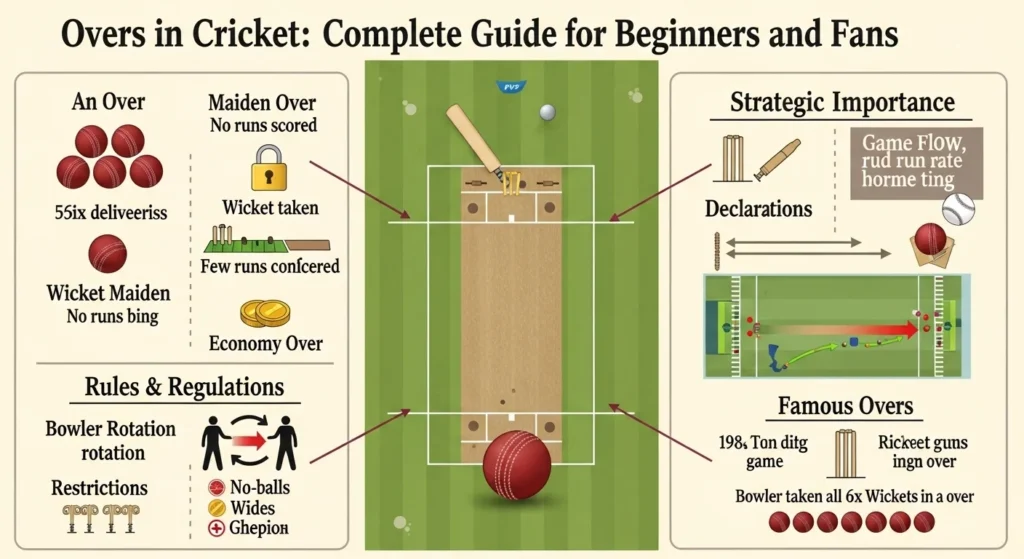
An over consists of six legal deliveries (balls) bowled by a single bowler from one end of the pitch to the batsman. Once these six balls are completed, the over is finished, and another bowler takes over from the opposite end.
Key Features of an Over
- One over = 6 legal balls (deliveries)
- Bowled by one bowler only
- After completing an over, bowling switches to the other end of the pitch
- Overs are used to control and structure the flow of the match
- The number of overs depends on the format of the game (T20, ODI, Test, etc.)
Simple Understanding of Overs
An over can be understood as a small unit of gameplay. Just like minutes make up an hour, overs make up a cricket match. They help divide the game into manageable parts and ensure fair opportunities for both teams.
Example of Overs in a Match
If a cricket match has 50 overs per side, then:
- Each team is allowed to face 50 overs while batting
- Since 1 over = 6 balls
- Total deliveries = 50 × 6 = 300 balls per team
This structure ensures that both teams get equal chances to bat and bowl under the same conditions.
Importance of Overs in Cricket
- Helps organize match duration
- Controls bowling strategy
- Creates fairness between teams
- Makes scoring and planning easier
- Defines different formats like T20, ODI, and Test cricket
Overs are the backbone of cricket structure. They divide the game into clear segments, making it easier for players, officials, and fans to follow the match and understand its progress.
History and Origin of Overs in Cricket – Complete Guide
Overs were not always six balls long. In early cricket history, the number of balls per over varied.
The concept of overs in cricket is one of the most fundamental parts of the game today, but it has evolved over many years. In the early days of cricket, there was no fixed structure like modern overs. Bowlers used to deliver balls continuously from one end until certain traditional conditions were met, and the idea of limiting deliveries had not yet been standardized.
The origin of overs can be traced back to the late 18th and early 19th century in England, where cricket was gradually becoming more organized. Initially, cricket matches were played with an undefined number of balls, and bowlers would deliver from one end until the captain decided to change ends. However, as the game became more competitive and structured, there was a need to create a fair system for both batting and bowling teams.
In the early development phase, an “over” consisted of only 4 deliveries in some regions of England. This system was introduced to bring balance between bat and ball and to speed up the game. Later, the number of balls per over increased to 5 and then 6 deliveries, depending on the country and time period.
By the early 20th century, most cricket-playing nations, including England and Australia, adopted the 6-ball over system, which became the global standard. However, there were exceptions—some countries briefly experimented with 8-ball overs, especially in Australia and South Africa, to increase scoring opportunities and reduce match duration.
Finally, in the modern era, the International Cricket Council (ICC) standardized the rule to 6 legal deliveries per over, which is now used in all formats of international cricket including Tests, One Day Internationals (ODIs), and T20 matches.
The introduction of overs brought structure, fairness, and strategy into cricket. It allowed teams to plan bowling changes, batting approaches, and match tactics more effectively. Today, overs are not just a rule but a core part of cricket strategy, influencing everything from scoring rates to field placements.
In conclusion, the history of overs in cricket shows how the game evolved from a free-flowing format into a highly organized sport. The standardization of overs has played a major role in making cricket more exciting, balanced, and globally consistent.
Evolution of Overs in Cricket – History, Changes, and Modern Format Development
- Earlier overs had 4 or 8 balls in some countries
- England standardized 6-ball overs in the late 19th century
- Today, most international matches use 6-ball overs
The concept of overs has evolved significantly throughout the history of cricket. In the early days of the sport, there was no standard number of balls in an over, and different cricket authorities used varying rules. During the nineteenth century, an over in many matches consisted of four balls. As cricket became more organized and international competitions grew in popularity, governing bodies recognized the need for greater consistency. As a result, the number of balls per over was gradually increased in several countries. At different times, overs of five, six, and even eight balls were used in various cricket-playing nations. For example, Australia and some other countries experimented with eight-ball overs for many years before eventually adopting the international standard.
The move toward six-ball overs helped simplify scoring, improve match organization, and create a consistent playing experience across different formats of the game. Today, six-ball overs are used in Test cricket, One Day Internationals (ODIs), and Twenty20 (T20) matches worldwide. The standardization of overs has also influenced cricket strategies, allowing teams to plan innings, manage bowling resources, and calculate run rates more effectively. Modern cricket relies heavily on the over system, with captains carefully rotating bowlers and batters adjusting their scoring approach based on the number of overs remaining. The evolution of overs reflects the sport’s continuous development and its efforts to create fair, competitive, and globally consistent rules.
This standardization helped make cricket more organized and easier to follow worldwide.
Rules of Overs in Cricket
Understanding the rules of overs is important for both players and fans.
Legal Deliveries in Cricket – Meaning, Rules, and Importance
A ball counts in an over only if it is a legal delivery.
A legal delivery in cricket is a ball that is bowled according to the Laws of the Game and counts as one of the six balls in an over. Legal deliveries are important because they ensure fair competition between the batting and bowling sides. Every bowler must follow specific rules when delivering the ball, and only deliveries that meet these requirements are considered legal. If a bowler breaks any of these rules, the umpire may call a no-ball or a wide, and the delivery will not count as one of the six legal balls of the over.
For a delivery to be legal, the bowler must deliver the ball with a proper bowling action and keep at least part of the front foot behind the popping crease at the moment the foot lands. If the bowler steps beyond the crease, the umpire signals a no-ball. Similarly, if the ball is bowled too far from the batter’s reach and cannot reasonably be played, it is called a wide. Both no-balls and wides result in extra runs for the batting team and require the bowler to bowl an additional delivery.
Legal deliveries can include a variety of bowling styles such as fast bowling, seam bowling, swing bowling, spin bowling, and slower-ball variations. Regardless of the type of delivery, it must comply with cricket regulations. Once a legal delivery is completed, it counts toward the over and allows the game to progress according to the established rules.
Understanding legal deliveries is essential for players, coaches, and cricket fans because they form the foundation of fair play. Bowlers who consistently deliver legal balls help maintain pressure on batters, avoid giving away extra runs, and contribute more effectively to their team’s success. As a result, mastering the ability to bowl legal deliveries is a fundamental skill in all formats of cricket.
Extra Deliveries in Cricket – Wide, No-Ball, and Their Role in Match Results
Extra deliveries in cricket are balls that do not count as part of the six legal deliveries required to complete an over. These deliveries occur when a bowler breaks certain rules, resulting in additional runs being awarded to the batting team. Because extra deliveries must be bowled again, they can increase the total number of balls in an over and give the batting side more scoring opportunities.
The most common types of extra deliveries are no-balls and wides. A no-ball is called when the bowler oversteps the popping crease, uses an illegal bowling action, or commits certain other violations. A wide is called when the ball is delivered too far from the batter to be played with a normal cricket shot. In both cases, the batting team receives an extra run, and the delivery must be repeated.
Extra deliveries can have a significant impact on a match. They increase the batting team’s score without requiring the batters to play a scoring shot and can disrupt a bowler’s rhythm and confidence. In limited-overs cricket, frequent extra deliveries can be especially costly because they provide additional scoring chances and reduce a team’s ability to control the game.
For bowlers, avoiding extra deliveries is an important skill. Maintaining proper technique, accuracy, and discipline helps minimize mistakes and prevents unnecessary runs. As a result, controlling extra deliveries is a key factor in successful bowling performances across all formats of cricket.
Some balls do not count in the six-ball limit:
- No-ball
- Wide ball
These must be re-bowled.
Change of Bowler in Cricket – Strategy, Timing, and Match Impact Explained
A change of bowler in cricket occurs when a captain decides to replace the current bowler with another player from the fielding team. This is an important tactical decision that can influence the course of a match. Captains change bowlers for various reasons, including maintaining bowler fitness, introducing a different bowling style, exploiting pitch conditions, or breaking a successful batting partnership. Since no bowler can bowl consecutive overs from both ends, changes are a regular part of cricket strategy in all formats of the game.
The decision to change a bowler is often based on match conditions and player performance. If a bowler is struggling to maintain accuracy or is conceding too many runs, the captain may introduce a new bowler to regain control. Similarly, if a bowler has completed a long spell and is becoming tired, a replacement may be necessary to ensure effectiveness and reduce the risk of injury. Captains also use bowling changes to create different challenges for batters by switching between fast bowlers, seam bowlers, and spin bowlers.
In limited-overs cricket, bowling changes are carefully planned because each bowler is restricted to a maximum number of overs. Captains must manage their bowling resources efficiently while responding to the flow of the game. In Test cricket, changes are often made to take advantage of changing pitch conditions or to keep bowlers fresh during long innings.
A successful change of bowler can have an immediate impact by creating pressure, taking wickets, or slowing the scoring rate. Many memorable cricket moments have resulted from well-timed bowling changes. Therefore, understanding when and why to change a bowler is a vital part of cricket strategy and an important responsibility for every captain.
- A bowler cannot bowl consecutive overs
- Another bowler must bowl from the opposite end
End Change in Cricket – What It Means and Why It Matters in Bowling Strategy
An end change in cricket occurs when a bowler switches from bowling at one end of the pitch to the other. This tactical adjustment is often made by the captain to improve a bowler’s effectiveness, take advantage of pitch conditions, or exploit environmental factors such as wind and sunlight. Although the bowler remains the same, changing ends can significantly influence the way the ball behaves and how comfortable the bowler feels during their run-up and delivery.
Captains usually consider several factors before deciding on an end change. One common reason is the condition of the pitch. Certain areas of the pitch may provide more bounce, seam movement, or assistance for spin bowlers. By changing ends, a bowler may be able to make better use of these conditions. Wind direction can also play an important role, especially for swing bowlers. Bowling with or against the wind can affect the speed and movement of the ball, making one end more favorable than the other.
Another reason for an end change is a bowler’s personal preference. Some bowlers feel more comfortable running in from a particular end because of the slope of the ground, lighting conditions, or the position of fielders. If a bowler is struggling to maintain accuracy or rhythm, changing ends may help improve performance and confidence.
In both Test cricket and limited-overs formats, end changes are a valuable strategic tool. A successful end change can lead to better control, increased wicket-taking opportunities, and greater pressure on batters. While it may appear to be a simple adjustment, an end change can have a significant impact on the outcome of a match and is often used by captains to gain a tactical advantage.
After each over:
- The fielding team switches ends
- The batsmen also change ends
Types of Overs in Different Cricket Formats
Cricket is played in different formats, and each format has its own structure of overs. An over is a set of 6 legal deliveries, but the total number of overs changes depending on the match type. This variation affects game duration, strategy, and playing style.
1. Test Cricket (Unlimited Overs Format)
Test cricket is the longest format of the game and focuses on skill, patience, and strategy rather than limited overs.
- No fixed limit of overs per team
- Match duration: up to 5 days
- Teams can bowl as many overs as needed
- Emphasis on endurance, technique, and strategy
- Bowling and batting decisions depend on match situation
👉 Test cricket is considered the purest form of the game.
2. One Day Internationals (ODIs)
ODI cricket is a limited-overs format designed to balance excitement and strategy.
- Each team gets 50 overs
- Total deliveries per team: 300 balls
- Match duration: approximately one day
- Requires balanced approach between attack and defense
- Fielding restrictions apply in powerplay overs
👉 ODIs combine strategy, timing, and consistent performance.
3. T20 Cricket (Fastest Format)
T20 cricket is the shortest and most explosive format of the game.
- Each team gets 20 overs
- Total deliveries per team: 120 balls
- Match duration: around 3 hours
- Highly aggressive batting style
- Focus on quick scoring and big hits
👉 T20 cricket is designed for entertainment and fast results.
Comparison of Cricket Formats by Overs
| Format | Overs per Team | Duration | Playing Style |
|---|---|---|---|
| Test Cricket | Unlimited | Up to 5 days | Defensive + Strategic |
| ODI | 50 overs | 1 day | Balanced |
| T20 | 20 overs | ~3 hours | Aggressive |
Overs define the structure and flow of cricket in every format. While Test cricket focuses on endurance and skill over unlimited overs, ODIs and T20s bring controlled excitement with fixed overs, making cricket more dynamic and entertaining for fans worldwide.
Importance of Overs in Cricket
Overs are essential because they control the pace and duration of the game.
Key Roles of Overs
- Limit the number of balls a team can face
- Help plan batting and bowling strategies
- Create pressure situations
- Decide match outcomes
Overs also help in calculating run rate and required run rate during a match.
Batting Strategies Based on Overs
Batting strategies change depending on the number of overs.
Powerplay Overs in Cricket – Rules, Strategy, and Importance Explained
Powerplay overs are a special period in limited-overs cricket during which fielding restrictions are applied to encourage attacking play and higher scoring. They are used in One Day Internationals (ODIs) and Twenty20 (T20) matches and play a major role in shaping a team’s batting and bowling strategies. During the powerplay, the fielding team is limited in the number of fielders allowed outside the inner circle, giving batters more opportunities to score boundaries.
In ODIs, the first 10 overs of an innings are known as the powerplay. During this period, only two fielders are allowed outside the 30-yard circle. In T20 cricket, the powerplay usually consists of the first six overs, with only two fielders permitted outside the circle. These restrictions encourage aggressive batting and often result in a fast start to the innings.
Powerplay overs are also challenging for bowlers because they must bowl accurately while defending large gaps in the field. Teams often use their best opening bowlers during this phase to take early wickets and control the scoring rate. Batters, on the other hand, aim to take advantage of the fielding restrictions by playing attacking shots.
The powerplay is one of the most exciting phases of a limited-overs cricket match. A strong performance during these overs can provide momentum, influence the direction of the innings, and significantly affect the final result of the game.
- Fielding restrictions apply
- Batsmen try to score quickly
Middle Overs in Cricket – Key Phase That Builds or Breaks the Innings
The middle overs in cricket refer to the phase of an innings that takes place after the powerplay and before the final death overs. In limited-overs formats such as One Day Internationals (ODIs) and Twenty20 (T20) matches, this period is crucial because teams focus on balancing scoring opportunities with wicket preservation. The middle overs often determine the foundation of an innings and can significantly influence the final result of a match.
In ODI cricket, the middle overs generally cover overs 11 to 40, while in T20 cricket they usually extend from the end of the powerplay until the final few overs. During this stage, fielding restrictions are reduced, allowing more fielders outside the inner circle. As a result, scoring boundaries becomes more challenging, and batters must rely on strike rotation, smart shot selection, and partnerships to maintain the scoring rate.
For bowlers, the middle overs provide an opportunity to build pressure and take wickets. Teams often introduce spin bowlers and change their bowling combinations during this phase. By bowling accurately and limiting easy scoring opportunities, bowlers can force batters into mistakes. Captains also use strategic field placements to restrict runs and create wicket-taking chances.
The middle overs are often described as the tactical phase of an innings because both teams focus heavily on strategy. Batters aim to build partnerships and prepare for a strong finish, while bowlers work to control the game and break important stands. A successful performance during the middle overs can create momentum and provide a significant advantage for either side. Therefore, these overs play a vital role in modern limited-overs cricket.
- Focus on building partnerships
- Rotate strike and avoid losing wickets
Death Overs in Cricket – Meaning, Strategy, and Importance in Limited Overs Matches
Death overs in cricket refer to the final phase of a limited-overs innings, usually the last 4 to 5 overs in a T20 match and the last 10 overs in a One Day International (ODI). This period is called the “death” because it is the closing stage of the innings, where the match situation becomes highly intense and every ball can have a major impact on the final score. During this phase, batting teams aim to score as many runs as possible, while bowling teams try to restrict runs and take wickets under pressure.
In the death overs, batters often play aggressive shots such as big hits, ramps, and scoops to maximize scoring. Since wickets are less valuable compared to runs at this stage, batters take higher risks. This makes the death overs one of the most exciting parts of a cricket match, with rapid scoring and dramatic momentum shifts.
For bowlers, the death overs are extremely challenging. They must bowl with accuracy, control, and variation while facing aggressive batting. Common bowling strategies include yorkers, slower balls, wide yorkers, and cutters to reduce scoring opportunities. Even small mistakes can result in boundaries, so precision is very important. Bowlers also use field placements carefully, placing fielders near the boundary to stop big shots.
Death overs often decide the outcome of a match because the final score is heavily influenced by performance in this phase. A strong batting finish can turn a moderate total into a winning one, while effective bowling in the death overs can save many runs and secure victory. Because of this, teams place great importance on specialized death-over batters and bowlers who can perform under pressure.
Overall, death overs are the most thrilling and decisive phase of limited-overs cricket, where strategy, skill, and nerves all play a key role in determining the result.
- Last few overs of the innings
- Aggressive batting to maximize runs
Bowling Strategies in Different Phases of Overs: Complete Guide for Beginners
Bowling in cricket is not just about delivering the ball—it is about using smart strategies in different phases of the match. Bowlers adjust their tactics according to the number of overs remaining, pitch conditions, and match situation.
1. Early Overs (Powerplay Overs Strategy)
The early overs are crucial because the ball is new and conditions often support swing and seam movement.
- Focus on line and length accuracy
- Use swing and seam bowling techniques
- Try to take early wickets to put pressure on batsmen
- Maintain tight field placements
- Avoid giving easy runs
👉 Early overs are all about creating pressure and breaking partnerships quickly.
2. Middle Overs Strategy
Middle overs are generally used to control the game and slow down the scoring rate.
- Introduce spin bowlers for control
- Focus on restricting runs rather than taking risks
- Build pressure through dot balls
- Force batsmen into mistakes
- Maintain consistent field settings
👉 Middle overs are key for controlling the flow of the match.
3. Death Overs Strategy
Death overs are the final overs of the innings where scoring rate is usually very high.
- Use yorkers and slower deliveries
- Bowl wide and block boundary shots
- Focus on variations in pace and line
- Protect boundaries at all costs
- Maintain calm under pressure
👉 Death overs require experience, accuracy, and smart variations.
Player Roles in Managing Overs
Different players contribute differently in managing overs effectively during a match.
1. Bowlers
- Deliver overs with proper strategy and discipline
- Maintain consistent line and length
- Adapt to match conditions and batsmen’s weaknesses
- Execute special deliveries like yorkers and bouncers
2. Captains
- Decide bowling rotation and strategy
- Set field placements according to overs phase
- Manage workload of bowlers effectively
- Analyze match situation and adjust plans
3. Batsmen
- Adjust scoring rate based on remaining overs
- Build innings in phases (slow start → acceleration)
- Target weaker bowlers during middle overs
- Play aggressively in death overs
Cricket Equipment Used During Overs
Proper equipment is essential for playing overs safely and effectively in cricket.
Basic Cricket Equipment
- Cricket bat for scoring runs
- Hard leather cricket ball for bowling
- Stumps and bails for wicket setup
- Protective gear including pads, gloves, helmet, and thigh guards
Importance of Equipment
All cricket equipment ensures:
- Player safety
- Fair gameplay
- Proper execution of bowling and batting techniques
- Standardization of the game worldwide
Overs in cricket are not just a counting system—they are the backbone of match strategy. From early swing bowling to middle overs control and death overs pressure tactics, every phase requires smart planning from bowlers, captains, and batsmen to win matches effectively.
Major Tournaments Featuring Overs in Cricket
Overs are a key part of all major cricket tournaments.
Popular Competitions
- ICC Cricket World Cup (50 overs)
- T20 World Cup (20 overs)
- Domestic leagues like IPL
Each format uses overs to define match structure.
Benefits of Playing Cricket: Physical and Mental Advantages Explained
Cricket is not only a popular sport but also a great way to improve both physical fitness and mental well-being. Regular participation in cricket helps players develop important life skills along with athletic abilities.
Physical Benefits of Playing Cricket
- Improves overall fitness and stamina through running, bowling, and fielding
- Enhances hand-eye coordination and reflexes
- Builds muscle strength and endurance
- Increases agility and body balance
- Promotes an active and healthy lifestyle
Mental Benefits of Playing Cricket
- Develops strong focus and concentration
- Improves decision-making skills under pressure
- Encourages teamwork and communication
- Builds discipline and patience
- Enhances strategic thinking ability
Interesting Facts About Overs in Cricket
Overs are an important part of cricket structure, and they come with many interesting facts that make the game more exciting and strategic.
- A maiden over occurs when no runs are scored in a complete over
- Hitting six sixes in one over is a rare and historic achievement in cricket
- Fast-scoring overs can completely change the momentum of a match
- Overs are used to calculate run rate and required scoring rate
- The concept of overs helps maintain structure and fairness in limited-overs cricket
Common Mistakes Related to Overs in Cricket
Managing overs effectively is very important in cricket. Mistakes in bowling or strategy can change the outcome of a match.
1. Overstepping (No-Ball Error)
Overstepping happens when a bowler crosses the popping crease during delivery.
- Results in a no-ball penalty
- Gives extra runs to the batting team
- May lead to additional free-hit opportunities in limited-overs cricket
2. Poor Over Management
If a bowling team fails to control runs in an over, it can create pressure.
- Conceding too many runs in a single over
- Losing control of the match momentum
- Weak field placement or poor bowling execution
3. Lack of Strategy in Overs
Not adjusting plans according to match conditions is a major mistake.
- Failure to adapt to powerplay, middle, or death overs
- Poor decision-making by captain or bowler
- Ineffective use of bowlers at the wrong time
Cricket is a game of skill, strategy, and teamwork. Understanding overs and avoiding common mistakes helps players improve performance, control match situations, and increase their chances of winning.
Conclusion
Overs in cricket are one of the most important elements of the game. They define the structure, control the pace, and influence strategies for both batting and bowling teams.
From understanding what an over is to learning how different formats like Test, ODI, and T20 cricket use overs, this concept is essential for every cricket fan and player. Overs also play a major role in planning strategies, managing players, and determining match outcomes.
Whether you are a beginner or an experienced player, having a strong understanding of overs will improve your knowledge and enjoyment of the game. By mastering this concept, you can better analyze matches, make smarter decisions, and appreciate the beauty of cricket even more.

Green Benn is a dedicated sports writer specializing in cricket, including IPL and international formats. Known for clear, engaging, and informative content, Green simplifies complex match analysis and player statistics for all readers. Passionate about sports storytelling, Green delivers reliable, SEO-friendly articles that keep fans updated and informed

