
LBW (Leg Before Wicket) is one of the most important and often controversial rules in cricket. Every cricket fan has witnessed heated discussions about LBW decisions, whether in local matches, international games, or major tournaments. The rule was introduced to prevent batsmen from unfairly using their legs to stop the ball from hitting the stumps.
Understanding LBW is essential for players, coaches, students, and cricket enthusiasts because it directly affects match outcomes. While the rule may appear simple at first, it involves several conditions that umpires must consider before declaring a batsman out. Modern technology such as the Decision Review System (DRS) has made LBW decisions more accurate, but it remains one of the most discussed aspects of cricket.
This comprehensive guide explains everything about LBW (Leg Before Wicket), including its history, rules, decision-making process, player strategies, equipment, major competitions, benefits of understanding the rule, and interesting facts. Whether you are new to cricket or an experienced fan, this article will help you gain a deeper understanding of one of the game’s most fascinating laws.
What Is LBW (Leg Before Wicket)?
LBW stands for Leg Before Wicket. It is a method of dismissing a batsman when the ball hits any part of the batter’s body, usually the leg, before it can hit the wicket.
The purpose of the rule is to stop batsmen from deliberately blocking the ball with their body instead of playing it with the bat.
If the umpire believes the ball would have gone on to hit the stumps and all LBW conditions are satisfied, the batter can be given out.
Basic Example of LBW
Imagine a bowler delivers a ball that travels toward the stumps. The batter misses the shot, and the ball strikes the pad directly in front of the wicket. If the umpire believes the ball would have hit the stumps, the batter may be ruled out LBW.
History and Origin of LBW
The LBW rule has existed for centuries and has evolved alongside cricket itself.
Early Development
In the early days of cricket, batsmen sometimes used their legs to protect the stumps. This made it difficult for bowlers to dismiss them fairly.
To solve this problem, cricket authorities introduced the LBW law during the 18th century.
Evolution of the Rule
Over time, the law became more detailed and specific. Cricket administrators refined the rule to ensure fairness for both batsmen and bowlers.
Modern cricket now uses advanced technology, including ball-tracking systems, to assist umpires in making accurate LBW decisions.
How the LBW Rule Works
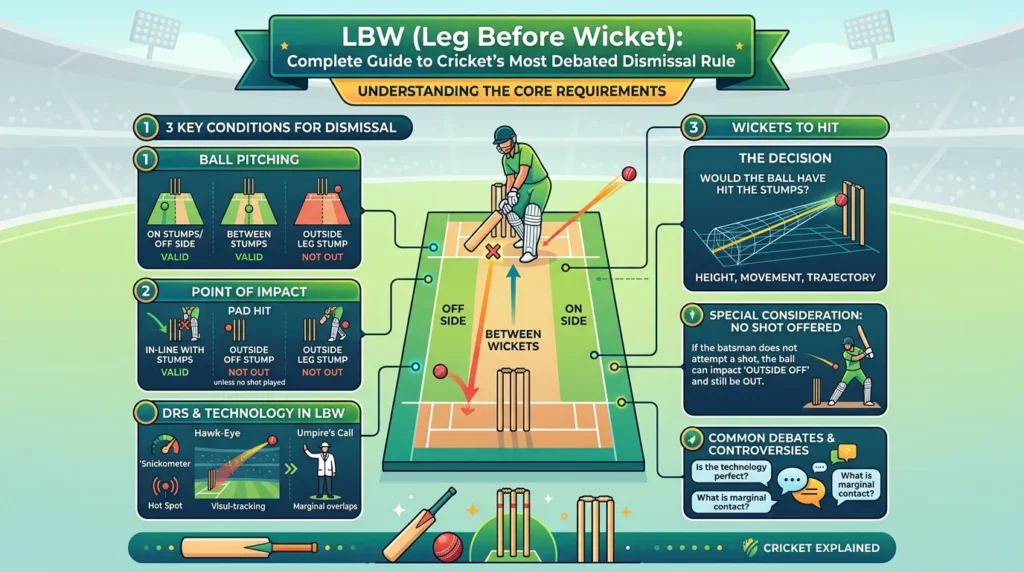
For a batsman to be given out LBW, several conditions must be met.
Condition 1: The Ball Must Be Legal
The delivery must not be a no-ball.
If the bowler oversteps the crease and bowls a no-ball, the batsman cannot be dismissed LBW.
Condition 2: The Ball Must Hit the Body First
The ball must strike the batter’s body before touching the bat.
If the ball hits the bat first and then the pad, LBW cannot be given.
Condition 3: Pitching Requirements
The ball must not pitch outside the leg stump.
If it pitches outside the leg stump, the batsman cannot be out LBW.
Condition 4: Impact Point
The ball must strike the batter in line with the stumps or under specific circumstances when attempting a shot.
Condition 5: Ball Path
The umpire must believe the ball would have continued to hit the stumps if the batter’s body had not blocked it.
Only when all these conditions are met can the umpire give the batsman out.
Understanding the Umpire’s Decision
LBW decisions require careful judgment.
Factors Considered by Umpires
Umpires evaluate:
- Where the ball pitched
- Where it struck the batter
- Whether the batter offered a shot
- The expected path of the ball
- Whether the ball would hit the stumps
Challenges for Umpires
The decision often happens within seconds. Umpires must make accurate judgments despite variations in speed, swing, spin, bounce, and angle.
This is why LBW remains one of cricket’s most difficult decisions.
Decision Review System (DRS) and LBW
Modern cricket uses technology to help review LBW decisions.
What Is DRS?
The Decision Review System allows players to challenge an umpire’s decision.
Technology assists officials by providing detailed analysis.
Ball Tracking Technology
Ball-tracking systems estimate:
- Pitching location
- Impact point
- Future ball trajectory
This helps determine whether the ball would have hit the stumps.
Umpire’s Call
Sometimes the technology shows a very close decision. In such cases, the original umpire’s ruling may remain because of the “Umpire’s Call” rule.
Bowling Strategies to Earn LBW Dismissals
Many bowlers specifically target LBW wickets.
Fast Bowlers
Fast bowlers often aim for:
- Full-length deliveries
- Yorkers
- Balls that swing into the batsman
These deliveries increase the chance of hitting the pads directly in front of the stumps.
Spin Bowlers
Spin bowlers use:
- Turn
- Drift
- Variation in flight
Spinners frequently trap batsmen LBW by making the ball change direction after pitching.
Accuracy Is Key
The most successful LBW bowlers consistently attack the stumps and maintain accurate line and length.
Batting Techniques to Avoid LBW
Good batsmen learn techniques to reduce LBW risks.
Playing Straight
Keeping the bat close to the body helps ensure contact with the ball before it reaches the pads.
Good Footwork
Moving the feet correctly allows the batter to get into a better position.
Reading the Bowler
Experienced batsmen carefully watch the bowler’s hand and release point.
Using the Bat Effectively
Defensive shots played with a straight bat can significantly reduce LBW chances.
Player Roles and LBW
Every player on the field has a role in an LBW appeal.
Bowler
The bowler aims to deliver a ball that satisfies LBW conditions.
Wicketkeeper
The wicketkeeper often provides valuable input during LBW appeals.
Fielders
Close fielders frequently appeal alongside the bowler.
Umpire
The umpire makes the final decision unless a review is requested.
Equipment Used in Cricket and Its Connection to LBW
Several pieces of equipment are relevant to LBW situations.
Bat
The bat is the primary defense against LBW.
Batting Pads
Pads protect the legs from injury but can also become the point of impact in an LBW dismissal.
Cricket Ball
The ball’s speed, seam movement, swing, and spin influence LBW decisions.
Protective Gear
Players also wear gloves, helmets, thigh guards, and abdominal protection for safety.
Major Cricket Competitions Where LBW Plays a Key Role
LBW decisions influence matches at every level.
ICC Cricket World Cup
Many famous World Cup matches have featured crucial LBW decisions.
ICC Champions Trophy
Top international teams often rely on LBW dismissals to break partnerships.
ICC World Test Championship
LBW is especially important in Test cricket because bowlers have more time to build pressure.
T20 World Cup
In fast-paced T20 cricket, a single LBW decision can completely change a match.
Domestic Leagues
Competitions around the world regularly feature game-changing LBW dismissals.
Benefits of Understanding the LBW Rule
Learning the LBW rule provides several benefits.
Better Match Understanding
Fans can follow umpire decisions more accurately.
Improved Playing Skills
Players can improve both batting and bowling techniques.
Enhanced Coaching
Coaches can teach proper tactics and game awareness.
Greater Appreciation of Cricket
Understanding LBW helps people appreciate the complexity of the sport.
Interesting Facts About LBW
One of Cricket’s Oldest Laws
LBW has been part of cricket for more than 250 years.
Most Debated Dismissal
Few cricket laws generate as much discussion as LBW.
Technology Revolutionized Decisions
DRS has significantly improved LBW accuracy.
Spinners Love LBW
Many spin bowlers use flight and turn specifically to trap batsmen LBW.
Match-Changing Impact
A single LBW decision can alter the outcome of an entire match.
Common Misconceptions About LBW
Myth: Any Ball Hitting the Pad Is Out
This is false. Multiple conditions must be satisfied.
Myth: Pitching Outside Leg Stump Can Be LBW
A batsman cannot be out LBW if the ball pitches outside leg stump.
Myth: DRS Always Changes Decisions
DRS may confirm the original umpire’s ruling.
Conclusion
LBW (Leg Before Wicket) is one of cricket’s most important and fascinating dismissal methods. Created to prevent batsmen from unfairly blocking the ball with their legs, the rule has evolved into a detailed and highly technical part of the game. Umpires must consider where the ball pitched, where it struck the batter, and whether it would have gone on to hit the stumps before making a decision.
Modern technology through DRS has improved accuracy, but LBW remains one of the sport’s most discussed topics. Bowlers use skill, precision, swing, and spin to create LBW opportunities, while batsmen rely on technique, footwork, and concentration to avoid them. Understanding LBW helps players improve their performance and allows fans to enjoy cricket on a deeper level.
Whether watching a World Cup final, a Test match, or a local game, knowledge of the LBW rule makes cricket more exciting and enjoyable. It remains a perfect example of the strategy, skill, and complexity that make cricket one of the world’s most loved sports.