
Have you ever looked at a sentence and wondered which word carries the main action? The answer is often the main verb. Main verbs are the words that give a sentence its central meaning. They tell us what a person or thing does, feels, thinks, or is.
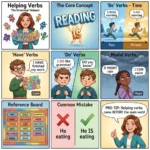
People search for “Main Verb” because it can be easy to confuse a main verb with a helping verb. For example, in the sentence “She is reading a book,” is is a helping verb, while reading is the main verb. In “They have finished the work,” have helps the sentence, while finished gives the main action.
Understanding main verbs is important for students, English learners, teachers, and anyone who wants to write better sentences. Once you know how to find the main verb, many grammar rules become easier.
In this guide, you will learn the meaning, types, examples, spelling differences, common mistakes, everyday uses, and frequently asked questions about main verbs.
Main Verb – Quick Answer
A main verb is the verb that gives the main meaning or action in a sentence.
It can show:
- An action
- A feeling
- A thought
- A state
- An event
Examples
Sarah writes every day.
Writes is the main verb because it tells us what Sarah does.
Ali is studying English.
Here:
- is = helping verb
- studying = main verb
They have completed the project.
Here:
- have = helping verb
- completed = main verb
Simple Definition
Main verb = the verb that carries the main meaning of a sentence.
A sentence can have a helping verb, but the main verb usually tells us what the subject actually does or experiences.
The Origin of Main Verb
The term main verb combines two common English words: main and verb.
The word verb comes from the Latin verbum, meaning “word.” It entered English through French and became a standard grammar term.
The word main comes from Old English and related Germanic forms. It developed meanings connected with something that is chief, principal, or most important.
Together, main verb means the principal verb in a verb phrase.
English grammar developed over many centuries. As English sentence structures became more complex, grammar terms were created to explain the different roles of verbs.
For example:
She is working.
The verb phrase has two parts:
- is = helping verb
- working = main verb
The main verb carries the central action.
The spelling main verb is the same in British and American English. There is no standard British spelling such as maine verb or another American form.
British English vs American English Spelling
The phrase main verb is spelled exactly the same in British and American English.
The difference appears in some verb forms, not in the phrase itself.
| Verb | British English | American English |
|---|---|---|
| Main verb | main verb | main verb |
| Travel | travelled | traveled |
| Cancel | cancelled | canceled |
| Label | labelled | labeled |
| Dial | dialled | dialed |
| Learn | learnt / learned | learned |
| Burn | burnt / burned | burned |
Example
British English:
She has travelled to London.
American English:
She has traveled to New York.
In both examples, travelled/traveled is the main verb.
The helping verb has does not change.
Important Point
There is no different spelling of “main verb” in British and American English.
The phrase remains:
main verb
Which Spelling Should You Use?
Since main verb has the same spelling in both English varieties, there is no spelling choice to make for this phrase.
However, when using specific verbs, follow the spelling style of your audience.
For US Readers
Use American English forms such as:
- traveled
- canceled
- labeled
Example:
The technician traveled to the factory.
For UK Readers
Use British English forms such as:
- travelled
- cancelled
- labelled
Example:
The technician travelled to the factory.
For Commonwealth Readers
British-style spelling is often suitable for readers in countries such as Australia and New Zealand, although local style guides may differ.
For Global Websites
Pick one English style and use it consistently.
Avoid mixing:
The engineer travelled to the site and canceled the test.
Instead, use either:
The engineer travelled to the site and cancelled the test.
or:
The engineer traveled to the site and canceled the test.
Common Mistakes with Main Verb
Main verbs are simple, but learners often confuse them with helping verbs.
Mistake 1: Calling the Helping Verb the Main Verb
Sentence:
She is reading a book.
Incorrect:
Is is the main verb.
Correct:
Reading is the main verb.
Is is helping the main verb reading.
Mistake 2: Thinking Every Verb Is a Main Verb
A sentence can contain more than one verb, but not every verb has the same role.
Example:
He has finished his work.
- has = helping verb
- finished = main verb
Mistake 3: Using the Wrong Main Verb Form
Incorrect:
She is write a letter.
Correct:
She is writing a letter.
After is in this continuous structure, the main verb uses the -ing form.
Mistake 4: Incorrect Subject-Verb Agreement
Incorrect:
He work every day.
Correct:
He works every day.
The main verb must agree with the subject in the present tense.
Mistake 5: Confusing Nouns and Main Verbs
Consider:
The driver drives the car.
- driver = noun
- drives = main verb
The noun names the person, while the verb tells us what the person does.
Mistake 6: Leaving Out the Main Verb
Incorrect:
She is very happy and her brother very tired.
Correct:
She is very happy, and her brother is very tired.
The second part needs the verb is.
Main Verb in Everyday Examples
Main verbs are used in almost every type of English communication.
In Emails
I attached the requested document.
Attached is the main verb.
Another example:
We need more information.
Need is the main verb.
In News
The company opened a new factory.
Opened is the main verb.
The team won the match.
Won is the main verb.
On Social Media
I love this picture.
Love is the main verb.
We visited the museum yesterday.
Visited is the main verb.
In Formal Writing
The engineer examined the electrical system.
Examined is the main verb.
The researchers developed a new method.
Developed is the main verb.
In Daily Conversation
I need help.
She works here.
They play football.
We watched a movie.
Each sentence contains a main verb that carries the central meaning.
Main Verb – Google Trends & Usage Data
The keyword “main verb” has educational search intent. People commonly search for it while learning English grammar or studying parts of speech.
Searchers may look for:
- Main verb meaning
- Main verb examples
- Main verb definition
- Main verb and helping verb
- Main verb examples in sentences
- What is a main verb?
- Main verb vs auxiliary verb
The keyword can attract searches from countries where English is taught in schools and language programs. This includes countries such as India, Pakistan, the United States, the United Kingdom, Canada, Australia, and other English-learning markets.
Search interest can change during school terms, examination periods, and grammar lessons.
Because “main verb” is mainly an informational keyword, users usually want a quick definition first. They then need examples and a comparison with helping verbs.
For SEO, content should answer the main question early and then cover related searches naturally.
Exact search-volume and country rankings change over time, so current figures should be checked in a live Google Trends or keyword research tool.
Main Verb Variations Comparison Table
| Term | Meaning | Example |
|---|---|---|
| Main verb | Gives the main meaning | She runs. |
| Helping verb | Supports the main verb | She is running. |
| Action verb | Shows an action | He jumps. |
| Linking verb | Connects the subject with information | She is happy. |
| Regular verb | Usually forms past tense with -ed | walk → walked |
| Irregular verb | Changes form in another way | go → went |
| Transitive verb | Takes an object | She opened the door. |
| Intransitive verb | Does not need a direct object | The baby slept. |
| Modal verb | Shows ability, possibility, or duty | You can swim. |
| Phrasal verb | Verb combined with another word | Please turn off the light. |
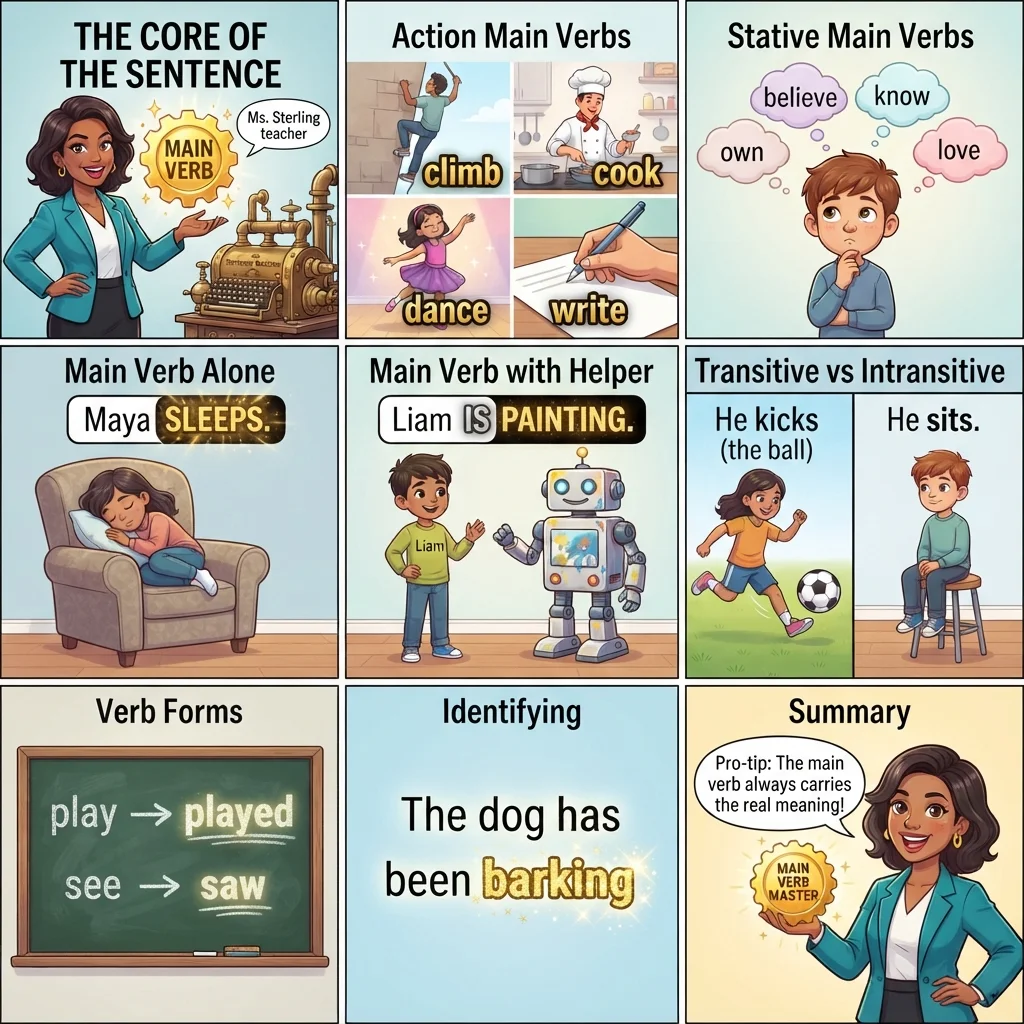
Types of Main Verbs
Main verbs can appear in several forms and categories.
Action Main Verbs
These show physical or mental actions.
Examples:
- run
- write
- eat
- think
- read
- build
- speak
Example:
The student writes an answer.
Linking Main Verbs
Some verbs connect the subject with information about it.
Examples include forms of be and verbs such as:
- seem
- become
- appear
- feel
- look
Example:
The machine seems broken.
Here, seems is the main verb.
Transitive Main Verbs
A transitive verb normally takes a direct object.
She opened the door.
- Main verb: opened
- Object: door
Intransitive Main Verbs
An intransitive verb does not require a direct object.
The baby slept.
Slept is the main verb, and there is no direct object.
Main Verb vs Helping Verb
This is one of the most important grammar differences.
| Feature | Main Verb | Helping Verb |
|---|---|---|
| Main role | Gives central meaning | Supports the main verb |
| Shows action/state | Usually | Sometimes |
| Can appear alone | Often | Sometimes |
| Example | running | is |
| Example sentence | She is running | She is running |
Consider:
They will play football.
- will = helping verb
- play = main verb
The word play gives the main action.
FAQs About Main Verb
What is a main verb?
A main verb is the verb that gives the central meaning of a sentence. It can show an action, state, feeling, thought, or event.
What is an example of a main verb?
Examples include run, eat, write, think, work, sleep, play, and learn.
What is the difference between a main verb and a helping verb?
A main verb gives the main meaning, while a helping verb supports it.
Example:
She is reading.
Is is the helping verb, and reading is the main verb.
Can “is” be a main verb?
Yes. Is can be a main verb when it works as the main linking verb.
Example:
She is happy.
Here, is is the main verb.
Can a sentence have two main verbs?
Yes. A sentence can have two or more main verbs when it contains multiple actions or clauses.
Example:
Tom washed the car and cleaned the garage.
Washed and cleaned are main verbs.
What is the main verb in “She is running”?
The main verb is running. Is is the helping verb.
How can I find the main verb?
First, find the verb or verb group. Then identify the word that carries the main action or state.
Example:
They have completed the work.
Completed is the main verb, while have is the helping verb.
Conclusion
A main verb is the central verb in a sentence. It gives the sentence its main meaning and can show an action, state, feeling, thought, or event. Examples include run, write, work, eat, think, and learn.
Main verbs are often used with helping verbs. In “She is reading,” is helps the main verb reading. In “They have finished,” have helps the main verb finished. Learning to separate these two roles makes English grammar much easier.
The phrase main verb has the same spelling in British and American English. Some individual verb forms may differ, such as travelled and traveled, so writers should choose the spelling style that matches their audience.
To master main verbs, practice finding them in simple sentences. Learn how they work with helping verbs, subjects, objects, and different tenses. With regular practice, you can identify main verbs quickly and use them with confidence in emails, schoolwork, professional writing, and everyday conversation.