Cricket is one of the world’s most popular sports, played and watched by millions of fans around the world. While spectators usually focus on batting, bowling, and fielding, the markings on the cricket pitch are equally important. Among these markings, the cricket crease plays a major role in determining player positions, dismissals, legal deliveries, and important umpiring decisions.
If you have ever wondered what is the crease in cricket, it is a marked line or set of lines on the pitch that provides important reference points for batters, bowlers, wicketkeepers, and umpires. Different creases have different purposes, and their dimensions are defined by the Laws of Cricket.
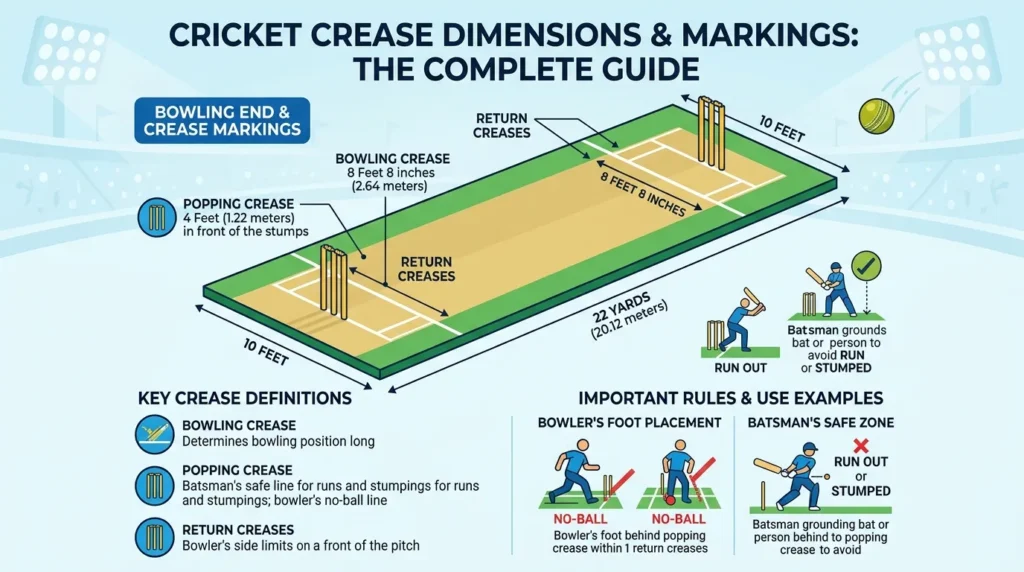
There are three main types of crease in cricket: the bowling crease, popping crease, and return crease. Together, these markings help umpires determine whether a batter is safely inside their ground, whether a bowler has delivered the ball legally, and whether dismissals such as run-outs and stumpings can occur.
Understanding the cricket crease is useful for players, coaches, students, and cricket fans. A small difference in a batter’s position or a bowler’s foot placement can affect the outcome of a delivery. This is why crease markings must be measured and maintained accurately on a cricket pitch.
This complete guide explains cricket crease dimensions, types of creases, official measurements, markings, rules, player strategies, and their importance in modern cricket.
What Is the Crease in Cricket?
A crease in cricket is a line or set of marked lines on the pitch that defines important positions for batters and bowlers. Creases are used as reference points for determining whether a batter is safely inside their ground, whether a bowler has delivered a legal ball, and whether a dismissal can occur.
The main cricket crease markings around each wicket include:
- Bowling crease
- Popping crease
- Return crease
Each crease has a specific position and purpose.
The popping crease is especially important for batters because it helps determine whether they are safely inside their ground. The bowling crease marks the position of the wicket, while the return crease helps determine the legal position of the bowler’s feet during delivery.
The crease in cricket is used when making decisions involving:
- Run-outs
- Stumpings
- Front-foot no-balls
- Bowler foot placement
- Batter’s safe ground
In simple terms, the cricket crease provides fixed reference lines that help players and officials apply the Laws of Cricket consistently.
History of Cricket Crease Markings
Early Cricket Grounds
In the early development of cricket, pitch markings were not always as standardized as they are today. Different grounds could use different methods for marking important areas of the pitch.
As the sport became more organized, standard measurements became increasingly important. Players and officials needed clearly defined reference points for determining wickets, batting positions, and legal deliveries.
Standardization of Cricket Laws
The Marylebone Cricket Club (MCC) played a major role in developing and maintaining the Laws of Cricket. Standard dimensions for the pitch and crease markings helped make the game more consistent between different grounds.
Modern Cricket Regulations
Modern professional cricket follows standardized pitch and crease measurements. These standards are used in international and domestic cricket, including:
- Test cricket
- One Day Internationals
- T20 Internationals
- Domestic competitions
- Major professional leagues
Although playing conditions can differ between grounds, the fundamental crease dimensions remain standardized.
Understanding the Cricket Pitch Layout
Before looking at individual crease dimensions, it helps to understand the basic layout of the cricket pitch.
Cricket Pitch Length
A standard cricket pitch measures:
- 22 yards
- 20.12 meters
- 66 feet
This is the distance between the two sets of wickets.
Cricket Pitch Width
The pitch is generally:
- 10 feet wide
- 3.05 meters wide
The crease markings are positioned around each wicket according to the Laws of Cricket.
Bowling Crease Dimensions
What Is the Bowling Crease?
The bowling crease is the line that passes through the three stumps at each end of the pitch. It marks the position of the wicket and provides a key reference point for the other crease markings.
Bowling Crease Length
The official bowling crease is:
- 8 feet 8 inches
- 2.64 meters
The three stumps are positioned along the bowling crease.
The wicket consists of:
- Three stumps
- Two bails
Importance of the Bowling Crease
The bowling crease is important because it:
- Identifies the position of the wicket
- Provides a reference for the popping crease
- Helps establish the pitch layout
- Assists umpires when judging bowling and wicket positions
The bowling crease should be clearly visible throughout a match so that players and umpires can easily identify the wicket area.
Popping Crease Dimensions
What Is the Popping Crease?
The popping crease is one of the most important markings on a cricket pitch. It is located in front of the bowling crease and is mainly used to determine whether a batter is inside their ground.
The popping crease is particularly important during:
- Run-outs
- Stumpings
- Running between wickets
- Some no-ball situations
Cricket Popping Crease Length
The popping crease is marked 4 feet (1.22 meters) in front of and parallel to the bowling crease.
Its marked length is at least 12 feet (3.66 meters). It is extended beyond the return creases so that the line is clearly visible and provides a useful reference for players and officials.
Therefore, when people search for cricket popping crease length, the key measurement to remember is a minimum of 12 feet.
Importance of the Popping Crease
The popping crease helps determine whether a batter is safely inside their ground.
For example, during a run-out, the batter must have their bat or person grounded behind the popping crease to be considered safe. If the wicket is fairly put down while the batter is out of their ground, the batter can be dismissed.
Popping Crease and Stumping
The popping crease is also important for stumpings. If a batter leaves the crease to play a delivery and fails to regain their ground before the wicket is fairly put down, they may be stumped if the conditions of the dismissal are satisfied.
Return Crease Dimensions
What Is the Return Crease in Cricket?
The return crease in cricket consists of two lines at each end of the pitch that run at right angles to the bowling crease.
These lines are especially important for determining the bowler’s legal foot position during delivery.
The return creases run parallel to the sides of the pitch and create the area within which the bowler’s back foot must remain.
Return Crease Measurement
Each return crease is positioned 4 feet 4 inches (1.32 meters) from the center stump.
The return crease is marked at least:
- 8 feet behind the popping crease
It also extends in front of the bowling crease and provides a reference for the bowler’s back-foot position.
Why Is the Return Crease Important?
The return crease helps umpires determine whether a bowler’s delivery is legal.
A bowler can be called for a no-ball if the back foot lands outside the return crease during delivery.
This makes the return crease in cricket particularly important for fast bowlers and other bowlers who use a long or aggressive delivery stride.
Complete Cricket Crease Dimensions Table
| Crease or Measurement | Official Dimension |
|---|---|
| Cricket pitch length | 22 yards (20.12 m) |
| Pitch width | 10 ft (3.05 m) |
| Bowling crease | 8 ft 8 in (2.64 m) |
| Bowling to popping crease distance | 4 ft (1.22 m) |
| Popping crease length | Minimum 12 ft (3.66 m) |
| Return crease from center stump | 4 ft 4 in (1.32 m) |
| Return crease behind popping crease | At least 8 ft |
These measurements form the basic framework of cricket crease dimensions used in organized cricket.
Crease to Crease Distance in Cricket
One common question is what is the crease to crease distance in cricket?
The answer depends on which creases are being compared.
The distance between the bowling crease and popping crease is 4 feet (1.22 meters).
This measurement is the same at both ends of a standard cricket pitch.
It is important not to confuse this measurement with the total pitch length. The pitch itself is 22 yards long from one wicket to the other, while the popping crease is positioned 4 feet in front of each bowling crease.
Understanding this difference makes the cricket pitch layout much easier to visualize.
Crease Length in Cricket
The term crease length in cricket can refer to different crease markings, so it is important to identify which crease is being discussed.
The main measurements are:
- Bowling crease: 8 feet 8 inches
- Popping crease: minimum 12 feet
- Return crease: positioned 4 feet 4 inches from the center stump
The popping crease extends beyond the return creases, while the return creases run at right angles to the bowling crease.
Cricket Crease Markings and Layout
Accurate cricket crease markings are essential because players and umpires rely on them throughout the match.
The markings should be:
- Straight
- Clearly visible
- Correctly positioned
- Properly measured
- Maintained throughout the game
The bowling crease is placed through the stumps. The popping crease is marked parallel to it, 4 feet in front. The return creases are marked at right angles to the bowling crease.
Together, these lines create the basic wicket and batter’s ground area.
Why Cricket Crease Dimensions Are Important
Ensuring Fair Play
Standard crease dimensions ensure that players compete under consistent conditions.
Assisting Umpires
Umpires use the crease markings to make important decisions about run-outs, stumpings, and no-balls.
Helping Batters
Batters need to understand their position in relation to the popping crease when running between wickets or attempting aggressive shots.
Helping Bowlers
Bowlers must maintain legal foot placement in relation to the popping and return creases.
Maintaining Consistency
Standardized measurements allow cricket to be played consistently across different countries, grounds, and competitions.
Cricket Rules Related to the Crease
Run-Out Rule
A batter can be run out when their wicket is fairly put down while they are out of their ground and the conditions for a run-out are satisfied.
The popping crease is the main reference point for determining whether the batter is inside their ground.
Stumping Rule
A batter can be stumped when they are out of their ground and the wicketkeeper fairly puts down the wicket, subject to the conditions of the dismissal.
The popping crease therefore plays an important role in stumping decisions.
Front-Foot No-Ball
The popping crease is also used as a reference when judging a bowler’s front-foot position.
For a legal delivery, some part of the bowler’s front foot must be behind the back edge of the popping crease when it lands.
If the front foot is completely beyond the permitted line, the delivery can be called a no-ball.
Return Crease Violation
The return crease is used to judge the bowler’s back-foot position.
A bowler can deliver a no-ball if the back foot lands outside the return crease during delivery.
This is why bowlers must carefully control their foot placement.
Batting Strategies Involving the Crease
Using the Crease Against Fast Bowlers
Batters sometimes move deeper inside their ground to create more time to react to fast deliveries.
Advancing Down the Pitch
A batter may move forward beyond the popping crease to attack a bowler, particularly against spin bowling.
However, moving down the pitch also increases the risk of being stumped.
Creating Angles
Batters can move across the crease to change the angle of the ball and create different scoring opportunities.
Staying Aware During Running
Crease awareness is extremely important when running between wickets. A batter must make sure their bat or person is grounded behind the popping crease when completing a run.
Bowling Strategies Related to the Crease
Changing Delivery Angles
Bowlers can alter their position at the crease to change the angle from which the ball reaches the batter.
Creating Movement
Seam and swing bowlers may use different positions on the crease to create different angles and lines.
Using the Crease Against Batters
Spin bowlers can also vary their position on the crease to create different angles and make it harder for batters to predict the delivery.
Maintaining Legal Foot Placement
Regardless of bowling style, bowlers must ensure their feet remain within the legal areas defined by the crease markings.
Player Roles and Their Use of the Crease
Batters
Batters use the crease to:
- Remain safely inside their ground
- Complete runs
- Avoid run-outs
- Attack bowlers
- Create different shot angles
Bowlers
Bowlers use the crease to:
- Deliver legal balls
- Change delivery angles
- Generate movement
- Vary their bowling position
Wicketkeepers
Wicketkeepers closely watch the batter’s position in relation to the popping crease, especially when attempting a stumping.
Umpires
Umpires monitor crease positions to make decisions about:
- No-balls
- Run-outs
- Stumpings
- Batter’s ground
Equipment Used for Marking Cricket Creases
Measuring Tape
Ground staff use accurate measuring equipment to establish the correct dimensions.
Marking String
String can be used to create straight and properly aligned lines during pitch preparation.
White Marking Paint
Visible marking material is used to make the creases easy to see during a match.
Pitch Maintenance Equipment
Ground staff maintain the playing surface and repaint or refresh markings when necessary.
Clear markings are especially important for close run-out and no-ball decisions.
Cricket Formats and Crease Usage
Test Cricket
Crease awareness remains important throughout long Test matches because batters and bowlers repeatedly use the same pitch markings for tactical purposes.
One Day Internationals
In ODIs, batters frequently use the crease to manipulate bowling angles and field placements.
T20 Cricket
T20 cricket often involves aggressive movement around the crease. Batters may move forward, backward, or across the crease to create scoring opportunities.
Domestic Cricket
Professional domestic competitions also follow the standardized Laws of Cricket and use the same fundamental crease dimensions.
Major Tournaments That Follow Standard Cricket Crease Dimensions
ICC Cricket World Cup
World Cup matches use standardized cricket pitch and crease measurements.
ICC T20 World Cup
T20 World Cup matches also use the standard crease layout at each end of the pitch.
ICC World Test Championship
International Test cricket follows the applicable Laws and playing conditions governing crease dimensions.
Indian Premier League
The IPL uses standard professional cricket pitch and crease measurements.
Other Major Leagues
Professional competitions such as:
- Big Bash League
- Pakistan Super League
- Caribbean Premier League
- SA20
also use standardized cricket pitch dimensions and crease markings.
Common Questions About Cricket Creases
What Is the Crease in Cricket?
The crease in cricket is a set of marked lines on the pitch that provides reference points for batters, bowlers, wicketkeepers, and umpires. The main creases are the bowling crease, popping crease, and return crease.
What Is a Cricket Crease Used For?
A cricket crease is used to determine important positions during play. It helps officials judge whether batters are inside their ground and whether bowlers have delivered the ball legally.
What Is the Return Crease in Cricket?
The return crease in cricket consists of lines running at right angles to the bowling crease. It is mainly used to determine whether the bowler’s back foot is in a legal position during delivery.
How Long Is the Bowling Crease?
The bowling crease measures 8 feet 8 inches (2.64 meters) and runs through the three stumps.
How Long Is the Popping Crease?
The popping crease is marked 4 feet (1.22 meters) in front of the bowling crease and has a minimum marked length of 12 feet (3.66 meters).
What Is the Crease to Crease Distance in Cricket?
The distance from the bowling crease to the popping crease is 4 feet (1.22 meters). This measurement applies at both ends of a standard cricket pitch.
Why Are Cricket Crease Markings Important?
Cricket crease markings provide clear reference points for players and umpires. They are essential for decisions involving run-outs, stumpings, no-balls, and legal bowling positions.
Interesting Facts About Cricket Crease Dimensions
The Popping Crease Has a Major Role in Dismissals
The popping crease is involved in many important decisions involving batters, especially run-outs and stumpings.
Creases Affect Bowling Legality
The bowler’s foot position in relation to the popping and return creases can determine whether a delivery is legal.
Crease Markings Are Standardized
Professional cricket uses standardized pitch and crease measurements to maintain consistency.
Technology Relies on Clear Crease Positions
Television replays and decision-making technologies often use the crease as a visual reference when reviewing close calls.
Creases Are Important at Every Level
From international cricket to local club matches, properly marked creases help players and umpires understand the playing area.
Common Mistakes Related to Cricket Creases
Confusing the Popping and Bowling Crease
The bowling crease passes through the stumps, while the popping crease is located 4 feet in front of it.
Misunderstanding the Return Crease
The return crease runs at right angles to the bowling crease and is important for judging the bowler’s back foot.
Overstepping the Popping Crease
A bowler can be called for a front-foot no-ball when the front foot lands completely beyond the permitted position relative to the popping crease.
Losing Awareness While Running
Batters can be dismissed if they fail to make their ground before the wicket is fairly put down.
Incorrect Ground Markings
Poorly measured or unclear crease markings can make important decisions more difficult.
Benefits of Understanding Cricket Crease Dimensions
Although crease dimensions are technical parts of cricket, understanding them can improve both knowledge and performance.
Better Batting Awareness
Batters can make better decisions when they understand exactly where their ground begins.
Improved Bowling Control
Bowlers can work on their run-up and delivery stride while keeping their feet within the legal areas.
Better Understanding of Umpiring Decisions
Fans and players can more easily understand why an umpire gives a batter out or calls a no-ball.
Improved Cricket Knowledge
Learning the crease layout provides a stronger understanding of the Laws of Cricket and how the pitch is used during a match.
What Are Cricket Creases?
A cricket crease is a line marked on the pitch near the stumps that serves as a reference point for batters, bowlers, and umpires.
These lines help determine:
- Safe zones for batters
- Legal bowling positions
- Run-out decisions
- Stumping decisions
- No-ball rulings
Each end of a cricket pitch contains three important crease markings:
- Bowling Crease
- Popping Crease
- Return Crease
Together, these markings form the foundation of many cricket laws.
History of Cricket Crease Markings
Early Cricket Grounds
In the early years of cricket, pitch markings were less standardized than they are today. Different grounds often used slightly different measurements.
Standardization of Cricket Laws
As cricket became more organized, governing bodies introduced standardized pitch and crease dimensions to ensure fairness.
The MCC eventually established official measurements that are now followed worldwide.
Modern Cricket Regulations
Today, all international and professional matches use identical crease dimensions, ensuring consistency across formats including:
- Test Cricket
- One Day Internationals (ODIs)
- T20 Internationals
- Domestic competitions
Understanding the Cricket Pitch Layout
Before discussing crease dimensions, it is important to understand the overall pitch structure.
Cricket Pitch Length
The standard cricket pitch measures:
- 22 yards
- 20.12 meters
- 66 feet
This distance is measured between the two sets of stumps.
Pitch Width
The pitch is approximately:
- 10 feet wide
- 3.05 meters
All crease markings are placed within this area according to official cricket laws.
Bowling Crease Dimensions
What Is the Bowling Crease?
The bowling crease is the line on which the stumps are positioned.
It runs horizontally across the pitch.
Official Bowling Crease Measurement
The bowling crease measures:
- 8 feet 8 inches
- 2.64 meters
This length includes the space occupied by the three stumps.
Position of the Stumps
The stumps are placed centrally on the bowling crease.
Each wicket consists of:
- Three stumps
- Two bails
Importance of the Bowling Crease
The bowling crease serves several important functions:
- Indicates wicket position
- Acts as a reference point for other creases
- Helps umpires judge bowling actions
Popping Crease Dimensions
What Is the Popping Crease?
The popping crease is the most frequently referenced crease during a cricket match.
Batters must reach this line to complete runs and avoid run-outs.
Official Popping Crease Measurement
The popping crease is located:
- 4 feet (1.22 meters) in front of the bowling crease
Its marked length is:
- Minimum 12 feet (3.66 meters)
However, it is usually extended beyond the return creases for visibility.
Importance of the Popping Crease
The popping crease determines:
- Safe ground for batters
- Run-out decisions
- Stumping decisions
- No-ball judgments
Safe Ground Rule
A batter is considered safe when:
- The bat is grounded behind the popping crease
- Part of the body is behind the crease
If not, the batter may be run out or stumped.
Return Crease Dimensions
What Is the Return Crease?
The return crease consists of two vertical lines positioned perpendicular to the bowling crease.
These lines define the area within which a bowler must deliver the ball.
Official Return Crease Measurement
Each return crease is positioned:
- 4 feet 4 inches (1.32 meters) from the center stump
The lines extend:
- At least 8 feet behind the popping crease
- At least 4 feet in front of the bowling crease
Purpose of the Return Crease
The return crease helps determine:
- Legal bowling action
- Foot placement during delivery
- No-ball decisions
Complete Cricket Crease Dimensions Table
| Crease Type | Measurement |
|---|---|
| Bowling Crease | 8 ft 8 in (2.64 m) |
| Distance from Bowling to Popping Crease | 4 ft (1.22 m) |
| Popping Crease Length | Minimum 12 ft (3.66 m) |
| Return Crease Distance from Center Stump | 4 ft 4 in (1.32 m) |
| Cricket Pitch Length | 22 yards (20.12 m) |
These dimensions are standardized worldwide.
Why Cricket Crease Dimensions Are Important
Ensuring Fair Play
Standard crease measurements ensure every match is played under identical conditions.
Assisting Umpires
Creases provide clear reference points for decision-making.
Supporting Player Safety
Proper markings help players understand boundaries and positions.
Maintaining Consistency
Uniform dimensions allow cricket to be played consistently across all countries.
Cricket Rules Related to the Crease
Run-Out Rule
A batter can be run out if:
- The wicket is broken legally
- The batter has not reached the popping crease
Stumping Rule
A wicketkeeper can stump a batter if:
- The batter leaves the crease
- The wicket is broken before returning
No-Ball Rule
A bowler commits a front-foot no-ball when:
- The front foot lands beyond the popping crease
Return Crease Violation
A no-ball may also occur if:
- The bowler’s back foot touches outside the return crease
Batting Strategies Involving the Crease
Using the Crease Against Fast Bowlers
Batters often move deeper into the crease to gain additional reaction time.
Advancing Down the Pitch
Players sometimes step outside the crease to attack bowlers aggressively.
Creating Angles
Batters can move across the crease to:
- Access different scoring areas
- Disrupt bowling lines
Avoiding Run-Outs
Awareness of crease position helps batters complete runs safely.
Bowling Strategies Related to the Crease
Changing Delivery Angles
Bowlers use different positions within the return crease to alter angles.
Creating Variations
Movement across the crease can help:
- Swing bowlers
- Seam bowlers
- Spin bowlers
Deceiving Batters
Different crease positions can create uncertainty for batters.
Maximizing Accuracy
Maintaining proper foot placement ensures legal deliveries.
Player Roles and Their Use of the Crease
Batters
Batters rely on crease awareness to:
- Score runs safely
- Avoid dismissals
- Create scoring opportunities
Bowlers
Bowlers use crease dimensions to:
- Deliver legal balls
- Generate movement
- Change angles
Wicketkeepers
Wicketkeepers closely monitor batters leaving their crease.
Umpires
Umpires constantly observe crease positions to make accurate decisions.
Equipment Used for Marking Cricket Creases
Measuring Tape
Ground staff use measuring tapes to ensure accurate dimensions.
Marking String
String helps maintain straight lines during pitch preparation.
White Marking Paint
Special paint is used to create visible crease markings.
Pitch Rollers and Maintenance Tools
Ground staff prepare the surface before applying crease lines.
Proper maintenance ensures crease visibility throughout the match.
Cricket Formats and Crease Usage
Test Cricket
Crease awareness is vital because matches last up to five days.
One Day Internationals
Batters frequently use the crease to manipulate field placements.
T20 Cricket
Aggressive batting often involves moving outside the crease.
Domestic Cricket
All professional domestic competitions follow official crease dimensions.
Major Tournaments That Follow Standard Cricket Crease Dimensions
ICC Cricket World Cup
All World Cup matches use standard ICC-approved crease measurements.
ICC T20 World Cup
Crease dimensions remain identical regardless of venue.
ICC World Test Championship
International Test matches strictly follow MCC laws.
Indian Premier League (IPL)
The IPL uses official international cricket dimensions.
Other Major Leagues
- Big Bash League
- Pakistan Super League
- Caribbean Premier League
- SA20 League
All use the same standardized crease measurements.
Benefits of Playing Cricket
Although crease dimensions are technical aspects of the game, understanding them contributes to better performance and enjoyment.
Physical Benefits
Cricket improves:
- Fitness
- Coordination
- Agility
- Strength
- Reflexes
Mental Benefits
Cricket enhances:
- Decision-making
- Concentration
- Strategic thinking
- Discipline
Social Benefits
Players develop:
- Teamwork
- Leadership
- Communication skills
Interesting Facts About Cricket Crease Dimensions
The Popping Crease Is Older Than Many Cricket Laws
The popping crease has existed in some form for centuries.
Creases Influence Many Dismissals
Run-outs, stumpings, and no-balls all depend on crease markings.
Technology Uses Crease Measurements
Modern systems like television replays rely heavily on crease positions.
Every International Ground Uses Identical Dimensions
Regardless of country or stadium, crease measurements remain the same.
Millions of Decisions Depend on Creases
Umpires reference crease lines countless times during a cricket season.
Common Mistakes Related to Cricket Creases
Overstepping the Popping Crease
Fast bowlers frequently concede no-balls by overstepping.
Losing Awareness While Running
Batters sometimes fail to ground their bat behind the crease.
Incorrect Ground Markings
Poorly marked creases can create confusion and controversy.
Misjudging Safe Ground
Players occasionally believe they are safe when they are actually short of the crease.
Conclusion
Cricket crease dimensions are among the most important measurements in the game. The bowling crease, popping crease, and return crease provide essential reference points for players and umpires. These markings influence numerous aspects of cricket, including run-outs, stumpings, no-balls, and legal deliveries.
Standardized by the MCC and followed by the ICC, cricket crease dimensions ensure fairness and consistency across all formats of the sport. Whether you are a player, coach, student, or fan, understanding these measurements enhances your appreciation of cricket and helps you better understand match situations.
From international tournaments to local club matches, crease dimensions remain a fundamental part of cricket’s structure and rules, making them an essential topic for anyone interested in the game.

Green Benn is a dedicated sports writer specializing in cricket, including IPL and international formats. Known for clear, engaging, and informative content, Green simplifies complex match analysis and player statistics for all readers. Passionate about sports storytelling, Green delivers reliable, SEO-friendly articles that keep fans updated and informed