Cricket is one of the most popular sports in the world, known for its unique playing conditions and large playing area. One of the most important aspects of the game is the cricket ground size, which directly affects how the game is played, scored, and strategized.
Unlike many other sports, cricket grounds are not of a fixed size or shape. This makes every ground slightly different, adding variety and excitement to the game. Understanding cricket ground size helps players, fans, and beginners better appreciate how matches unfold.
In this detailed guide, we will explore everything about cricket ground size, including dimensions, layout, rules, strategies, and its impact on gameplay.
What Is Cricket Ground Size? Dimensions, Layout, and Field Structure Explained
A cricket ground is the complete playing area used for a cricket match, including the central pitch, 30-yard inner circle, outfield, and boundary line.No, every cricket ground does not have exactly the same overall size. The cricket playground size can vary depending on the stadium layout, available land, boundary distances, and ground design. Some venues have shorter square boundaries and longer straight boundaries, while others have a larger and more evenly shaped outfield. However, international grounds must still follow the relevant playing-condition requirements for safe and fair competition. Its overall size can vary from one venue to another because cricket grounds do not have one fixed outer dimension. The pitch itself has standardized measurements, while the boundary and outfield can differ depending on the stadium’s design and available space.
Unlike many other sports, cricket does not require every ground to have identical dimensions. While the pitch has fixed measurements, the overall size and shape of the ground can vary from one stadium to another, provided they meet the guidelines set by the International Cricket Council (ICC).
Main Parts of a Cricket Ground
A standard cricket ground is made up of the following key areas:
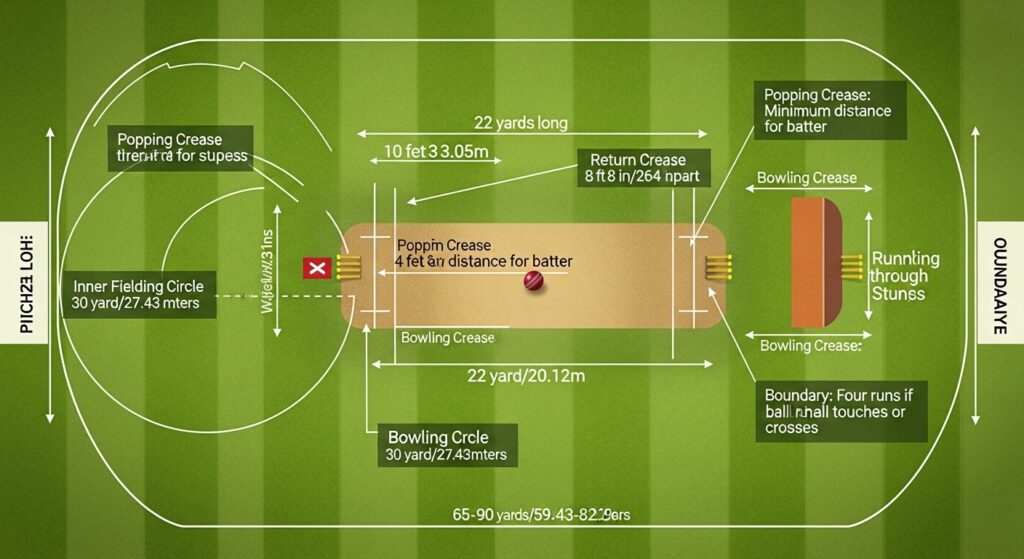
- Central Pitch: A 22-yard (20.12-meter) strip where the batting and bowling take place.
- 30-Yard Circle (Inner Circle): A marked circle around the pitch used mainly for fielding restrictions in limited-overs matches.
- Outfield: The grassy area between the inner circle and the boundary where fielders chase the ball and prevent runs.
- Boundary Line: The outer edge of the playing field, marked by a rope, painted line, or boundary fence. A ball reaching or crossing this line scores four or six runs, depending on whether it touches the ground first.
Together, these areas form the complete cricket ground and create the playing environment for domestic and international matches.
Standard Shape of a Cricket Ground
Most cricket grounds are oval or nearly circular in shape. The cricket field shape can vary from one venue to another, with some grounds being circular, elliptical, or slightly irregular depending on the available land and stadium design. This design provides enough space for fielders to position themselves effectively while allowing batsmen to play shots in every direction.
Common ground shapes include:
- Oval
- Circular
- Slightly elliptical
- Irregular oval (depending on the stadium’s available land)
Unlike sports such as football or tennis, cricket does not require every ground to have exactly the same shape. The size and boundary distances can vary from venue to venue.
Does Every Cricket Ground Have the Same Size?
No. One of the unique features of cricket is that ground sizes are not completely standardized. The dimensions of the playing field may differ because of stadium design, surrounding infrastructure, and available space.
For example:
- Some stadiums have short square boundaries but longer straight boundaries.
- Others have large outfields, making it harder for batsmen to score boundaries.
- Historic cricket grounds often have irregular shapes due to the way they were originally constructed.
However, international venues must still comply with the ICC’s recommended boundary measurements to ensure fair and competitive play.
Why Is Cricket Ground Size Important?
The size of a cricket ground has a significant impact on how the game is played. Larger grounds generally favor bowlers and fielders because clearing the boundary requires more power, while smaller grounds often benefit batsmen by making boundaries easier to score.
Ground size also influences:
- Batting strategy and shot selection
- Bowling tactics and field placements
- Running between the wickets
- Number of boundaries scored
- Overall pace and excitement of the match
Understanding cricket ground size helps players, coaches, and fans appreciate how different venues can affect match conditions and playing strategies.
Official Cricket Ground Dimensions: ICC Standard Measurements Explained
Although cricket grounds can differ in overall size and shape, the International Cricket Council (ICC) provides standard guidelines to ensure that matches are played fairly and consistently. While the central pitch has fixed dimensions, the overall cricket field dimensions and boundary distances may vary within an approved range depending on the stadium’s design, available space, and ground layout.
The cricket ground length is not fixed in the same way as the cricket pitch. The length of cricket ground can vary from one venue to another because boundary distances depend on the stadium layout, available playing area, and ground design. Some grounds have shorter boundaries, while others provide a larger outfield, creating different conditions for batting, bowling, and fielding.
Official Boundary Dimensions
The boundary is the outer edge of the cricket field, usually marked by a boundary rope, painted line, or fence. If the ball reaches or crosses this line, the batting team scores four runs if the ball touches the ground first, or six runs if it crosses the boundary on the full.
ICC Recommended Boundary Size
The cricket boundary size can vary from one ground to another within the permitted playing conditions. Boundary distances are measured from the center of the pitch, and the size of the boundary can have a direct effect on batting, bowling, fielding positions, and scoring patterns.
- Minimum boundary distance: 59.43 meters (65 yards) from the center of the pitch.
- Maximum boundary distance: 82.29 meters (90 yards) from the center of the pitch.
The cricket boundary length varies between grounds because the distance from the pitch to the boundary is not identical at every venue. Boundary length can affect how easily batters score fours and sixes, while also influencing bowling plans and fielding positions.
These measurements help create a balanced contest between batsmen and bowlers while maintaining player safety and exciting gameplay.
Why Do Boundary Sizes Vary?
Unlike the cricket pitch, boundary dimensions are not identical at every stadium. The size of the playing field often depends on:
- Stadium design and architecture
- Available land and surrounding infrastructure
- Safety requirements
- Historical ground layouts
- Venue-specific playing conditions
As a result, some grounds have shorter square boundaries, while others feature longer straight boundaries or larger outfields. These differences can significantly influence batting tactics, bowling strategies, and field placements.
Standard Cricket Pitch Dimensions
The cricket pitch is the most important part of the playing field. It is the narrow rectangular strip located at the center of the ground where all batting, bowling, and wicket-taking action takes place.
Unlike the boundary, the pitch has fixed dimensions that remain the same for every professional, domestic, and international cricket match.
Official Pitch Measurements
The standard cricket pitch measures:
- Length: 20.12 meters (22 yards)
- Width: 3.05 meters (10 feet)
These measurements have remained unchanged for many years and are used in all formats of the game, including Test matches, One Day Internationals (ODIs), and Twenty20 (T20) cricket.
Why Is the Pitch Size Fixed?
A uniform pitch size ensures fairness across all levels of cricket. Regardless of where a match is played, players compete under the same basic conditions for batting and bowling.
The standardized pitch dimensions help maintain:
- Consistent bowling distances
- Fair batting conditions
- Accurate umpiring decisions
- Uniform playing standards worldwide
- Equal competition in domestic and international matches
Although the condition of the pitch—such as its hardness, grass cover, moisture, and cracks—may differ from one venue to another, its official length and width always remain the same, ensuring consistency throughout the sport.
Inner Circle (30-Yard Circle)
This circle is important for fielding restrictions in limited-overs cricket.
Key Details
- Radius: 27.43 meters (30 yards)
- Used during powerplays
- Controls fielding positions
Cricket Ground Layout Explained: Key Areas of the Playing Field
.A cricket ground is divided into several important areas that together form the complete playing field. Understanding the cricket ground dimensions helps explain how the pitch, 30-yard circle, outfield, and boundary work together during a match. While the pitch has fixed measurements, the overall ground and boundary distances can vary from one venue to another.
Pitch Area
The pitch is the most important part of a cricket ground. It is a rectangular strip located at the exact center of the field where every ball is bowled and every innings begins.
The pitch contains the wickets at both ends and is the area where batsmen face deliveries, score runs, and bowlers attempt to take wickets. Because it directly affects bounce, pace, and spin, the condition of the pitch can greatly influence the outcome of a match.
Key Features of the Pitch:
- Located at the center of the cricket ground
- Measures 22 yards (20.12 meters) in length
- Contains a set of wickets at each end
- Used for batting, bowling, and running between the wickets
- Has fixed dimensions in every format of cricket
The pitch is often considered the heart of the cricket field because every delivery starts from this area.
Infield (30-Yard Circle)
The infield is the area surrounding the pitch and extending to the 30-yard circle. This section is especially important in One Day Internationals (ODIs) and T20 matches, where fielding restrictions apply during different stages of the innings.
Fielders positioned inside the circle are responsible for stopping quick singles, preventing easy boundaries, and creating run-out opportunities.
Main Characteristics of the Infield:
- Surrounds the central pitch
- Enclosed by the 30-yard circle
- Used for close and attacking fielding positions
- Plays a major role during powerplays
- Helps bowlers apply pressure by restricting easy runs
Common fielding positions found in the infield include cover, point, mid-off, mid-on, square leg, and short fine leg.
Outfield
The outfield is the large grassy area between the 30-yard circle and the boundary line. It covers most of the cricket ground and is where fielders chase the ball after powerful shots played by the batsmen.
A smooth and well-maintained outfield allows the ball to travel quickly, making boundaries more likely. Conversely, a slower outfield can reduce the speed of the ball and make it easier for fielders to stop it.
Features of the Outfield:
- Located outside the 30-yard circle
- Covered with carefully maintained natural grass
- Provides space for deep fielding positions
- Helps fielders save boundaries and stop fours and sixes
- Influences how fast the ball travels across the ground
Deep fielders are commonly positioned in the outfield at locations such as long-on, long-off, deep midwicket, deep square leg, deep cover, and third man.
Boundary Line
The boundary line marks the outer limit of the playing field. It is usually indicated by a boundary rope, painted line, advertising cushions, or a low fence surrounding the ground.
The boundary determines whether a shot scores four runs or six runs.
- If the ball touches the ground before crossing the boundary, the batting team scores four runs.
- If the ball clears the boundary without touching the ground, the batting team scores six runs.
Key Features of the Boundary Line:
- Marks the edge of the cricket field
- Usually identified by a rope or painted line
- Determines boundary scores
- Varies in distance from one stadium to another within ICC guidelines
- Plays a major role in batting and fielding strategies
The size and shape of the boundary can significantly affect scoring patterns, with shorter boundaries generally favoring batsmen and larger grounds providing more opportunities for fielders to prevent boundaries.
Why Understanding the Ground Layout Matters
Knowing the layout of a cricket ground helps players make better tactical decisions during a match. Bowlers adjust their line and length based on field placements, batsmen choose their shots according to boundary distances, and captains position fielders strategically to limit scoring opportunities.
Whether you are a beginner learning the game or an experienced cricket enthusiast, understanding the pitch, infield, outfield, and boundary line provides a solid foundation for appreciating how cricket is played at every level.
History of Cricket Ground Sizes
History and Evolution of Cricket Ground Size
Cricket grounds have changed significantly over the centuries. From simple open fields used in the early days of the game to today’s world-class stadiums, the design, layout, and dimensions of cricket grounds have evolved alongside the sport itself. Although the cricket pitch has always maintained standard measurements, the overall size and design of the ground have become more organized and carefully regulated over time.
Early Cricket Grounds
In the early history of cricket, matches were played on natural grass fields, village commons, and open meadows rather than purpose-built stadiums. There were very few official rules regarding the size or shape of the playing area.
As a result, every ground looked different, and playing conditions varied from one location to another.
Characteristics of early cricket grounds included:
- Natural grass fields with uneven surfaces.
- No standard boundary distances or field dimensions.
- Boundaries marked by trees, fences, hedges, or other natural landmarks.
- Irregularly shaped playing areas depending on the available land.
- Minimal seating and facilities for players and spectators.
These differences often influenced the style of play, with some grounds favoring batsmen and others providing an advantage to bowlers.
Evolution of Cricket Ground Design
As cricket grew into an organized international sport during the 18th and 19th centuries, governing bodies introduced standardized laws and recommendations to improve fairness and consistency.
Dedicated cricket stadiums began replacing open fields, and greater attention was given to field design and maintenance.
Major developments included:
- Standardization of the 22-yard cricket pitch.
- Introduction of recommended boundary distances.
- Better drainage and high-quality grass surfaces.
- Clearly marked fielding circles and boundary ropes.
- Purpose-built stadiums with spectator seating, pavilions, and practice facilities.
- Improved ground maintenance using modern equipment and turf management techniques.
These improvements created safer playing conditions and provided a more consistent experience for players at every level of the game.
Modern Cricket Grounds
Today’s cricket grounds combine traditional playing standards with modern technology. International stadiums are designed to meet the requirements of the International Cricket Council (ICC) while also offering world-class facilities for players, officials, broadcasters, and spectators.
Modern cricket grounds typically feature:
- ICC-compliant pitch and boundary measurements.
- Advanced laser and GPS technology for accurate field measurements.
- High-quality drainage and irrigation systems.
- Well-maintained outfields for faster and safer play.
- LED floodlights for day-night matches.
- Large seating capacities, digital scoreboards, and broadcast infrastructure.
- Adjustable boundary ropes that can be repositioned for different formats or venue requirements while remaining within ICC guidelines.
Today, every international cricket stadium is carefully designed to balance player safety, competitive fairness, and an enjoyable viewing experience. Although the overall shape and boundary size of cricket grounds may still vary, modern standards ensure that every venue provides a professional and consistent environment for the game.
Rules Related to Cricket Ground Size: ICC Boundary, Fielding, and Safety Regulations
The size of a cricket ground is more than just a measurement—it directly affects how the game is played. The International Cricket Council (ICC) has established rules regarding boundary distances, fielding restrictions, and player safety to ensure fair competition across all levels of cricket. While the overall dimensions of cricket grounds may vary, these regulations help maintain consistency in domestic and international matches.
Boundary Rules
The boundary marks the outer limit of the playing field and plays an important role in scoring. It is usually indicated by a boundary rope, painted line, advertising cushions, or a low fence.
When the ball reaches the boundary, the batting team is automatically awarded runs based on how the ball crosses the line.
Scoring Rules for Boundaries
- A ball that touches the ground before reaching or crossing the boundary scores four runs.
- A ball that clears the boundary without touching the ground scores six runs.
- If a fielder touches the boundary while in contact with the ball, the batting side is awarded the appropriate boundary runs.
- The ball remains in play until it completely reaches or crosses the boundary line.
Because boundary distances differ between stadiums, players often adjust their batting and bowling strategies according to the size of the ground.
Fielding Restrictions
Cricket also includes fielding restrictions, particularly in limited-overs formats such as One Day Internationals (ODIs) and T20 cricket. These rules are designed to encourage attacking cricket and create a fair balance between bat and ball.
The restrictions are based on the 30-yard (27.4-meter) inner circle, which surrounds the central pitch.
Key Fielding Rules
- During specific overs, only a limited number of fielders are allowed outside the 30-yard circle.
- The remaining fielders must stay inside the circle until the restrictions are lifted.
- Captains must carefully position their fielders to comply with these regulations.
- Fielding restrictions vary depending on the format of the match and the stage of the innings, such as the Powerplay in ODIs and T20s.
These rules encourage aggressive batting, create more scoring opportunities, and make limited-overs cricket more exciting for spectators.
Player Safety Regulations
Player safety is a major consideration when determining the size and layout of a cricket ground. Modern stadiums are designed to provide enough playing space while reducing the risk of injuries.
The ICC recommends appropriate boundary distances so that fielders have sufficient room to run, dive, and complete catches without colliding with fences, advertising boards, or spectators.
Important safety measures include:
- Maintaining recommended minimum boundary distances.
- Providing adequate space between the boundary rope and perimeter fencing.
- Using soft boundary cushions or advertising boards to reduce the impact of collisions.
- Keeping the outfield level, well-maintained, and free from hazards.
- Ensuring safe run-off areas for fielders chasing the ball at high speed.
These regulations help protect players while maintaining the quality and fairness of the game.
Why These Rules Matter
The rules related to cricket ground size ensure that every match is played under safe and competitive conditions. Standardized boundary guidelines, fielding restrictions, and safety measures create a balanced contest between batsmen and bowlers while allowing players to perform at their best.
Whether it’s a local club match or an international tournament, these regulations contribute to fair play, exciting cricket, and a safer environment for everyone on the field.
How Cricket Ground Size Affects Gameplay, Strategy, and Match Outcomes
The size of a cricket ground has a significant influence on the way the game is played. Although the basic rules of cricket remain the same, the dimensions of the playing field can affect batting, bowling, fielding, scoring rates, and overall team strategy. Players and captains often adjust their tactics based on whether they are playing on a small, medium, or large ground.
A smaller ground generally favors aggressive batting, while a larger ground gives bowlers and fielders more opportunities to control the game. Understanding how ground size impacts gameplay helps explain why teams adopt different strategies at different venues.
Batting Advantage on Different Ground Sizes
The size of the boundary has a direct effect on a batter’s scoring opportunities. On grounds with shorter boundaries, powerful shots are more likely to reach the rope, making it easier to score fours and sixes. Conversely, larger grounds require greater power, better timing, and smarter shot placement.
On smaller cricket grounds, batters often benefit from:
- Easier boundary scoring.
- More sixes from mistimed shots.
- Higher run rates in limited-overs matches.
- Greater confidence to play attacking strokes.
On larger cricket grounds, batters need to:
- Generate more power to clear the boundary.
- Focus on precise timing and placement.
- Rotate the strike by running quick singles and doubles.
- Build partnerships instead of relying only on big hits.
As a result, batting strategies often change depending on the dimensions of the ground.
Bowling Strategy Based on Ground Size
Bowlers carefully adapt their plans according to the size of the playing field. Since smaller grounds make boundary scoring easier, bowlers must rely on accuracy, variation, and intelligent tactics to restrict runs.
Common bowling adjustments include:
- Bowling fuller or wider deliveries to reduce scoring opportunities.
- Using slower balls, cutters, and yorkers on smaller grounds.
- Changing pace and line to force mistimed shots.
- Targeting larger boundary areas to encourage risky strokes.
- Working closely with the captain to set effective field placements.
On larger grounds, bowlers have a greater margin for error because batters need more power to clear the boundary, allowing bowlers to attack with greater confidence.
Fielding Strategy and Captaincy
Ground size also has a major impact on field placements and the captain’s tactical decisions. Before every match, captains study the boundary dimensions to determine the most effective positions for their fielders.
Fielding strategies may include:
- Placing boundary riders where batters are most likely to hit.
- Positioning close-catching fielders when conditions favor bowlers.
- Adjusting the field to protect shorter boundaries.
- Using deeper fielders on larger grounds to save extra runs.
- Rotating fielders based on the strengths and weaknesses of individual batters.
On grounds with uneven boundary lengths, captains often protect the shorter side while encouraging bowlers to make batters hit toward the longer boundary.
Influence on Match Scoring and Tactics
Ground dimensions can significantly affect the overall scoring pattern of a match.
For example:
- Smaller grounds often produce high-scoring matches with more fours and sixes.
- Larger grounds usually reward smart running between the wickets, resulting in more singles, doubles, and triples.
- Teams may choose different batting or bowling tactics after assessing the ground size before the match begins.
- Captains often consider boundary dimensions when deciding whether to bat or bowl first.
This is why teams spend time analyzing the venue before every game, as the size of the ground can influence both individual performances and the final result.
Why Ground Size Matters in Modern Cricket
Whether it is a Test match, One Day International (ODI), or T20 game, the size of the cricket ground plays a crucial role in shaping the contest between bat and ball. It influences scoring opportunities, bowling plans, fielding positions, and overall team strategy.
Players, coaches, and analysts carefully study ground dimensions before every match because understanding the venue can provide a valuable tactical advantage and improve a team’s chances of success.
Best Cricket Strategies Based on Ground Size
Successful cricket teams do not rely only on skill—they also adapt their tactics to the size of the ground. Before every match, captains, coaches, and players carefully study the boundary dimensions, pitch conditions, and outfield to develop strategies that maximize their strengths and exploit the opposition’s weaknesses.
Whether playing on a small, medium, or large cricket ground, adjusting batting, bowling, and fielding plans can make a significant difference to the final result.
Batting Strategies for Different Ground Sizes
A batter’s approach should vary depending on the size of the playing field. While smaller grounds encourage attacking cricket, larger grounds reward patience, placement, and intelligent running between the wickets.
Batting on Small Cricket Grounds
On grounds with shorter boundaries, batters can play more aggressively because even mistimed shots have a better chance of reaching the boundary.
Effective strategies include:
- Play attacking strokes from the start.
- Target short boundaries with lofted shots.
- Take advantage of the Powerplay to score quickly.
- Use powerful shots such as pulls, hooks, and straight drives.
- Put pressure on bowlers by maintaining a high scoring rate.
Since boundaries are easier to hit, teams often aim for bigger totals on smaller grounds.
Batting on Large Cricket Grounds
On larger grounds, simply hitting the ball hard is not always enough. Batters must rely on timing, placement, and fitness to build an innings.
Successful tactics include:
- Rotate the strike with quick singles and doubles.
- Place shots into open gaps rather than always targeting the boundary.
- Build partnerships through consistent scoring.
- Wait for loose deliveries before attempting big shots.
- Convert singles into doubles whenever possible.
Smart running between the wickets becomes just as important as boundary hitting on larger grounds.
Bowling Strategies According to Ground Size
Bowlers must adjust their plans based on the dimensions of the cricket ground. Understanding where batters are likely to target boundaries helps bowlers choose the right line, length, and variations.
Bowling on Small Grounds
Since shorter boundaries increase the risk of conceding fours and sixes, bowlers should focus on accuracy and deception.
Recommended strategies include:
- Bowl yorkers to limit scoring opportunities.
- Use slower balls and change of pace to disrupt timing.
- Avoid predictable deliveries in the batter’s hitting zone.
- Mix bouncers with fuller deliveries to create uncertainty.
- Force batters to hit toward the longer side of the ground whenever possible.
Variation is often the key to success on smaller grounds.
Bowling on Large Grounds
Larger boundaries allow bowlers to attack with greater confidence because batters need extra power to clear the rope.
Effective tactics include:
- Maintain tight and consistent line and length.
- Encourage batters to play aerial shots toward the longer boundaries.
- Build pressure by bowling dot balls.
- Use attacking field settings to create wicket-taking chances.
- Exploit the extra outfield space to force catches in the deep.
Large grounds often reward disciplined bowling and patient game plans.
Fielding Strategies Based on Ground Size
Field placement is another area where ground dimensions have a major impact. Captains constantly adjust their field based on the size of the boundaries, the batter’s strengths, and the match situation.
Fielding on Small Grounds
On grounds with short boundaries, preventing fours and sixes becomes the priority.
Common fielding strategies include:
- Position fielders along the boundary rope.
- Protect the shortest boundary first.
- Place strong catchers in likely hitting zones.
- Cut off powerful drives and pull shots.
- Encourage batters to hit toward the longer side of the field.
Quick reactions and athletic fielding are especially valuable on compact grounds.
Fielding on Large Grounds
Larger grounds provide more space for fielders to save runs and create wicket-taking opportunities.
Captains often:
- Spread fielders to cover wider areas.
- Place deep fielders where catches are most likely.
- Protect gaps to reduce doubles and triples.
- Use aggressive infield positions when bowlers are building pressure.
- Rotate fielders according to the batter’s scoring areas.
Strong communication and teamwork become increasingly important because fielders must cover larger distances.
Why Teams Adapt Their Strategies
Every cricket venue presents unique challenges. Professional teams spend time analyzing ground dimensions before each match because even small differences in boundary size can influence batting plans, bowling tactics, and field placements.
By adapting their strategies to the size of the cricket ground, teams can:
- Maximize scoring opportunities.
- Reduce unnecessary boundaries.
- Improve bowling efficiency.
- Save valuable runs in the field.
- Increase their chances of winning close matches.
Understanding how ground size affects strategy is one of the key factors that separates successful teams from their opponents at every level of cricket.
How Cricket Ground Size Affects Player Roles and Performance
The size of a cricket ground influences the responsibilities of every player on the field. Whether it is a batter looking for boundaries, a bowler trying to restrict runs, or a fielder covering the outfield, each player must adapt their approach according to the ground’s dimensions.
Professional teams carefully study the size and layout of a venue before a match because it helps them develop effective tactics and assign fielding positions. Understanding how ground size affects each player’s role is essential for success in all formats of cricket.
Batsmen
For batters, ground size plays a major role in shot selection, scoring opportunities, and overall batting strategy. Smaller grounds encourage aggressive stroke play, while larger grounds require patience, precision, and intelligent placement.
On different-sized grounds, batters often:
- Adjust their shot selection based on the boundary distance.
- Play lofted shots more confidently on smaller grounds.
- Focus on timing rather than power on larger grounds.
- Target gaps in the field to score singles, doubles, and triples.
- Rotate the strike to keep the scoreboard moving.
- Assess the shorter and longer boundaries before attacking.
Experienced batters quickly identify the easiest scoring areas and modify their game plan to suit the conditions.
Bowlers
Bowlers must carefully adapt their tactics according to the dimensions of the cricket ground. A delivery that is safe on a large ground could easily be hit for six on a smaller one, making accuracy and planning extremely important.
Successful bowlers typically:
- Plan their line and length based on the size of the boundaries.
- Use yorkers, slower balls, and variations to limit big shots.
- Encourage batters to hit toward the longer side of the ground.
- Avoid predictable deliveries that can be easily attacked.
- Work closely with the captain to match bowling plans with field placements.
- Change tactics depending on the batter’s strengths and the venue.
By understanding the ground dimensions, bowlers can reduce scoring opportunities and increase their chances of taking wickets.
Fielders
Fielders are directly affected by the size of the cricket ground because they are responsible for covering large areas and preventing boundaries. On bigger grounds, fielders must run longer distances, while on smaller grounds they need quick reactions to stop powerful shots.
Key responsibilities include:
- Covering more ground on larger fields.
- Preventing fours and sixes by cutting off boundary shots.
- Supporting bowlers with accurate throws and quick returns.
- Taking catches near the boundary without touching the rope.
- Communicating effectively with teammates to avoid fielding errors.
- Maintaining excellent fitness, speed, agility, and endurance throughout the match.
Athletic fielders can save valuable runs and create wicket-taking opportunities, making them an essential part of any successful team.
Teamwork and Tactical Awareness
Although batters, bowlers, and fielders have different responsibilities, they must work together to adapt to the size of the cricket ground. Captains adjust field placements, bowlers execute specific plans, and batters modify their scoring approach based on the venue.
By understanding how ground dimensions influence each role, teams can make smarter tactical decisions, improve overall performance, and gain a competitive advantage during every match.
Cricket Ground Equipment and Technology
The quality of a cricket match depends not only on the players but also on the equipment and technology used to prepare and manage the ground. From maintaining the pitch to making accurate umpiring decisions, every piece of equipment plays an important role in ensuring a fair, safe, and professional game.
Essential Cricket Ground Equipment
Every cricket ground requires a range of equipment for pitch preparation, field maintenance, and match operations.
Boundary Rope
The boundary rope marks the outer edge of the playing field. If the ball touches or crosses the rope after being hit by the batter, it is awarded four or six runs, depending on how it reaches the boundary.
Stumps and Bails
Three wooden stumps and two bails are placed at each end of the pitch. They are essential for dismissals such as bowled, run-out, and stumped, and must meet official cricket regulations.
Pitch Covers
Pitch covers protect the playing surface from rain, excessive sunlight, and moisture. Keeping the pitch dry helps maintain consistent bounce and playing conditions throughout the match.
Grass Maintenance Equipment
Ground staff use specialized tools to maintain the outfield and pitch, including:
- Lawn mowers for even grass cutting
- Rollers to compact the pitch
- Water sprinklers for controlled irrigation
- Pitch brushes and rakes for surface preparation
- Line-marking machines for accurate field markings
Proper maintenance ensures player safety and high-quality playing conditions.
Modern Technology Used on Cricket Grounds
Technology has transformed cricket by improving accuracy, fairness, and ground management.
Boundary Measurement Systems
Laser measuring devices and digital surveying equipment help groundskeepers set boundary ropes at the correct distance according to tournament regulations.
Decision Review Cameras
Multiple high-definition cameras are positioned around the stadium to assist third umpires in reviewing close decisions involving boundaries, catches, run-outs, and stumpings.
Drones for Ground Inspection
Many stadiums now use drones to capture aerial images of the ground. These help with:
- Ground inspections
- Boundary planning
- Drainage assessment
- Event preparation
- Stadium promotions and broadcasting
Advanced Pitch Monitoring
Modern cricket venues may also use moisture meters, soil sensors, and weather monitoring systems to analyze pitch conditions before and during matches. These tools help groundskeepers prepare surfaces that meet international standards.
Famous Cricket Grounds and Their Sizes
Cricket stadiums can vary considerably in size, layout, and boundary distances. Understanding cricket stadium dimensions helps explain why some venues have shorter boundaries and smaller playing areas, while others provide a much larger outfield. These differences can influence batting, bowling, fielding, and overall match strategy.
| Cricket Ground | Approximate Boundary Size | Playing Characteristics |
|---|---|---|
| Melbourne Cricket Ground (MCG) | Very Large | Favors endurance, fielding, and strategic batting |
| Eden Gardens | Medium | Balanced conditions for batters and bowlers |
| Sharjah Cricket Stadium | Relatively Small | Known for shorter boundaries and high-scoring games |
| Lord’s Cricket Ground | Medium to Large | Traditional ground with varied boundary lengths |
| Narendra Modi Stadium | Large | Offers spacious outfield and strategic gameplay |
Because no international standard requires every cricket ground to have identical dimensions, each venue creates unique tactical challenges.
Cricket Ground Size in Different Match Formats
Cricket grounds used for international matches can vary in their overall size, shape, and boundary distances. The international ground size depends on the venue’s available space and layout, while the central pitch remains standardized. These differences can affect scoring, fielding positions, bowling tactics, and the way teams approach matches in different formats.
Test Cricket
Test matches are usually played on larger grounds where players must rely on patience, fitness, and long-term strategy. Larger boundaries make aggressive stroke play more challenging and reward disciplined bowling and fielding.
One Day Internationals (ODIs)
ODI matches generally feature balanced boundary sizes that provide equal opportunities for both batting and bowling teams. Captains often adjust field placements based on the dimensions of each venue.
T20 Cricket
T20 cricket often uses shorter boundaries to encourage attacking batting and produce entertaining, high-scoring matches. However, many international stadiums still maintain larger boundaries depending on their natural layout.
Advantages of Playing on Different Ground Sizes
Physical Benefits
Playing on grounds of varying sizes helps players:
- Improve endurance and stamina
- Increase running speed between wickets
- Build agility and athleticism
- Develop stronger fielding skills
Tactical and Mental Benefits
Different-sized grounds challenge players to:
- Adapt batting techniques
- Plan smarter bowling strategies
- Improve field placement decisions
- Read match situations more effectively
- Build confidence in different playing conditions
Interesting Facts About Cricket Ground Dimensions
- Every international cricket ground has its own unique boundary measurements.
- Boundary ropes may be adjusted slightly for broadcasting requirements or player safety while remaining within the Laws of Cricket.
- High-altitude stadiums allow the ball to travel farther because of thinner air.
- Wind direction, humidity, and weather conditions can significantly influence ball movement and scoring patterns.
- Larger outfields often result in more catches and fewer boundaries.
Common Mistakes Players Make on Different Ground Sizes
Players often struggle when they fail to adjust their game according to the venue. Common mistakes include:
- Misjudging boundary distances
- Choosing poor field placements
- Attempting unnecessary big shots on large grounds
- Running slowly between wickets
- Ignoring wind direction and pitch conditions
- Using the same strategy regardless of venue size
Learning to adapt quickly can greatly improve overall performance.
Tips for Beginners
If you are new to cricket, understanding ground dimensions can improve your game.
- Study the basic layout of a cricket ground.
- Observe boundary distances before each match.
- Learn how different venues influence batting and bowling.
- Watch professional players adjust their strategies.
- Practice both power hitting and placement shots.
- Improve fitness to perform well on larger grounds.
How Cricket Ground Size Influences Match Results
Ground size has a major impact on scoring patterns and team strategies.
- Smaller grounds usually produce higher scores because boundaries are easier to clear.
- Larger grounds reward accurate bowling, athletic fielding, and smart running between wickets.
- Captains modify field placements based on boundary dimensions.
- Batters choose different shot selections depending on the size of the playing area.
- Bowlers vary their line and length to reduce scoring opportunities.
- Teams often select different playing combinations based on the characteristics of each venue.
Conclusion
Cricket ground size is a key factor that influences every aspect of the game. From batting and bowling to fielding and strategy, the size and shape of the ground play a major role in match outcomes.
While the pitch remains standard, the boundary dimensions and overall field size vary, making each cricket ground unique. Understanding these differences helps players perform better and allows fans to enjoy the game more deeply.
Whether you are a beginner or an experienced cricket enthusiast, learning about cricket ground size will enhance your knowledge and appreciation of this exciting sport.

Green Benn is a dedicated sports writer specializing in cricket, including IPL and international formats. Known for clear, engaging, and informative content, Green simplifies complex match analysis and player statistics for all readers. Passionate about sports storytelling, Green delivers reliable, SEO-friendly articles that keep fans updated and informed