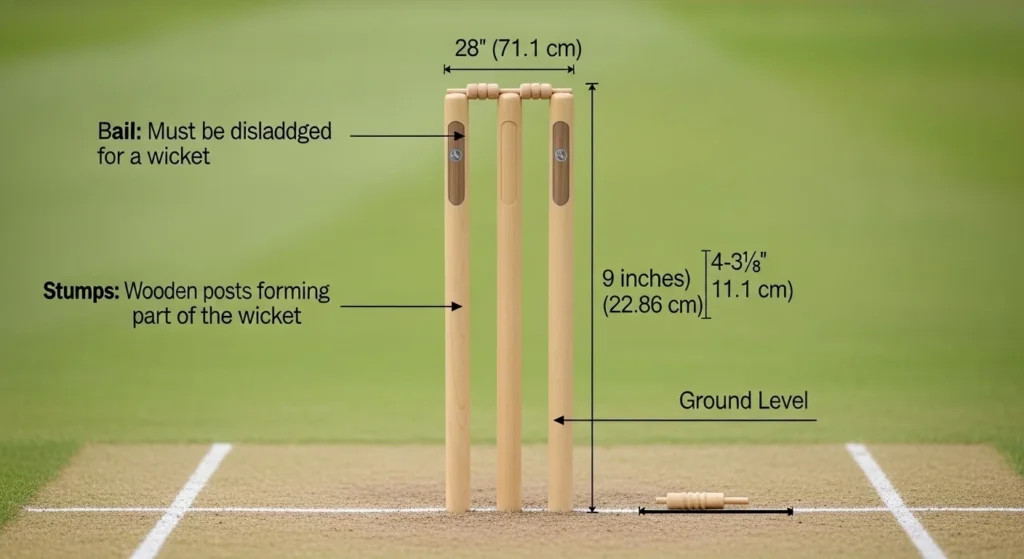

When you search for cricket stump height, the first thing you need to know is that standard cricket stumps are 28 inches (71.1 cm) tall. A complete cricket wicket has three stumps and two bails, with the three stumps forming a wicket that is 9 inches (22.86 cm) wide.
The size of the stumps is not just a technical measurement. It provides a consistent target for bowlers, a fixed wicket for batters to protect, and an important reference point for umpires when judging dismissals. The same standard dimensions are used in major forms of cricket, including Test matches, ODIs, and T20 cricket, subject to the applicable playing conditions.
Many cricket fans, students, players, and beginners search for how tall cricket stumps are, their measurements in inches, centimeters, and feet, and whether stump dimensions change between different formats. Understanding these measurements also makes it easier to learn how wickets, bails, and related cricket rules work.
In this guide, you will learn the official cricket stump height, wicket width, stump and bail measurements, wicket setup requirements, dimensions across major cricket formats, and the role of stump height in bowling, batting, wicketkeeping, and dismissals.
Stump Height in Cricket – Quick Answer
The standard cricket stump height is 28 inches (71.1 cm), measured from the playing surface to the top of the stumps. A standard cricket wicket has three stumps and two bails.
The three stumps together form a wicket that is 9 inches (22.86 cm) wide. The bails rest in grooves at the top of the stumps and help show when the wicket has been broken.
Cricket Stump Measurements
| Measurement | Standard Size |
|---|---|
| Stump height | 28 inches (71.1 cm) |
| Stump height in feet | 2 feet 4 inches |
| Stump height in cm | 71.1 cm |
| Wicket width | 9 inches (22.86 cm) |
| Number of stumps | 3 |
| Number of bails | 2 |
| Bail length | About 4.31 inches (10.95 cm) |
How Tall Are Cricket Stumps?
Cricket stumps are 28 inches tall, which is approximately 71.1 cm or 2 feet 4 inches. This is the standard height for wickets used in major forms of cricket.
Quick answer: Cricket stump height is 28 inches (71.1 cm), while the complete wicket is 9 inches (22.86 cm) wide.
Official Cricket Stump Height: Standard Measurements, Dimensions, and Their Importance in the Game
The stump height in cricket is one of the most important specifications defined by the Laws of Cricket. Stumps are the three vertical wooden posts that form the wicket at each end of the pitch. Their dimensions are standardized to ensure fairness, consistency, and uniform playing conditions across all levels of cricket, from local matches to international tournaments.
According to the official cricket regulations, each stump must have a height of 28 inches (71.1 centimeters) above the ground. The three stumps are positioned side by side, and two bails are placed on top of them to complete the wicket. These measurements are used worldwide in Test cricket, One Day Internationals (ODIs), Twenty20 (T20) matches, and domestic competitions.
The fixed stump height plays a crucial role in maintaining a balance between batting and bowling. Bowlers aim to hit the stumps directly to dismiss a batter, while batters try to protect their wicket. If the ball strikes the stumps and removes one or both bails, the batter may be given out under various dismissal methods, including bowled, run out, stumped, or hit wicket. Because the stump height is the same everywhere, players can develop consistent techniques and strategies regardless of the venue.
The height of 28 inches has been carefully maintained throughout the history of modern cricket because it provides a fair challenge for both bowlers and batters. Fast bowlers often target the base of the stumps with yorkers, while spin bowlers use flight, drift, and turn to beat the batter and hit the wicket. The standard dimensions also support modern technologies such as ball-tracking systems, Hawk-Eye analysis, and Decision Review System (DRS), which rely on accurate wicket measurements.
In addition to height, the complete wicket has other standardized dimensions. The total width of the three stumps together is 9 inches (22.86 cm), while the bails resting on top add further structure to the wicket. These precise measurements help ensure that every cricket match is played under the same conditions, preserving the integrity of the sport.
Overall, the official stump height of 28 inches (71.1 cm) is a fundamental element of cricket. It helps maintain fair competition, supports accurate umpiring decisions, and contributes to the balance between bat and ball that makes cricket one of the most exciting and skillful sports in the world.
History and Evolution of Cricket Stumps
Cricket stumps have changed in design and construction over the history of the sport, while the basic purpose of the wicket has remained the same: providing a target for bowlers and a structure that can be broken to complete certain dismissals.
Early forms of cricket used wickets that were different from the standardized three-stump wicket used today. As the Laws of Cricket developed, wicket dimensions and construction became more consistent.
The modern wicket consists of three stumps and two bails. Standard dimensions, including the 28-inch (71.1 cm) stump height, help ensure that wickets are set up consistently in organized cricket.
From Traditional Stumps to Modern Technology
Traditional cricket stumps were generally made from wood and relied on the physical movement of the bails to show when the wicket had been broken.
Modern cricket has also introduced LED stumps and bails. These systems contain sensors and lights that can show almost immediately when the wicket has been disturbed. They are particularly useful in professional cricket, where close stumpings and run-outs can be difficult to judge.
Despite these technological improvements, the basic structure of the wicket remains familiar:
- Three stumps
- Two bails
- 28-inch (71.1 cm) standard stump height
- 9-inch (22.86 cm) wicket width
The evolution of cricket stumps shows how the equipment has become more advanced while retaining the fundamental design that has been central to cricket for generations.
Official Rules for Stump Height and Wicket Setup
The Laws of Cricket specify standard dimensions for the wicket so that it can be set up consistently in organized matches. The standard stump height is 28 inches (71.1 cm) above the playing surface, and the complete wicket is 9 inches (22.86 cm) wide.
A standard wicket contains three stumps and two bails. The stumps are placed vertically in the ground, while the bails rest in grooves at the top of the stumps.
Standard Wicket Requirements
| Wicket Feature | Standard Requirement |
|---|---|
| Stump height | 28 inches (71.1 cm) |
| Wicket width | 9 inches (22.86 cm) |
| Number of stumps | 3 |
| Number of bails | 2 |
The three stumps are known as the off stump, middle stump, and leg stump. They must be positioned correctly so the wicket has the required dimensions and remains suitable for play.
How Is the Wicket Set Up?
Before play begins, the wicket is positioned at each end of the pitch according to the Laws and the competition’s playing conditions. The stumps are inserted into the ground and the bails are placed on top.
The wicket should be stable and properly aligned. If a stump or bail becomes damaged during a match, it may need to be replaced so that play can continue under the applicable playing conditions.
When Does Breaking the Wicket Matter?
Breaking the wicket is an important part of several dismissal types, including bowled, stumped, run out, and hit wicket. However, simply moving a stump or bail does not automatically mean the batter is out. The specific requirements of the relevant dismissal law must be satisfied.
For example, a bowled dismissal generally requires the ball to break the wicket, while a run out or stumping has additional conditions involving the batter’s position and the ball.
Why Are Standard Wicket Dimensions Important?
Standardized stump height and wicket dimensions provide the same basic target and reference point for players, umpires, and match officials. Whether the match is played in a professional stadium or on a properly prepared cricket ground, the standard wicket dimensions help maintain consistency.
Key rule: A standard cricket wicket uses three stumps that are 28 inches (71.1 cm) high and forms a wicket 9 inches (22.86 cm) wide, with two bails placed on top.
Importance of Stump Height in Cricket
The stump height in cricket is essential for fair gameplay.
| Aspect | Importance of Stump Height | Impact on the Game |
|---|---|---|
| Fair Bowling | Standard stump height ensures equal conditions for all bowlers | Maintains fairness in matches |
| LBW Decisions | Correct stump height helps umpires judge LBW accurately | Improves decision-making |
| Bowled Dismissals | Proper stump size allows clear bowled outcomes | Ensures accurate wicket results |
| Balance of Game | Supports balance between bat and ball | Keeps cricket competitive |
| International Standards | ICC uses fixed stump dimensions worldwide | Maintains consistency globally |
| Wicketkeeping | Correct height helps wicketkeepers judge ball movement | Improves catching and stumping |
| Fast Bowling Accuracy | Bowlers target stumps more effectively | Enhances bowling strategy |
| Spin Bowling Control | Spinners use stump line for turn and accuracy | Increases tactical bowling |
| Training & Practice | Standard stump height helps players practice correctly | Develops professional skills |
| Match Technology | DRS and Hawk-Eye systems rely on correct stump measurements | Improves technology accuracy |
Standard Cricket Stump Measurements
| Measurement | Size |
|---|---|
| Total Height of Stumps | 28 inches (71.1 cm) |
| Width of Three Stumps Together | 9 inches (22.86 cm) |
| Bail Length | About 4.31 inches (10.95 cm) |
Stump height is very important in cricket because it maintains fairness, supports accurate umpiring decisions, improves bowling strategy, and keeps international cricket standards consistent.
Importance of Standard Stump Height for Bowlers, Batters, and Umpires
The standardized stump height of 28 inches (71.1 cm) plays a significant role in every aspect of cricket. It not only serves as the primary target for bowlers but also helps batters protect their wicket and assists umpires in making accurate decisions. Because the dimensions remain the same across all cricket grounds, players can develop consistent skills and strategies while ensuring fair competition.
Importance of Stump Height for Bowlers
For bowlers, the wicket is the ultimate target. The standard height of the stumps helps bowlers judge their line, length, and trajectory more effectively. Whether delivering fast yorkers, swing bowling, seam bowling, or spin deliveries, bowlers rely on the fixed dimensions of the wicket to plan their attacks.
Key benefits for bowlers include:
- Provides a clear and consistent target area.
- Helps improve bowling accuracy and precision.
- Assists in developing effective wicket-taking strategies.
- Enables bowlers to practice under standardized conditions.
- Supports better control of line and length.
A properly positioned wicket allows bowlers to challenge batters while maintaining fairness throughout the game.
Importance of Stump Height for Batters
Batters must constantly protect their wicket while attempting to score runs. The standard stump height helps them understand the area they need to defend and improves their ability to judge incoming deliveries.
Key benefits for batters include:
- Clearly defines the wicket area that must be protected.
- Helps judge the line and trajectory of the ball.
- Assists in making shot-selection decisions.
- Supports defensive and attacking batting techniques.
- Provides consistency across different playing venues.
Because the wicket dimensions are always the same, batters can adapt their techniques more effectively regardless of the match location.
Importance of Stump Height for Umpires
Umpires rely on the standardized dimensions of the wicket when making decisions during a match. Accurate stump placement helps ensure that dismissals and appeals are judged fairly according to the Laws of Cricket.
Key benefits for umpires include:
- Assists in making accurate LBW (Leg Before Wicket) decisions.
- Helps determine dismissals such as bowled, stumped, and hit wicket.
- Supports the use of ball-tracking and DRS technology.
- Ensures consistency in decision-making across matches.
- Maintains fairness and adherence to cricket regulations.
Importance of Standard Stump Height for Bowlers, Batters, and Umpires
The standardized stump height of 28 inches (71.1 cm) plays a significant role in every aspect of cricket. It not only serves as the primary target for bowlers but also helps batters protect their wicket and assists umpires in making accurate decisions. Because the dimensions remain the same across all cricket grounds, players can develop consistent skills and strategies while ensuring fair competition.
Importance of Stump Height for Bowlers
For bowlers, the wicket is the ultimate target. The standard height of the stumps helps bowlers judge their line, length, and trajectory more effectively. Whether delivering fast yorkers, swing bowling, seam bowling, or spin deliveries, bowlers rely on the fixed dimensions of the wicket to plan their attacks.
Key benefits for bowlers include:
- Provides a clear and consistent target area.
- Helps improve bowling accuracy and precision.
- Assists in developing effective wicket-taking strategies.
- Enables bowlers to practice under standardized conditions.
- Supports better control of line and length.
A properly positioned wicket allows bowlers to challenge batters while maintaining fairness throughout the game.
Importance of Stump Height for Batters
Batters must constantly protect their wicket while attempting to score runs. The standard stump height helps them understand the area they need to defend and improves their ability to judge incoming deliveries.
Key benefits for batters include:
- Clearly defines the wicket area that must be protected.
- Helps judge the line and trajectory of the ball.
- Assists in making shot-selection decisions.
- Supports defensive and attacking batting techniques.
- Provides consistency across different playing venues.
Because the wicket dimensions are always the same, batters can adapt their techniques more effectively regardless of the match location.
Importance of Stump Height for Umpires
Umpires rely on the standardized dimensions of the wicket when making decisions during a match. Accurate stump placement helps ensure that dismissals and appeals are judged fairly according to the Laws of Cricket.
Key benefits for umpires include:
- Assists in making accurate LBW (Leg Before Wicket) decisions.
- Helps determine dismissals such as bowled, stumped, and hit wicket.
- Supports the use of ball-tracking and DRS technology.
- Ensures consistency in decision-making across matches.
- Maintains fairness and adherence to cricket regulations.
The fixed stump height is therefore essential not only for players but also for match officials responsible for enforcing the laws of the game.
Gameplay Impact of Stump Height
Impact of Stump Height on Bowling, Batting, and Dismissals in Cricket
The standard stump height of 28 inches (71.1 cm) is a fundamental part of cricket because it directly influences bowling accuracy, batting techniques, and various methods of dismissal. Since the wicket dimensions are the same in every match, players can develop consistent skills and strategies while maintaining fairness across all levels of the game.
Effect of Stump Height on Bowling Accuracy
For bowlers, the stumps serve as the primary target when attempting to dismiss a batter. The fixed height allows bowlers to accurately judge their line, length, bounce, and swing. Whether delivering fast-paced yorkers or spinning the ball sharply, bowlers rely on the standard wicket dimensions to execute their plans effectively.
Key impacts on bowling include:
- Provides a consistent target for wicket-taking deliveries.
- Helps bowlers improve line and length accuracy.
- Assists in planning yorkers, full-length balls, and spin deliveries.
- Supports the development of bowling strategies and precision.
- Ensures uniform playing conditions across different grounds.
A correctly measured wicket allows bowlers to perform with confidence and consistency.
Effect of Stump Height on Batting Defense
Batters must constantly protect their wicket while scoring runs. The standard stump height helps them understand the area they need to defend and influences their stance, footwork, and shot selection. Since wicket dimensions remain consistent, batters can adapt their techniques more effectively against different types of bowling.
Key impacts on batting include:
- Helps batters judge the line and trajectory of the ball.
- Influences proper batting stance and positioning.
- Assists in defensive shot-making techniques.
- Helps players protect the wicket more effectively.
- Provides consistency in batting conditions across all matches.
A clear understanding of wicket dimensions enables batters to balance defense and attack more efficiently.
Role of Stump Height in Cricket Dismissals
Several common methods of dismissal depend directly on the correct placement and height of the stumps. If the wicket dimensions were altered, it could significantly affect the outcome of these dismissals and the fairness of the game.
Major dismissals influenced by stump height include:
- Bowled – Occurs when the ball hits the stumps and dislodges the bails.
- Leg Before Wicket (LBW) – Umpires assess whether the ball would have gone on to hit the stumps.
- Hit Wicket – Happens when the batter accidentally breaks the wicket while playing a shot or setting off for a run.
Because these dismissals rely on the wicket’s position and dimensions, maintaining the official stump height of 28 inches (71.1 cm) is essential for fair and accurate decision-making in cricket.
How Stump Height Affects Cricket Gameplay
The 28-inch stump height provides a consistent target for bowlers and a fixed reference point for batters, wicketkeepers, and umpires. Although stump height does not change during normal play, it influences how players approach different situations.
Impact on Bowlers
For bowlers, the stumps are one of the main targets when attacking the batter. The standard height helps bowlers develop consistent lines and lengths during training and matches.
Fast bowlers may target the top of the stumps with full-length deliveries, while other bowlers may use variations in pace, movement, and trajectory to bring the stumps into play.
Impact on Batters
Batters must protect a wicket that is 28 inches high and 9 inches wide. This makes judgment of line, length, and shot selection important.
A batter’s defensive technique is particularly important when the ball is moving toward the stumps. Leaving, defending, or attacking the ball depends on factors such as its line, length, pace, and movement.
Impact on Wicketkeepers
Wicketkeepers use the position of the stumps as a reference when standing behind the wicket. Their distance from the stumps can change depending on the bowler, pace of the delivery, and match situation.
The standard wicket dimensions also provide a consistent reference when wicketkeepers attempt stumpings and take catches behind the batter.
Impact on Umpires
Umpires use the wicket as an important reference when making decisions involving the stumps. Dismissals such as bowled, stumped, run out, and hit wicket have specific requirements under the Laws of Cricket.
The standardized wicket dimensions help provide a consistent physical reference, but the final decision depends on the circumstances and requirements of the particular dismissal.
Why Consistent Stump Height Matters
Keeping the stump height standardized means players do not have to adapt to a different-sized wicket simply because they move to another venue or cricket format.
The 28-inch height therefore provides consistency for:
- Bowling practice and accuracy
- Batting technique and defense
- Wicketkeeping positioning
- Umpiring and wicket-related decisions
- Cricket equipment manufacturing
- Match preparation and ground setup
Overall, stump height is a small but important part of cricket’s standardized playing environment. The same basic wicket dimensions allow players to develop techniques and strategies around a consistent target.
Equipment Used with Stumps
Stumps
- Made of wood
- Strong and durable
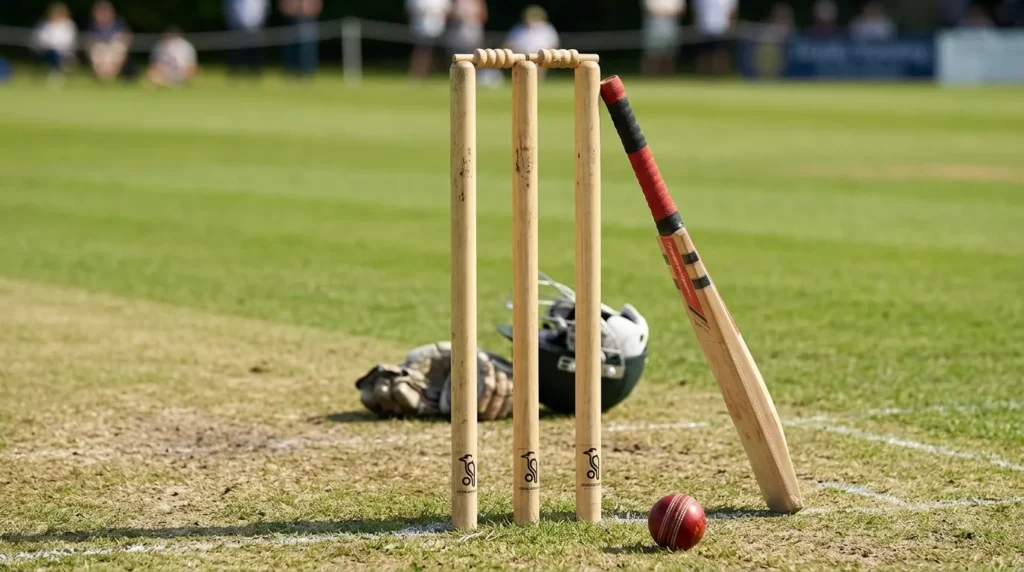
Stumps are an important part of cricket equipment used to form the wicket on both ends of the pitch. A wicket consists of three vertical wooden posts called stumps and two small wooden pieces called bails placed on top of them. The stumps are usually made of wood and are placed firmly into the ground. Their main purpose is to help determine dismissals such as bowled, stumped, and run out.
The standard height of cricket stumps is 28 inches (71.1 cm), and the total width of the three stumps together is 9 inches (22.86 cm). The middle stump is placed between the off stump and leg stump. Bowlers aim at the stumps to get wickets, while batsmen protect them while batting.
Stumps are essential for fair play and accurate decision-making in cricket. Modern cricket also uses technology like LED stumps and bails, which light up when disturbed, helping umpires make faster and more accurate decisions during close run-outs or stumpings.
Bails
- Placed on top
- Fall when stumps are hit
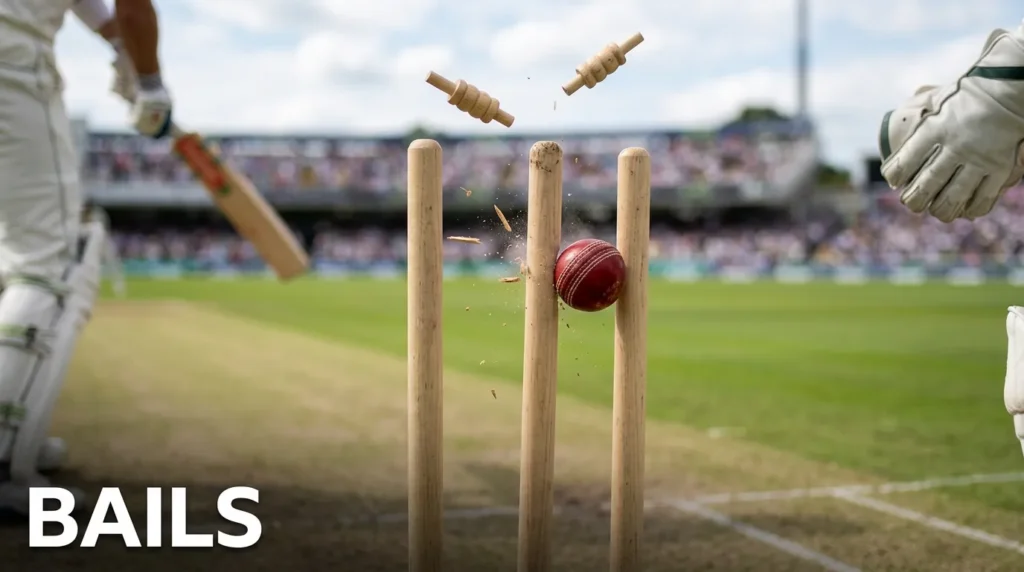
Bails are small wooden pieces placed on top of the cricket stumps to complete the wicket. A cricket wicket consists of three stumps and two bails. The main purpose of the bails is to show whether the wicket has been broken during the game. When a ball hits the stumps and at least one bail falls off, the batsman can be declared out in situations such as bowled, stumped, or run out.
Each bail is designed with two small ends that rest in grooves on the stumps. They are lightweight so they can easily fall when the stumps are disturbed. According to standard cricket rules, each bail is about 4.31 inches (10.95 cm) long.
Bails play an important role in umpiring decisions because they clearly indicate when the wicket is broken. In modern cricket, LED bails are commonly used in international matches. These bails light up instantly when removed from the stumps, helping umpires make accurate decisions during close run-outs and stumpings.
Pitch Surface
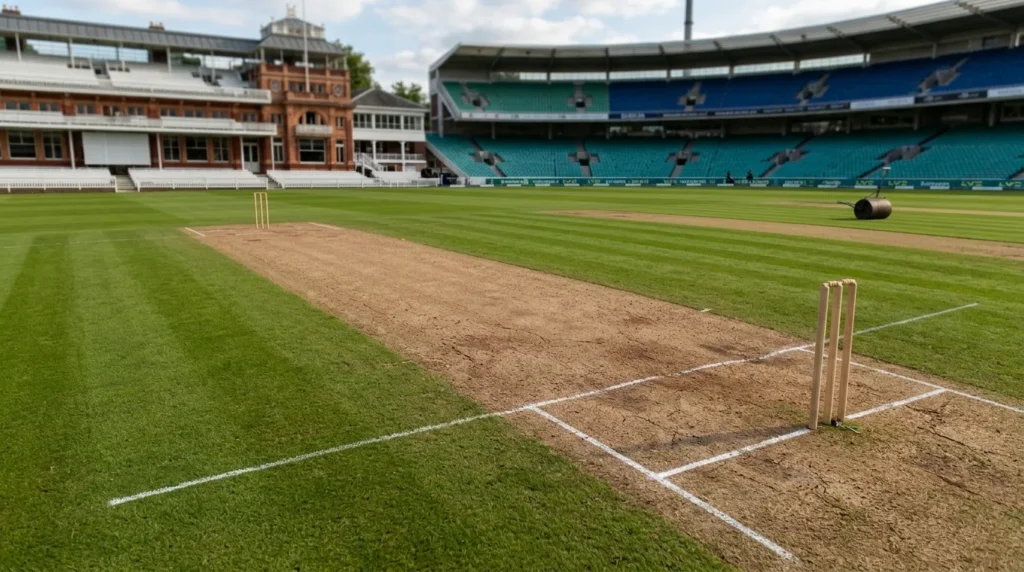
- Supports stumps
- Must be firm and level
The pitch surface is the central playing area of a cricket field where bowling and batting take place. It is a flat rectangular strip located in the middle of the ground and is usually made of clay, soil, and grass. The standard cricket pitch is 22 yards (20.12 meters) long. The condition of the pitch surface plays a very important role in the outcome of a cricket match because it affects batting, bowling, and ball movement.
Different pitch surfaces behave differently during matches. A hard and dry pitch generally helps batsmen because the ball bounces evenly, making stroke play easier. Green pitches with more grass support fast bowlers by providing swing and seam movement. Dusty or cracked pitches usually help spin bowlers because the ball turns more sharply.
Pitch conditions can also change as the match progresses. In longer formats like Test cricket, the surface may become rough and worn, making batting more difficult later in the game.
Overall, the pitch surface is one of the most important factors in cricket because it directly influences match strategy, player performance, and game results.
Stump Height Across Test, ODI, and T20 Cricket
The standard stump height in cricket is 28 inches (71.1 cm) across major formats, including Test cricket, One Day Internationals (ODIs), and T20 cricket. The format of the match does not normally change the standard dimensions of the wicket.
Stump Height in Test Cricket
In Test cricket, the wicket uses the standard 28-inch (71.1 cm) stumps and 9-inch (22.86 cm) overall wicket width. Because Test matches can last several days, bowlers and batters often focus on consistent line, length, and movement around the stumps.
Stump Height in ODI Cricket
ODI cricket also uses the standard 28-inch stump height. The wicket dimensions remain standardized even though the match has a limited number of overs and generally involves more aggressive scoring strategies than Test cricket.
Stump Height in T20 Cricket
T20 cricket uses the same standard 28-inch (71.1 cm) stump height. The shorter format encourages attacking bowling and batting, but the physical dimensions of the wicket remain the same.
Cricket Stump Height by Format
| Cricket Format | Stump Height | Wicket Width |
|---|---|---|
| Test cricket | 28 inches (71.1 cm) | 9 inches (22.86 cm) |
| ODI cricket | 28 inches (71.1 cm) | 9 inches (22.86 cm) |
| T20 cricket | 28 inches (71.1 cm) | 9 inches (22.86 cm) |
Does Stump Height Change Between Formats?
No. The standard stump height remains 28 inches (71.1 cm) in Test, ODI, and T20 cricket. What changes is the way players approach the game. Bowlers may use different variations, while batters adjust their techniques according to the match format and playing conditions.
The consistent wicket dimensions ensure that players compete against the same basic target regardless of the format.
Comparison Section
Difference Between Stump Height and Stump Width
| Feature | Stump Height | Stump Width |
|---|---|---|
| Measurement | 28 inches | About 1.38 inches each |
| Direction | Vertical | Horizontal thickness |
| Importance | Defines wicket height | Defines wicket width |
| Usage | Bowling target | Ball passing gap |
This shows the difference between stump height and stump width clearly.
Common Mistakes in Stump Installation and Maintenance
Proper stump placement is essential for maintaining fair and accurate gameplay. Even small errors in wicket setup can affect bowling accuracy, batting judgment, and umpiring decisions. For this reason, match officials carefully inspect the stumps before play begins.
Some of the most common mistakes related to cricket stumps include:
- Incorrect Placement: Stumps positioned outside the official measurements can affect the wicket’s dimensions.
- Uneven Alignment: Stumps must be placed in a straight line and at equal spacing.
- Loose Bails: Improperly fitted bails may fall too easily or fail to dislodge correctly during play.
- Poor Pitch Support: Soft or damaged pitch surfaces may cause stumps to lean or move out of position.
- Incorrect Height: Stumps that do not meet the official 28-inch (71.1 cm) standard can affect the fairness of the game.
Avoiding these mistakes helps ensure that cricket matches are played according to official regulations.
Benefits of Standard Stump Height in Cricket
The standardized stump height of 28 inches (71.1 cm) provides several advantages for players, officials, and the sport as a whole. Consistent wicket dimensions help maintain fairness and support accurate decision-making throughout a match.
Benefits for the Game
Standardized stump dimensions contribute significantly to the integrity and consistency of cricket.
Key benefits include:
- Ensures fair competition between batters and bowlers.
- Maintains consistent playing conditions worldwide.
- Supports accurate umpiring decisions.
- Improves the effectiveness of DRS and ball-tracking technology.
- Preserves the official Laws of Cricket.
Benefits for Players
Players at all levels benefit from consistent wicket dimensions because they can practice and compete under the same conditions.
Key benefits include:
- Enhances bowling accuracy and control.
- Improves batting technique and defensive skills.
- Supports wicketkeeping performance.
- Helps players develop consistent strategies.
- Provides reliable training conditions.
Standardization of Stump Height in Major Cricket Tournaments
All major cricket competitions follow the same official stump height and wicket specifications established by the Laws of Cricket. This standardization ensures that players compete under identical conditions regardless of the tournament or venue.
Major tournaments that use standard stump dimensions include:
- ICC Cricket World Cup
- ICC T20 World Cup
- ICC World Test Championship
- Indian Premier League (IPL)
- The Ashes Series
- Champions Trophy
- International and Domestic Cricket Competitions
The use of uniform wicket dimensions helps maintain fairness and consistency across global cricket events.
Interesting Facts About Cricket Stump Height
Cricket stumps have a fascinating history and have evolved over time while maintaining their essential dimensions.
Some interesting facts include:
- The official stump height has remained largely unchanged for many decades.
- Originally, cricket wickets consisted of only two stumps before the third stump was introduced.
- The third stump was added to reduce unfair gaps and improve wicket-taking opportunities.
- Modern professional cricket often uses LED stumps and bails for improved visibility and television coverage.
- Stumps are involved in several methods of dismissal, including bowled, run out, stumped, and hit wicket.
- Advanced technologies such as DRS and Hawk-Eye use wicket dimensions when making decisions.
Benefits of Playing Cricket
Cricket is not only an entertaining sport but also provides numerous physical, mental, and social benefits for players of all ages.
Physical Benefits of Cricket
Regular participation in cricket contributes to overall health and fitness.
Key physical benefits include:
- Improves cardiovascular fitness.
- Builds muscular strength and endurance.
- Enhances hand-eye coordination.
- Increases agility and reflexes.
- Promotes flexibility and body control.
- Supports healthy weight management.
Mental and Social Benefits of Cricket
Cricket also helps develop important mental skills and personal qualities.
Key mental benefits include:
- Improves concentration and focus.
- Develops strategic thinking and decision-making.
- Builds teamwork and communication skills.
- Encourages discipline and patience.
- Enhances confidence and leadership abilities.
- Helps manage pressure in competitive situations.
These benefits make cricket one of the most popular and rewarding sports worldwide, both for recreational players and professional athletes.
Conclusion
The stump height in cricket is a small but very important part of the game. It ensures fair play, helps bowlers target accurately, and assists umpires in making correct decisions. Without standard stump dimensions, cricket would lose its consistency and balance.
Understanding stump height helps players improve their skills and better understand the rules of the game. Whether you are a beginner or an experienced player, this knowledge is essential for mastering cricket.
By learning about stump height, you can appreciate the technical side of cricket and enjoy the game more deeply.

Jon Smith is a passionate sports writer specializing in cricket and global sporting events. With a keen eye for match analysis and player performance, he creates clear, engaging, and informative content. His work focuses on simplifying complex sports insights, making them accessible for beginners and experienced fans alike worldwide.