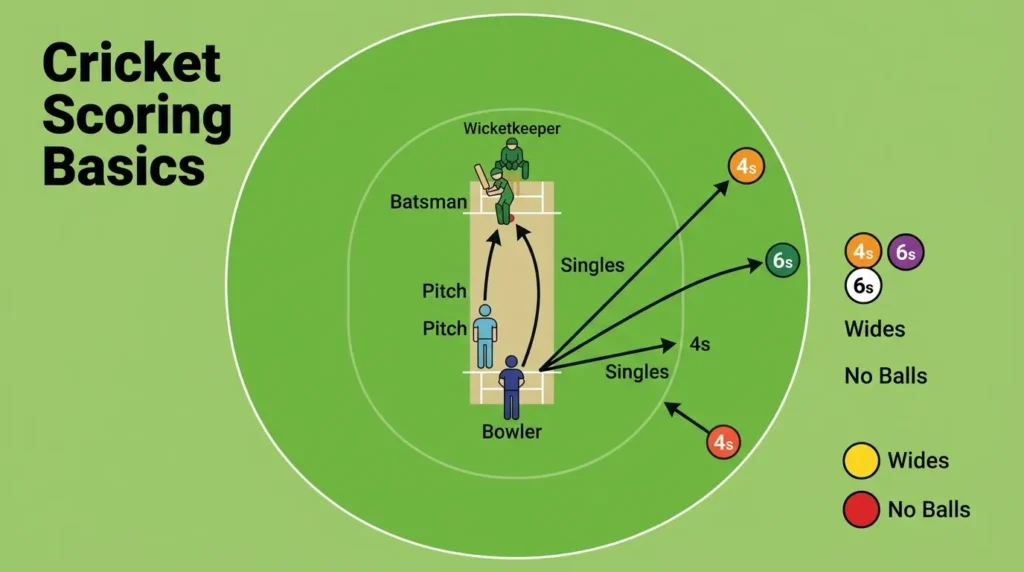
The cricket scoring system is one of the most important aspects of the game. Whether you are a new fan, a student learning about cricket, or someone watching a match for the first time, understanding how scoring works can make the game far more enjoyable. Cricket is played and followed by millions of people worldwide, especially in countries such as India, Australia, England, Pakistan, South Africa, and New Zealand.
Unlike many other sports where points are scored in a simple manner, cricket has a detailed scoring system that includes runs, extras, wickets, strike rates, run rates, and partnerships. Every ball delivered can affect the scorecard and ultimately determine the outcome of a match.
The cricket scoring system has evolved over time to accommodate different formats of the game, including Test matches, One Day Internationals (ODIs), and Twenty20 (T20) cricket. Understanding the fundamentals of scoring helps players, coaches, fans, and analysts appreciate the strategic elements of the sport.
In this comprehensive guide, you will learn how runs are scored, how wickets impact scoring, the role of scorers, different types of extras, and much more.
History of the Cricket Scoring System
Cricket originated in England during the 16th century and gradually developed into an organized sport. As cricket became more structured, a formal scoring system was introduced to record runs, wickets, and match statistics.
In the early days, scoring was done manually using simple scorebooks. Over time, official scorers became an essential part of every match. Today, modern technology allows electronic scoreboards, live scoring applications, and advanced statistical analysis.
Despite technological advancements, the fundamental principles of the cricket scoring system remain largely unchanged.
What Is the Cricket Scoring System?
The cricket scoring system is the method used to record and calculate runs scored by a batting team during a match.
The main objective of the batting team is to score as many runs as possible while avoiding losing all their wickets. The bowling team aims to restrict scoring and dismiss batters.
A team’s score is usually displayed in the following format:
Example: 250/6
This means:
- 250 runs have been scored
- 6 wickets have been lost
- 4 wickets remain
The team with the higher score at the end of the match generally wins.
How Runs Are Scored in Cricket
Running Between the Wickets
The most common way to score runs is by running between the wickets.
After hitting the ball, batters run to opposite ends of the pitch.
Each successful exchange equals:
- 1 run
- 2 runs
- 3 runs
- Occasionally 4 or more runs if fielding errors occur
Boundary Four
When the ball reaches the boundary rope after touching the ground, the batting team receives four runs.
Features of a boundary four:
- Ball touches the ground before reaching boundary
- No need to run between wickets
- Automatically counts as four runs
Boundary Six
A six is scored when the batter hits the ball over the boundary without it touching the ground.
Features:
- Maximum runs from a single legal delivery
- Exciting for spectators
- Common in T20 cricket
Understanding Wickets in Cricket
A wicket represents the dismissal of a batter.
Each team generally has ten wickets available during an innings.
When ten batters are dismissed:
- The innings ends
- The final score is recorded
Common Ways a Batter Gets Out
Bowled
The ball hits the stumps and removes the bails.
Caught
A fielder catches the ball before it touches the ground.
Leg Before Wicket (LBW)
The batter’s leg blocks a ball that would have hit the stumps.
Run Out
A batter fails to reach the crease before the stumps are broken.
Stumped
The wicketkeeper removes the bails while the batter is outside the crease.
Types of Extras in the Cricket Scoring System
Extras are runs awarded to the batting team without being scored directly from the bat.
Wide Ball
A delivery too far from the batter to play a reasonable shot.
Penalty:
- One extra run
- Additional delivery required
No Ball
An illegal delivery by the bowler.
Common reasons:
- Overstepping the crease
- Dangerous bowling action
Penalty:
- One extra run
- Free hit in limited-overs cricket
Bye
Runs scored when the ball passes the batter without touching the bat.
Leg Bye
Runs awarded when the ball hits the batter’s body and runs are completed legally.
Role of the Official Scorer
Every cricket match includes official scorers who record:
- Runs scored
- Wickets taken
- Extras
- Overs bowled
- Batting statistics
- Bowling statistics
The scorer ensures accuracy throughout the match and communicates with umpires whenever necessary.
Understanding Overs and Their Impact on Scoring
An over consists of six legal deliveries bowled by one bowler.
Different formats have different over limits:
Test Cricket
- No fixed over limit
- Matches last up to five days
One Day International (ODI)
- 50 overs per team
T20 Cricket
- 20 overs per team
The number of overs available significantly influences scoring strategies.
Run Rate in Cricket
Run rate measures the speed at which a team scores runs.
Formula
Run Rate = Total Runs ÷ Overs Faced
Example
If a team scores:
- 180 runs
- In 20 overs
Run Rate = 180 ÷ 20 = 9.00
A higher run rate often indicates aggressive batting.
Strike Rate in Cricket
Strike rate measures how quickly a batter scores runs.
Formula
Strike Rate = (Runs Scored ÷ Balls Faced) × 100
Example
If a batter scores:
- 60 runs
- From 40 balls
Strike Rate = 150
A higher strike rate is particularly valuable in T20 cricket.
Partnerships and Team Scoring
A partnership refers to the runs scored by two batters together before a wicket falls.
Strong partnerships help:
- Build innings
- Reduce pressure
- Create winning totals
Successful teams often rely on multiple productive partnerships throughout an innings.
Player Roles in the Cricket Scoring System
Batter
Primary responsibility:
- Score runs
- Build partnerships
Bowler
Primary responsibility:
- Take wickets
- Restrict scoring
Wicketkeeper
Responsible for:
- Catching
- Stumpings
- Assisting fielders
Fielders
Help prevent runs and create dismissal opportunities.
Equipment Used for Scoring and Match Play
Important cricket equipment includes:
- Cricket bat
- Cricket ball
- Stumps and bails
- Protective pads
- Gloves
- Helmet
- Scorebook
- Electronic scoreboard
Modern matches also use advanced scoring software and statistical systems.
Strategies for Maximizing Scores
Teams use various strategies to improve scoring.
Rotating Strike
Batters frequently take singles to keep the scoreboard moving.
Capitalizing on Loose Deliveries
Poor deliveries are targeted for boundaries.
Powerplay Utilization
Teams score aggressively during fielding restrictions.
Building Partnerships
Stable partnerships create a foundation for larger totals.
Major Cricket Tournaments Where Scoring Statistics Matter
Several major tournaments rely heavily on scoring records and statistics.
ICC Cricket World Cup
The most prestigious ODI tournament.
ICC T20 World Cup
Features fast-paced, high-scoring matches.
ICC World Test Championship
Highlights long-format cricket performance.
Indian Premier League (IPL)
One of the world’s most popular T20 leagues.
The Ashes
Historic Test series between England and Australia.
Benefits of Understanding the Cricket Scoring System
Learning the scoring system offers several advantages:
Physical Benefits for Players
- Better game awareness
- Improved decision-making
- Enhanced tactical planning
Mental Benefits
- Stronger analytical thinking
- Better concentration
- Increased strategic understanding
Benefits for Fans
- Easier match analysis
- Better appreciation of player performance
- More enjoyable viewing experience
Interesting Facts About Cricket Scoring
- A single over can theoretically produce dozens of runs due to extras.
- The highest individual scores often exceed 300 runs in Test cricket.
- Scoreboards have evolved from handwritten records to digital systems.
- Some T20 matches see teams scoring over 250 runs in just 20 overs.
- Official scorers are considered essential match officials.
Conclusion
The cricket scoring system is the foundation of every cricket match. It determines how runs are counted, how wickets affect an innings, and how teams compete across different formats. From singles and boundaries to extras and strike rates, every aspect contributes to the final result. Understanding the scoring system not only helps players improve their performance but also allows fans to enjoy the sport on a deeper level. Whether you watch Test cricket, ODIs, or T20 matches, a solid knowledge of cricket scoring makes every game more exciting and meaningful.

Green Benn is a dedicated sports writer specializing in cricket, including IPL and international formats. Known for clear, engaging, and informative content, Green simplifies complex match analysis and player statistics for all readers. Passionate about sports storytelling, Green delivers reliable, SEO-friendly articles that keep fans updated and informed