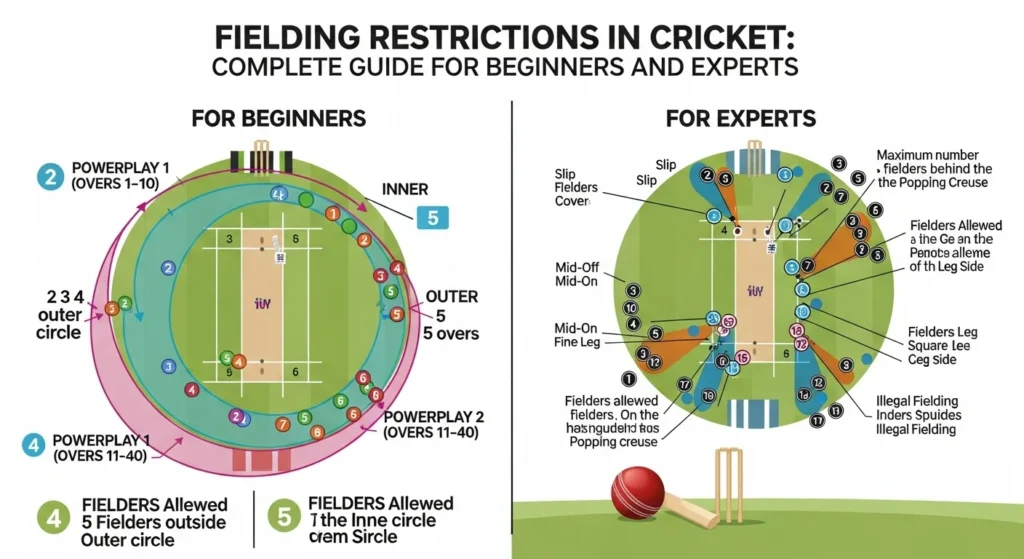

Fielding restrictions are one of the most important rules in modern cricket. They control how many fielders can be placed in certain areas of the ground during different phases of a match. These rules make the game more exciting, balanced, and fair for both batsmen and bowlers.
For beginners, understanding fielding restrictions may seem confusing at first. However, once you learn the basics, it becomes easier to follow matches and understand team strategies.
In this detailed guide, you will learn everything about fielding restrictions, including their history, rules, strategies, and importance in cricket.
What Are Fielding Restrictions?
Fielding restrictions are rules that limit where fielders can stand on the cricket field during specific overs of a match. These restrictions mainly apply to limited-overs formats such as:
- One Day Internationals (ODIs)
- Twenty20 (T20) matches
The main goal is to:
- Encourage attacking batting
- Prevent defensive field placements
- Keep the game entertaining
History of Fielding Restrictions
Early Days of Cricket
In the early days, cricket had no strict fielding restrictions. Captains could place fielders anywhere on the ground. This often led to very defensive strategies, especially in limited-overs matches.
Introduction of Restrictions
To make the game more exciting, cricket authorities introduced fielding restrictions in the 1980s and 1990s. These rules were later improved and updated over time.
Modern Era Changes
Today, fielding restrictions are clearly defined and strictly followed, especially in T20 cricket, where fast scoring is essential.
Types of Fielding Restrictions
Fielding restrictions are mainly divided into phases based on the number of overs.
Powerplay in Cricket
What Is a Powerplay?
A powerplay is a specific period in a match when fielding restrictions are the strictest. During this time, fewer fielders are allowed outside the 30-yard circle.
Powerplay in One Day Internationals (ODIs)
ODIs have three powerplay phases:
Powerplay 1 (Overs 1–10)
- Only 2 fielders allowed outside the 30-yard circle
- Encourages aggressive batting
Powerplay 2 (Overs 11–40)
- Maximum 4 fielders allowed outside the circle
- Balanced phase between batting and bowling
Powerplay 3 (Overs 41–50)
- Maximum 5 fielders allowed outside the circle
- Focus shifts slightly towards bowling strategy
Powerplay in T20 Cricket
T20 matches have only one powerplay:
Powerplay (Overs 1–6)
- Only 2 fielders allowed outside the circle
- Very aggressive batting phase
After Powerplay (Overs 7–20)
- Maximum 5 fielders allowed outside the circle
The 30-Yard Circle Rule
What Is the 30-Yard Circle?
The 30-yard circle is a marked area around the pitch. It plays a key role in fielding restrictions.
Key Rules
- During powerplay, most fielders must stay inside this circle.
- Only a limited number can stand outside it.
- This creates scoring opportunities for batsmen.
Fielding Positions and Restrictions
Close Fielders
These fielders stand near the batsman:
- Slip
- Gully
- Short leg
They are usually inside the circle.
Boundary Fielders
These fielders stand near the boundary line:
- Long-on
- Long-off
- Deep midwicket
- Deep cover
Their number is limited during fielding restriction phases.
Key Rules of Fielding Restrictions
Here are some important rules every cricket fan should know:
- Only a fixed number of fielders can stand outside the 30-yard circle.
- If the rule is broken, it results in a no-ball.
- In some formats, there must be a minimum number of fielders on the off-side.
- Wicketkeepers and bowlers are not included in restriction counts.
Importance of Fielding Restrictions
For Batsmen
- Easier to score boundaries
- More gaps in the field
- Encourages attacking shots
For Bowlers
- Requires smart bowling strategies
- Focus on accuracy and variations
For the Game
- Makes matches more exciting
- Increases scoring rates
- Keeps fans engaged
Strategies During Fielding Restrictions
Batting Strategies
During powerplay, batsmen often:
- Play aggressive shots
- Target gaps in the field
- Take advantage of fewer boundary fielders
Common techniques:
- Lofted shots
- Drives through covers
- Pull and hook shots
Bowling Strategies
Bowlers must be smart during restricted phases:
- Bowl tight lines and lengths
- Use swing and seam movement
- Mix slower balls and yorkers
Captain’s Role
The captain plays a key role in setting the field:
- Deciding field placements
- Adjusting strategy based on batsmen
- Managing bowlers effectively
Fielding Restrictions in Different Formats
Test Cricket
- No fielding restrictions
- Completely flexible field placements
- Focus on strategy and patience
One Day Internationals (ODIs)
- Structured powerplay phases
- Balanced gameplay
Twenty20 (T20)
- Strict restrictions
- High scoring matches
- Fast-paced action
Common Mistakes Related to Fielding Restrictions
Players and teams sometimes make errors such as:
- Placing too many fielders outside the circle
- Poor communication among players
- Misunderstanding powerplay rules
These mistakes can result in:
- No-balls
- Free hits
- Extra runs for the batting team
Role of Umpires in Fielding Restrictions
Umpires are responsible for:
- Monitoring field placements
- Ensuring rules are followed
- Calling no-balls when restrictions are violated
They play a crucial role in maintaining fairness in the game.
Equipment and Field Markings
Important Markings
- 30-yard circle
- Boundary line
- Pitch area
These markings help players and umpires follow fielding restriction rules accurately.
Major Tournaments and Fielding Restrictions
Fielding restrictions are applied in all major limited-overs tournaments, such as:
- ICC Cricket World Cup
- ICC T20 World Cup
- Domestic leagues like franchise T20 tournaments
These rules ensure consistency across all competitions.
Benefits of Fielding Restrictions
Physical Benefits
- Encourages active fielding
- Improves agility and reflexes
- Enhances fitness levels
Mental Benefits
- Develops strategic thinking
- Improves decision-making
- Builds teamwork and coordination
Interesting Facts About Fielding Restrictions
- Powerplays were introduced to make cricket more exciting.
- T20 cricket relies heavily on fielding restrictions for high scores.
- Many famous innings are built during powerplay overs.
- Bowlers often face the most pressure during restricted overs.
How Fielding Restrictions Impact Match Results
Fielding restrictions can completely change the outcome of a match:
- Strong powerplay batting can set a big total
- Good bowling during restrictions can limit scoring
- Captains’ decisions during these phases are often match-winning
Tips for Beginners to Understand Fielding Restrictions
If you’re new to cricket, follow these simple tips:
- Watch where fielders are standing
- Count how many are outside the circle
- Notice changes after powerplay ends
- Listen to commentary for explanations
Conclusion
Fielding restrictions are a vital part of modern cricket, especially in limited-overs formats. They bring balance between bat and ball while making the game more exciting for fans.
By controlling field placements, these rules encourage aggressive batting, smart bowling, and strategic captaincy. Whether you are a beginner or an experienced cricket fan, understanding fielding restrictions will greatly improve your knowledge and enjoyment of the game.