
Imagine a fast bowler running in at full speed, delivering a powerful ball, and the batter stepping forward to play a shot. At that exact moment, one small white line on the pitch decides whether the batter is safe or out. This line is called the popping crease, and it plays a crucial role in almost every delivery in cricket.
The popping crease is one of the most important markings on a cricket pitch. It is not just a line—it controls decisions like run-outs, stumpings, and even no-balls. For beginners, understanding this line can greatly improve their knowledge of the game, while for players, it directly affects performance and strategy.
In this article, you will learn everything about the popping crease, including its definition, history, rules, player roles, techniques, and real match applications. Whether you are a student, athlete, coach, or cricket fan, this guide will help you understand the game more clearly.
What is Popping Crease?
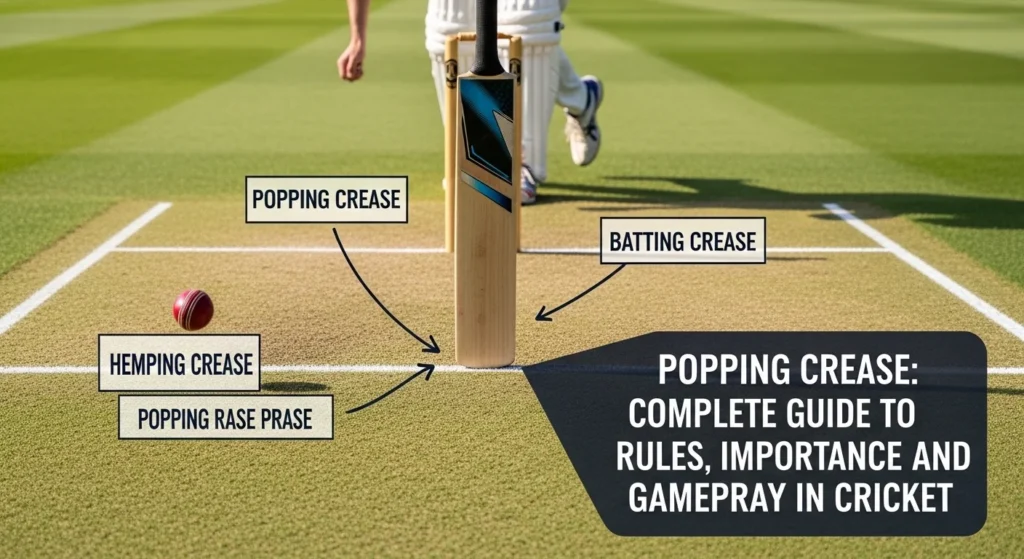
The popping crease is a line marked on the cricket pitch in front of the stumps at both ends.
Simple Definition
It is the line that determines:
- Whether a batter is inside the safe area
- Whether a run-out or stumping can happen
- Whether a bowler has delivered a legal ball
Practical Example
- If a batter steps out of the popping crease and misses the ball, the wicketkeeper can stump them.
- If a batter is outside this line while running and the ball hits the stumps, they can be run out.
History and Origin of Popping Crease
Cricket has evolved over centuries, and so have its rules and markings.
Early Cricket
- In early cricket, there were fewer pitch markings
- Decisions were less precise
Development of Crease Lines
- The popping crease was introduced to bring accuracy
- It helped umpires make fair decisions
- Over time, it became a standard rule in international cricket
Today, it is defined and regulated under official cricket laws, making it an essential part of the game.
Rules and Gameplay Explanation
Understanding the rules related to the popping crease is very important.
Batsman must reach to avoid a run out called
A batsman must reach a specific safe area on the pitch to avoid being run out in cricket, and this area is called the crease. The crease is a marked line at both ends of the pitch that determines whether a batsman is safe or out while running between the wickets. In simple terms, when two batsmen are trying to score runs, they run from one end of the pitch to the other. To complete a run safely, the batsman must place either his bat or any part of his body behind the popping crease before the fielding team hits the wicket with the ball. If the batsman fails to reach the crease in time and the wicket is broken, he is declared run out.
The crease plays a very important role in cricket because it defines the safe zone for the batsman. There are mainly three types of creases: the popping crease, the bowling crease, and the return crease. Among these, the popping crease is the most important for a run out decision. It is the line that the batsman must cross or touch to remain safe while completing a run. Even if the batsman is very close to the crease but has not grounded his bat or foot inside it when the wicket is broken, he will be given out.
A run out usually happens when fielders quickly throw the ball to the wicketkeeper or bowler while the batsmen are attempting to complete a run. This requires excellent teamwork, speed, and accuracy from the fielding side. At the same time, batsmen must also judge their running carefully. They need to decide whether to attempt a run or stay safe based on the position of the ball and the fielders. Communication between the two batsmen is also very important to avoid confusion and unnecessary run outs.
Modern cricket has made run outs even more exciting because of technology like third umpire reviews. When there is doubt about whether the batsman reached the crease in time, the decision is referred to the third umpire. Using slow-motion replays and different camera angles, the umpire checks if the bat or foot was grounded inside the crease before the wicket was broken.
In conclusion, the crease is a critical part of cricket rules that determines whether a batsman is safe or out during running between wickets. A batsman must reach and ground his bat or body inside the crease before the wicket is broken to avoid being run out. Understanding this rule is essential for players as well as fans, as it is one of the most common and thrilling ways a batsman can get out in the game of cricket.
Basic Rules
- The popping crease is drawn parallel to the bowling crease
- It is usually 4 feet (1.22 meters) in front of the stumps
- A batter must keep part of their body or bat behind this line to be safe
Role in Run-Out
- If the batter is outside the popping crease and the stumps are broken → OUT
- If any part of the bat or body is behind the line → NOT OUT
Role in Stumping
- When the batter leaves the crease and misses the ball
- The wicketkeeper can remove the bails
- If the batter is outside the popping crease → OUT
Role in No-Ball
- Bowlers must land their front foot behind the crease
- Crossing the line results in a no-ball
Important Techniques and Strategies
The popping crease is not just about rules—it also affects player strategies.
Batting Techniques
1. Staying Inside the Crease
- Helps avoid run-outs
- Important during defensive play
2. Using the Crease for Shots
- Batters move forward or backward
- Helps play spin and fast bowling effectively
Bowling Techniques
1. Controlled Foot Placement
- Bowlers must control their front foot
- Prevents no-balls
2. Using the Crease Width
- Bowlers vary angles using the crease
- Makes it harder for batters
Wicketkeeping Techniques
- Stay alert near the stumps
- Quick reactions for stumpings
- Watch batter’s foot position carefully
Player Roles and Positions
Different players interact with the popping crease in different ways.
Batter
- Must stay inside the crease for safety
- Uses it for positioning and shot selection
Bowler
- Must not cross the crease illegally
- Uses it to control delivery angle
Wicketkeeper
- Watches batter’s position
- Responsible for stumpings and run-outs
Fielders
- Aim throws at stumps when batter is outside crease
- Play a key role in run-out situations
Equipment Used in Relation to Popping Crease
While the crease itself is a marking, several equipment items are related to it.
Key Equipment
- Cricket pitch roller – used to prepare surface
- Marking tools – used to draw crease lines
- Stumps and bails – placed relative to crease
- Cricket bat – used by batter to stay inside crease
Major Tournaments Where Popping Crease Plays a Key Role
The popping crease is important in all levels of cricket, especially major tournaments.
International Competitions
- ICC Cricket World Cup
- T20 World Cup
- Test Championship
Domestic Leagues
- Various T20 leagues
- First-class cricket tournaments
In these matches, many decisions depend on the popping crease.
Benefits of Playing Cricket (Role of Popping Crease)
Understanding crease rules improves gameplay and performance.
Physical Benefits
- Improves reflexes
- Enhances coordination
- Builds stamina
Mental Benefits
- Improves decision-making
- Develops focus
- Builds strategic thinking
Interesting Facts About Popping Crease
- The popping crease is always parallel to the bowling crease
- It is one of the most used lines in cricket decisions
- Many famous matches have been decided by close crease calls
- Technology like third umpire often checks crease position
Comparison Section
Difference Between Popping Crease and Bowling Crease
| Feature | Popping Crease | Bowling Crease |
|---|---|---|
| Position | In front of stumps | Aligned with stumps |
| Purpose | Determines batter safety | Defines bowler’s position |
| Use in gameplay | Run-out, stumping decisions | Delivery legality |
| Distance from stumps | About 4 feet | At stumps |
Common Mistakes and How to Avoid Them
For Batters
- Leaving crease too early
- Not grounding bat properly
Solution: Always keep bat grounded behind the line
For Bowlers
- Overstepping the crease
- Poor foot control
Solution: Practice run-up and foot placement
For Fielders
- Slow reaction near stumps
- Inaccurate throws
Solution: Improve coordination and accuracy
Future Trends in Cricket Related to Crease
Cricket is evolving with technology.
Advanced Umpiring
- Third umpire decisions
- Ultra-motion cameras
Smart Cricket Fields
- Automated line detection
- Digital tracking systems
Player Training
- AI-based coaching
- Video analysis of foot positions
Conclusion
The popping crease is a small but extremely important part of cricket. It plays a major role in deciding whether a player is safe or out, making it central to the game’s rules and fairness. From batting techniques to bowling accuracy and wicketkeeping skills, this line affects every aspect of gameplay.
Understanding the popping crease helps beginners learn the game faster and allows experienced players to improve their performance. Whether it’s a close run-out or a quick stumping, this simple line often becomes the center of attention in crucial match moments.
By mastering its rules and importance, you can gain deeper insight into cricket and enjoy the game with greater confidence and knowledge.

Jon Smith is a passionate sports writer specializing in cricket and global sporting events. With a keen eye for match analysis and player performance, he creates clear, engaging, and informative content. His work focuses on simplifying complex sports insights, making them accessible for beginners and experienced fans alike worldwide.