
Cricket may look simple at first glance, but every detail of the playing area has a direct impact on how the game is played. One such important element is the pitch width in cricket. While most fans focus on pitch length or surface conditions, the width of the pitch also plays a crucial role in maintaining fairness and consistency.
Imagine a bowler delivering a fast ball or a spinner trying to turn the ball sharply. The space available on the pitch directly affects their control and accuracy. Similarly, batters depend on a well-defined pitch area to judge line and play shots effectively.
Understanding the pitch width in cricket is essential for players, coaches, students, and cricket enthusiasts. It helps in learning proper gameplay rules, improving techniques, and maintaining standard playing conditions.
In this article, you will learn everything about pitch width, including its official dimensions, history, rules, importance, strategies, player roles, equipment, and interesting facts. By the end, you will have a complete understanding of how pitch width influences modern cricket.
Here is the detailed version with each topic expanded to 5–6 lines and written in simple, easy-to-understand English.
What is Pitch Width in Cricket?
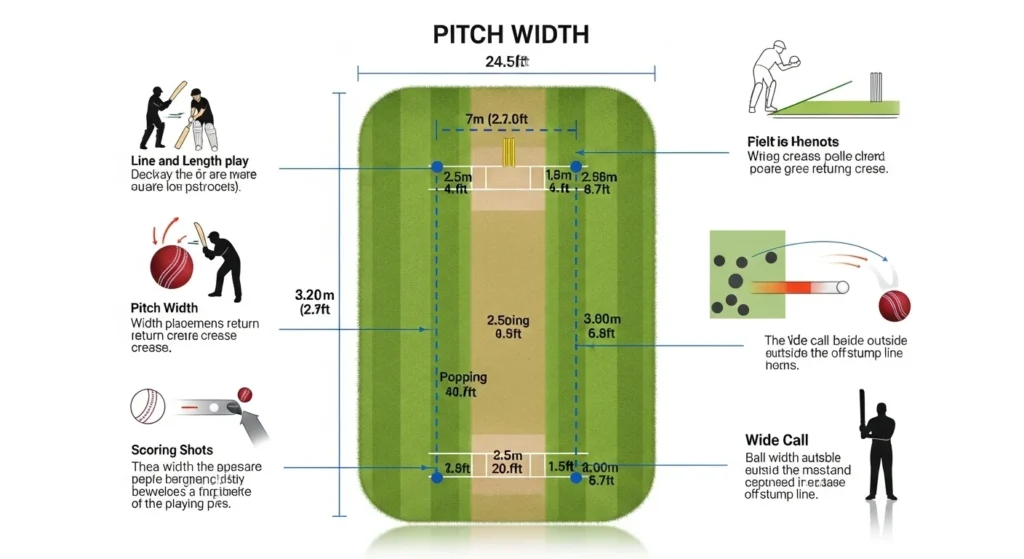
The pitch width in cricket refers to the horizontal measurement of the rectangular strip located at the center of the cricket field. This is the area where the bowler delivers the ball and the batter attempts to score runs. While many people know that a cricket pitch is 22 yards long, fewer understand that its width is also fixed by official laws. The width plays an important role in maintaining consistency and fairness in the game. Standardized dimensions ensure that players compete under the same conditions in every match.
Official Measurement
According to the Laws of Cricket, the standard width of a cricket pitch is 10 feet (3.05 meters). This measurement is used in all professional and international cricket matches. Whether the game is played in England, India, Australia, or any other cricket-playing nation, the pitch width remains the same. Having a fixed width helps maintain uniform playing conditions and allows teams to prepare their strategies effectively. It is one of the fundamental dimensions of a cricket field.
- Standard pitch width: 10 feet
- Equivalent to 3.05 meters
- Used in international and domestic cricket
- Defined by official cricket laws
- Ensures consistency in gameplay
Simple Explanation
In simple terms, pitch width is the distance from one side of the pitch to the other. It determines how much space bowlers have to vary their line and how batters judge their shots. Even though players usually focus on pitch length, the width also influences movement and positioning. The standard width ensures that bowlers cannot gain an unfair advantage due to unusual playing conditions. It creates balance between batting and bowling.
Practical Example
The width of the pitch affects both batting and bowling tactics during a match. Bowlers use the available width to target different areas outside the batter’s reach and force mistakes. Batters rely on their understanding of pitch dimensions to judge whether to play on the off side or leg side. Field placements are also influenced by the expected line of the bowler. Therefore, pitch width contributes to strategic decision-making throughout the game.
- Bowlers adjust their line using pitch width.
- Batters judge off-side and leg-side shots.
- Fielding captains plan field placements.
- Umpires use markings for decision-making.
- Players develop tactics based on standard dimensions.
History and Standardization of Pitch Dimensions
During the early years of cricket, there were no fixed standards for pitch dimensions. Different grounds used their own measurements, resulting in variations that affected gameplay. Some pitches were wider, narrower, or prepared differently depending on local practices. This lack of consistency created challenges when teams competed against each other. As cricket became more organized, the need for standard dimensions became increasingly important.
The Marylebone Cricket Club (MCC) eventually introduced official laws to regulate pitch measurements. These standards were later adopted worldwide and now form the basis of modern cricket regulations. The International Cricket Council (ICC) follows these laws to ensure that international matches are played under identical conditions. Standardization promotes fairness and allows players to perform consistently regardless of the venue.
Importance of Standardization
- Ensures fair competition.
- Creates uniform playing conditions.
- Helps players adapt more easily.
- Supports accurate officiating.
- Maintains the integrity of the game.
Today, both the pitch length of 22 yards and the 10-foot pitch width are universally accepted standards in cricket.
Pitch Width Rules and Guidelines
The pitch width is governed by official cricket laws that specify how the playing surface should be prepared and maintained. These guidelines ensure that neither team gains an unfair advantage because of unusual pitch conditions. Match officials carefully inspect the pitch before games to confirm that it complies with the required standards. Proper preparation contributes to player safety and balanced competition.
Standard Rules
The laws clearly state that the pitch must have a width of 10 feet (3.05 meters). The surface should be level and free from dangerous irregularities that could affect the bounce of the ball. Consistent dimensions allow players to perform confidently in different venues around the world. Officials are responsible for ensuring these requirements are met before the match begins.
- Pitch width must be 10 feet.
- Surface should be flat and even.
- Dimensions must follow official laws.
- Conditions should remain fair.
- Match officials verify compliance.
Pitch Markings
Several important markings appear on the cricket pitch and assist players and umpires during play. These lines define legal bowling areas and help determine whether deliveries are valid. Clear and visible markings are essential for accurate decision-making throughout the match. Without these markings, it would be difficult to apply many of cricket’s laws correctly.
The main pitch markings include:
- Bowling crease
- Popping crease
- Return crease
These markings help umpires judge no-balls, determine run-out situations, and monitor legal deliveries. Proper marking of the pitch is therefore an important part of match preparation.
Maintenance Rules
Maintaining the pitch correctly is just as important as constructing it according to official dimensions. Groundsmen carefully prepare the surface to ensure fair and safe play for both teams. Rolling the pitch improves firmness and consistency, while controlling grass levels affects pace and bounce. Excessive wear or uneven conditions can influence the outcome of a match unfairly.
Maintenance guidelines include:
- Pitch must be properly rolled.
- Grass levels should be controlled.
- Surface should remain even.
- Moisture levels require monitoring.
- The pitch should not provide an unfair advantage.
Good pitch maintenance preserves the quality of the contest and allows skill, rather than poor conditions, to determine the result of the game.
Importance of Cricket Pitch Width
The cricket pitch width is an essential part of the game’s standardized dimensions. Although the width is fixed at 10 feet (3.05 meters), it plays a significant role in ensuring fair competition, consistent playing conditions, and accurate officiating. Standard pitch dimensions allow players to compete under the same conditions at every level of cricket, from local matches to international tournaments.
Importance for Bowlers
A standard pitch width helps bowlers maintain consistent line and length while creating different bowling angles. Fast bowlers can use seam and swing movement effectively, while spin bowlers benefit from predictable pitch dimensions when planning their deliveries. Consistent pitch measurements also make it easier for bowlers to adapt when playing at different venues.
Importance for Batters
Batters rely on standard pitch dimensions to judge the line and length of each delivery. This consistency helps them position themselves correctly, select appropriate shots, and play with greater confidence. Whether playing defensive strokes or attacking boundaries, a uniform pitch width supports fair batting conditions.
Importance for Umpires
For umpires, the official pitch width provides a standardized reference for monitoring the playing area and ensuring that matches are conducted according to the Laws of Cricket. Consistent pitch dimensions also contribute to accurate decision-making throughout the game.
How Cricket Pitch Width Affects Gameplay
While the pitch width remains the same in every format, it has an important influence on how the game is played. Players develop strategies based on these fixed dimensions to maximize performance.
Bowling Accuracy and Line
Bowlers use the standard pitch width to maintain precise line and length. Deliveries aimed just outside the off stump, on middle stump, or toward the leg stump are easier to execute consistently because every cricket pitch follows the same official measurements.
Shot Selection and Placement
Batters use their understanding of the pitch dimensions to judge the line of the ball and choose the most suitable shot. Depending on the delivery, they may play drives, cuts, pulls, sweeps, or defensive strokes while maintaining proper balance and footwork.
Bowling Angles and Ball Movement
The standard pitch width allows bowlers to vary their angles without changing the official playing area. Fast bowlers combine seam and swing movement with different release positions, while spin bowlers use flight, drift, and turn to challenge batters under consistent pitch conditions.
Fairness and Consistency
One of the greatest advantages of a fixed pitch width is that it provides equal playing conditions for every team. Whether the match is a Test, ODI, or T20 game, the standardized dimensions help maintain fairness, consistency, and the integrity of cricket worldwide.
Techniques Related to Cricket Pitch Width
Although the cricket pitch width is fixed at 10 feet (3.05 meters), players use the available space strategically to improve their performance. Bowlers, batters, and fielders all adapt their techniques according to the pitch dimensions and match conditions.
Bowling Techniques
Bowlers use the full width of the pitch to create different angles and challenge batters. Fast bowlers aim for consistent line and length around the off stump, while also varying their release point to generate movement. Spin bowlers use the pitch width to change angles, encourage turn, and exploit rough areas as the match progresses.
Batting Techniques
Batters make full use of the standard pitch width by adjusting their stance and footwork according to the line of the delivery. Effective shot placement, quick movement, and proper balance help them score runs on both sides of the wicket while minimizing risks.
Fielding Techniques
Captains position fielders based on the batter’s strengths, the bowler’s strategy, and the dimensions of the pitch. Accurate field placement helps cover scoring areas, create catching opportunities, and reduce easy boundaries.
How Different Players Use the Standard Pitch Width
Every player on the field benefits from understanding the official pitch dimensions. While the width remains constant, each role requires a different approach.
Fast Bowlers
Fast bowlers use the pitch width to vary their bowling angles and maintain pressure on batters. Bowling just outside the off stump often encourages edges to the wicketkeeper or slip fielders, while accurate line and length remain key to success.
Spin Bowlers
Spin bowlers take advantage of the pitch by changing their angles of attack and using surface wear to generate extra turn and bounce. They aim to force batters into mistakes through flight, spin, and precision.
Batters
Batters use the available width to judge line, adjust their footwork, and play a wide range of attacking and defensive shots. Good positioning allows them to score freely while reducing the chances of dismissal.
Equipment Used for Cricket Pitch Preparation
Maintaining a standard cricket pitch requires specialized equipment to ensure the surface remains safe, consistent, and suitable for competitive play.
Pitch Roller
A pitch roller is used to compress and flatten the surface before matches. Rolling creates a firm and even pitch, improving bounce and playing conditions.
Grass Cutter (Mower)
A grass cutter or mower keeps the grass at the required height. Proper grass maintenance influences pace, bounce, and seam movement while ensuring the pitch remains consistent.
Pitch Marking Tools
Ground staff use marking tools, measuring tapes, string lines, and specialized marking paint to accurately draw the bowling creases, popping creases, return creases, and other pitch markings according to the official Laws of Cricket.
Watering and Maintenance Equipment
Sprinklers, hoses, covers, and pitch maintenance tools help groundskeepers control moisture levels and protect the pitch from adverse weather. Regular maintenance ensures fair and consistent playing conditions throughout the season.
Cricket Pitch Width in Different Formats
The official cricket pitch width remains the same in every format of the game. Whether it is a Test match, One Day International (ODI), or T20 match, the pitch is always 10 feet (3.05 meters) wide as specified by the Laws of Cricket. While the dimensions never change, the style of play and strategies used on the pitch vary significantly across formats.
Test Cricket
In Test cricket, the standard pitch width supports a balanced contest between bat and ball over five days. Players rely on patience, technique, and consistency, while bowlers use swing, seam movement, and spin to challenge batters as the pitch gradually changes throughout the match.
One Day International (ODI)
In ODI cricket, the same pitch width provides a balance between controlled batting and disciplined bowling. Batters aim to score at a steady pace while preserving wickets, and bowlers focus on maintaining accurate line and length to restrict runs during the 50-over innings.
T20 Cricket
T20 cricket is the most aggressive format, but it still uses the standard pitch width. Batters play attacking shots from the start, while bowlers rely on variations such as slower balls, yorkers, and bouncers to limit scoring. Although the playing style is much faster, the official pitch dimensions remain unchanged.
Comparison Section
Difference Between Pitch Length and Pitch Width
| Feature | Pitch Length | Pitch Width |
|---|---|---|
| Measurement | 22 yards | 10 feet |
| Direction | End to end | Side to side |
| Importance | Determines distance | Controls playing space |
| Usage | Bowling distance | Shot direction |
This shows the difference between pitch length and pitch width clearly.
Common Mistakes Related to Cricket Pitch Width
Although the official cricket pitch width is fixed by the Laws of Cricket, mistakes in pitch preparation and field setup can still affect the quality of a match. Groundskeepers and officials must ensure that the pitch is prepared and marked correctly before play begins.
Common Errors
- Incorrect or unclear pitch markings.
- Uneven or poorly prepared pitch surfaces.
- Neglecting regular pitch maintenance.
- Setting field positions without considering the pitch dimensions.
- Using damaged or worn-out crease markings.
Proper preparation and maintenance help ensure fair competition and player safety.
Benefits of Standard Cricket Pitch Width
A standard pitch width creates consistency in cricket at every level, from local club matches to international tournaments. It allows players, umpires, and coaches to compete under the same conditions regardless of the venue.
Benefits for the Game
- Ensures fairness for both batting and bowling sides.
- Maintains consistency across domestic and international matches.
- Supports accurate umpiring decisions.
- Preserves the integrity of the Laws of Cricket.
- Improves the overall quality of the game.
Benefits for Players
- Helps batsmen and bowlers adapt to standard playing conditions.
- Improves accuracy in bowling and batting techniques.
- Assists coaches in developing consistent training methods.
- Enables players to perform confidently on different grounds.
- Creates equal opportunities for all teams.
Major Cricket Tournaments That Follow Standard Pitch Dimensions
Every professional cricket tournament follows the official pitch measurements specified in the Laws of Cricket. This ensures that matches are played under consistent conditions regardless of the country or venue.
Major tournaments include:
- ICC Cricket World Cup
- ICC Men’s T20 World Cup
- ICC World Test Championship
- Indian Premier League (IPL)
- The Ashes Series
- Big Bash League (BBL)
- Pakistan Super League (PSL)
- Caribbean Premier League (CPL)
Using standardized pitch dimensions ensures fairness and consistency throughout these competitions.
Interesting Facts About Cricket Pitch Width
Cricket pitch dimensions have remained largely unchanged for many years, helping maintain uniform playing conditions around the world.
Some interesting facts include:
- The official cricket pitch width is 10 feet (3.05 meters).
- The width remains the same in Test, ODI, and T20 cricket.
- Every ICC-approved venue follows the same standard dimensions.
- Pitch width contributes to consistent crease markings and umpire positioning.
- Standard dimensions make it easier for players to adapt when competing in different countries.
- Although pitch conditions vary, the official pitch measurements remain constant.
These fixed dimensions are one of the reasons cricket maintains consistent playing standards across all formats.
Conclusion
The pitch width in cricket is a fundamental aspect of the game that ensures fairness, consistency, and proper gameplay. While it may seem like a simple measurement, it has a major impact on bowling accuracy, batting technique, and overall match strategy.
Understanding pitch dimensions helps players improve their performance and adapt to different playing conditions. From beginners to professionals, everyone benefits from knowing how pitch width affects the game.
By mastering this concept, you can better understand cricket rules, enhance your skills, and enjoy the sport at a deeper level.

Jon Smith is a passionate sports writer specializing in cricket and global sporting events. With a keen eye for match analysis and player performance, he creates clear, engaging, and informative content. His work focuses on simplifying complex sports insights, making them accessible for beginners and experienced fans alike worldwide.