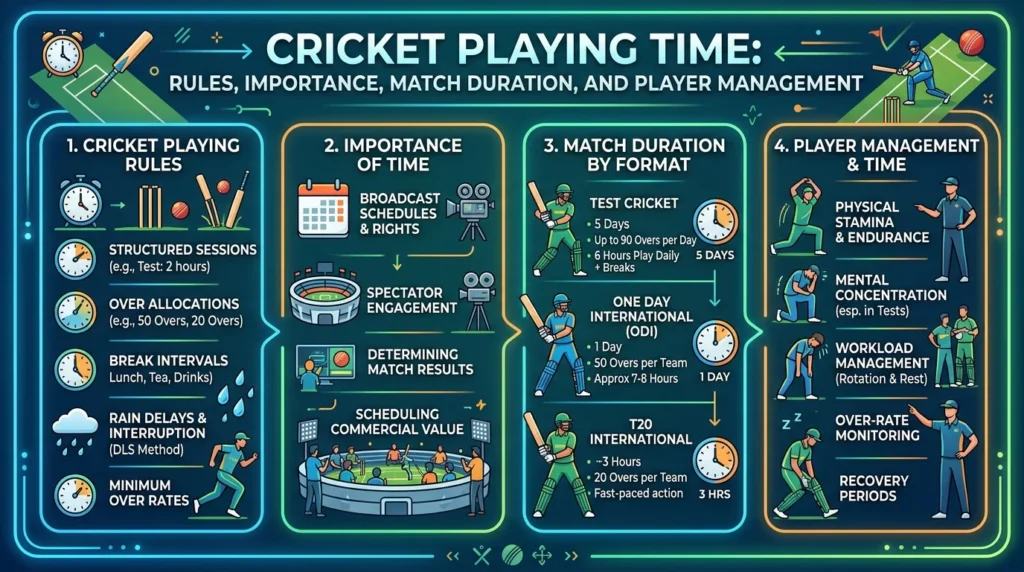

Cricket is one of the most popular sports in the world, followed by millions of fans across countries like India, Australia, England, and Pakistan. One important concept in cricket is “playing time.” Playing time in cricket refers to the amount of time players spend actively participating in a match through batting, bowling, fielding, or wicketkeeping.
Unlike many other sports, cricket does not always have a fixed match duration. Different cricket formats have different time structures, overs, innings, and playing conditions. Test matches may last up to five days, while T20 matches can finish in only a few hours. Because of this variety, understanding playing time in cricket is important for players, coaches, students, and fans.
Playing time affects fitness, team strategy, player rotation, recovery, and overall match performance. Modern cricket teams carefully manage player workloads to maintain physical and mental health throughout long tournaments and international schedules. This article explains everything about playing time in cricket, including match duration, rules, player roles, strategies, fitness, equipment, major tournaments, and interesting facts.
What Is Playing Time in Cricket?
Playing time in cricket refers to the period during which players actively participate in a cricket match. This includes:
- Batting time
- Bowling spells
- Fielding sessions
- Wicketkeeping duties
- Match overs and innings duration
Cricket playing time varies greatly depending on the format of the game.
Importance of Playing Time in Cricket
Playing time is important because it:
- Improves player experience
- Builds stamina and endurance
- Helps skill development
- Supports team balance
- Increases match awareness
- Affects player fitness and recovery
Longer playing time often tests both physical and mental strength.
History of Playing Time in Cricket
Cricket originated in England during the 16th century. Early cricket matches had no fixed overs or time limits. Some games lasted several days until a winner was decided.
Early Cricket Matches
Early cricket matches were very different from the modern game we see today. Cricket is believed to have started in England during the 16th and 17th centuries, and in the beginning it was mostly played by children and rural communities. Slowly, it became popular among adults and later spread to schools, clubs, and eventually international level. The early cricket matches were very simple in structure, with basic rules and less formal organization. There were no proper cricket grounds like today, and matches were often played on open fields, villages, or farmland. The equipment was also very basic, with handmade bats and rough leather balls. Protective gear like helmets, pads, and gloves did not exist, so players had to rely only on skill and courage.
In early cricket, the rules were not fully standardized. Different regions had their own playing styles, and many matches were played with local agreements on how the game should be conducted. The number of overs, players, and scoring methods were often flexible. The concept of formal teams and international competition did not exist at that time. Over time, cricket became more organized, especially during the 18th century when the Marylebone Cricket Club (MCC) in England played a major role in forming official laws of cricket.
Early matches were usually longer in duration compared to modern limited-overs games. Some matches lasted several days without strict time limits. Scoring was also slower because pitches were uneven and difficult to bat on. Bowlers had a major advantage due to rough surfaces and unpredictable ball movement. Despite these challenges, early cricket attracted growing interest, especially among the British upper class, who helped promote the sport.
As cricket developed, it spread to different parts of the world through the British Empire, including countries like India, Australia, and the West Indies. These early international matches laid the foundation for modern cricket formats such as Test matches, One Day Internationals, and T20 cricket. Overall, early cricket matches played a crucial role in shaping the sport into the global game we enjoy today, combining tradition, skill, and evolving rules over time.
In traditional cricket:
- Matches continued until teams completed innings.
- Time limits were flexible.
- Players often spent entire days on the field.
This made cricket physically demanding and highly strategic.
Introduction of Timed Formats
The introduction of timed formats in cricket marked a major development in the evolution of the game. Earlier, cricket matches were mainly played without strict time limits, especially in the early days of Test cricket and first-class matches. These games could continue for several days until a result was achieved, but sometimes they also ended in draws due to lack of time or slow scoring. To make the game more structured, competitive, and result-oriented, cricket authorities introduced timed formats with specific playing durations and conditions. This change helped improve the pace of the game and made it more interesting for both players and spectators.
In timed formats, the match is played within a fixed number of days or hours, and teams must try to achieve a result within that time. For example, in Test cricket, matches are usually played over five days with a set number of overs per day. If the result is not achieved within the time limit, the match is declared a draw. This system adds pressure on teams to play more positively and strategically. It also encourages better planning in batting, bowling, and field placements.
The introduction of timed formats also helped in organizing cricket more professionally. It made scheduling easier for tournaments and allowed broadcasters to plan match coverage more effectively. Players had to adapt their techniques according to time constraints, balancing defense and attack depending on the match situation. This led to the development of different playing styles and strategies.
One of the main advantages of timed formats is that they bring fairness and structure to the game. Teams cannot delay the match unnecessarily, and both sides get equal opportunity within a fixed period. However, there are also some limitations, such as matches ending in draws even when one team may have performed better overall.
Overall, the introduction of timed formats played a key role in modernizing cricket. It transformed the game from an open-ended contest into a structured sport with clear rules, improving competitiveness, audience engagement, and global appeal.
As cricket became more popular worldwide, organized formats were introduced.
Test Cricket
Test cricket officially became the longest format and can last up to five days.
One Day Cricket
Limited-overs cricket later introduced fixed overs to shorten playing time.
T20 Cricket
T20 cricket became even faster, creating shorter and more entertaining matches for modern audiences.
Popular cricket events include:
- ICC Cricket World Cup
- ICC T20 World Cup
- Indian Premier League
- Big Bash League
Playing Time in Different Cricket Formats
Different formats have unique time structures.
Test Cricket Playing Time
Test cricket is the longest and most traditional format of cricket, and its playing time is designed to test the skill, patience, and endurance of players. Unlike limited-overs formats such as ODIs or T20s, Test matches are not restricted to a fixed number of overs. Instead, they are played over a period of five days, making it the most challenging format in the sport.
Each day of a Test match usually consists of about 6 hours of play, divided into three sessions. The first session is played in the morning, followed by a lunch break, then the second session in the afternoon, a tea break, and finally the last session in the evening. This structured timing ensures that players get rest periods while maintaining continuous gameplay throughout the day.
In total, a standard Test match provides around 90 overs per day, although this can vary depending on match conditions, weather interruptions, and over-rate delays. Over five days, a maximum of about 450 overs can be bowled if there are no interruptions. However, many matches finish earlier if one team dominates the game.
The long playing time in Test cricket allows both teams to use deeper strategies. Batsmen can take time to build innings, while bowlers can plan long spells and set up dismissals over multiple overs. This is why Test cricket is often called the “purest form of cricket,” as it tests all aspects of a player’s ability, including technique, concentration, and mental strength.
Weather and light conditions also play an important role in Test match timing. If rain interrupts play or natural light becomes poor, umpires may stop the game for safety reasons. These interruptions can affect the total playing time and sometimes lead to drawn matches.
One of the key features of Test cricket is that there is no tie-break system like Super Overs. If the match is not completed within the five days, it is declared a draw, unless one team wins earlier by completing all innings.
Overall, Test cricket playing time is carefully structured to balance fairness, challenge, and endurance. It remains the ultimate test of cricketing skill and strategy, making it a highly respected format in the sport.
Test cricket is the longest format.
Test Cricket Playing Time
Test cricket is the longest format of the game, designed to examine a team’s skill, patience, and endurance over multiple days. Each match is scheduled for up to five days, with both teams having two innings each unless the match ends earlier due to a result. Every day consists of approximately six hours of scheduled playing time, divided into three sessions with breaks for lunch and tea.
Match Duration
- Played over up to five days
- Approximately six hours of scheduled play each day
- Three playing sessions are conducted daily
- Each team usually has two innings
- A match may end early if a result is achieved before the fifth day
Daily Session Breakdown
Each day’s play is divided into three sessions:
- Morning Session: Play begins after the scheduled start time.
- Afternoon Session: Resumes after the lunch break.
- Evening Session: Continues after the tea break until the close of play.
Between these sessions, players take lunch and tea breaks, while additional drinks breaks may be taken depending on weather conditions.
One Day International (ODI) Playing Time
One Day International (ODI) cricket is a limited-overs format that is completed in a single day. Each team is allowed 50 overs, making the game faster than Test cricket while still providing a balance between batting and bowling. Under normal conditions, an ODI match lasts around 7 to 8 hours, including the innings break and other scheduled intervals.
Match Duration
- Completed in one day
- Each team faces 50 overs
- Total playing time is approximately 7–8 hours
- Includes one innings per team
- Ends when both teams complete their innings or one team successfully chases the target
Session Breakdown
An ODI match generally follows this schedule:
- First Innings: The team batting first plays its 50 overs.
- Innings Break: A scheduled break of about 45 minutes separates the two innings.
- Second Innings: The chasing team bats until completing 50 overs or reaching the target score.
This format offers an ideal balance between the traditional endurance of Test cricket and the fast-paced excitement of T20 cricket.
One Day International (ODI) Playing Time
One Day International (ODI) cricket is a limited-overs format where each team plays a fixed number of overs, and the match is completed in a single day. The total playing time of an ODI match is usually around 7 to 8 hours, making it shorter than Test cricket but longer than T20 cricket.
An ODI match is structured so that each team gets 50 overs to bat. This results in a total of 100 overs in the match, excluding interruptions and delays. The match is divided into two innings, and each innings takes approximately 3 to 3.5 hours depending on the scoring speed, weather conditions, and over rate.
There are also scheduled breaks in ODI cricket. After the first innings, there is a break of about 40 to 45 minutes for lunch or interval before the second innings begins. This helps players rest and allows ground staff to prepare the field for the next team.
In total playing time:
- First innings: ~3 to 3.5 hours
- Break: ~40–45 minutes
- Second innings: ~3 to 3.5 hours
- Total match duration: ~7 to 8 hours
ODI cricket also has rules to ensure the match finishes on time. Teams must maintain a minimum over rate, meaning they must bowl their 50 overs within the allowed time. If they are too slow, penalties can be applied. This keeps the game structured and avoids unnecessary delays.
Weather and external conditions can also affect ODI playing time. Rain interruptions may reduce overs using the Duckworth-Lewis-Stern (DLS) method, which adjusts the target score based on overs lost. This ensures that the match still produces a fair result even if time is reduced.
One of the key features of ODI cricket is that it always produces a result. If both teams end with equal scores, a tie is declared, or in some tournaments, special rules like a Super Over are used to decide the winner.
Overall, ODI playing time is designed to balance excitement and endurance. It gives enough time for strategic batting and bowling while keeping the match limited to one day, making it highly popular among fans around the world.
Match Structure
- 50 overs per team
- Usually completed in one day
- Around 7 to 8 hours total
ODIs balance traditional cricket with modern entertainment.
T20 Cricket Playing Time
T20 cricket, also known as Twenty20 cricket, is the shortest and most exciting format of the game. It is designed to be fast, entertaining, and completed in a single evening. The total playing time of a T20 match is usually around 3 to 3.5 hours, making it the most viewer-friendly format in modern cricket.
In a standard T20 match, each team gets 20 overs to bat, which means the entire match consists of 40 overs in total. Each innings generally lasts about 1 hour 20 minutes to 1 hour 40 minutes, depending on scoring speed, wickets, and over rate. Because of its short duration, T20 cricket is very popular among fans who want quick and action-packed entertainment.
The structure of a T20 match is simple:
- First innings: 20 overs (approx. 80–100 minutes)
- Interval break: around 15–20 minutes
- Second innings: 20 overs (approx. 80–100 minutes)
- Total match time: around 3 to 3.5 hours
One of the key features of T20 cricket is strict time management. Teams are required to maintain a fast over rate, meaning they must complete their 20 overs within a limited time. If they fail to do so, penalties or fielding restrictions may be applied. This rule ensures that the match finishes on time and maintains excitement.
T20 matches are highly dynamic because every ball is important. Batters play aggressively from the start, aiming for boundaries and quick runs. Bowlers also use different strategies like yorkers, slower balls, and variations to control scoring. Fielding teams must stay alert because even small mistakes can change the outcome quickly.
Weather conditions and interruptions can also affect T20 playing time. If rain reduces overs, the Duckworth-Lewis-Stern (DLS) method is used to adjust the target score fairly. However, even with interruptions, efforts are made to complete the match within the same evening.
One of the biggest advantages of T20 cricket is that it provides fast results and high entertainment value. It attracts large audiences, especially in franchise leagues like the IPL, BBL, and PSL.
Overall, T20 cricket playing time is short, intense, and action-packed, making it the most modern and commercially successful format in the sport of cricket.
T20 cricket is the shortest international format.
Match Duration
- 20 overs per team
- Usually lasts around 3 hours
T20 cricket focuses on aggressive batting and fast gameplay.
Rules Related to Playing Time in Cricket
Cricket has several rules that control playing time.
Over Rate Rules
Over Rate Rules
Over rate rules in cricket are designed to ensure that matches are played within a proper time limit without unnecessary delays. The over rate refers to the number of overs a team must bowl in a specific period of time. These rules are very important in all formats of cricket, especially in Test, ODI, and T20 matches, because they help maintain the flow, fairness, and schedule of the game.
In simple terms, over rate means how fast a bowling team completes its overs. For example, if a team is required to bowl 50 overs in a certain time in an ODI match, it must maintain a steady pace so that all overs are completed before the allowed time ends. If the team is too slow, it is considered a violation of over rate rules.
In ODI cricket, teams are expected to bowl 50 overs in about 3.5 hours. In T20 cricket, 20 overs must be completed in around 80–90 minutes. In Test cricket, teams must bowl about 90 overs in a full day of play. These time targets ensure that the match stays on schedule and finishes properly.
If a team fails to maintain the required over rate, several penalties can be applied depending on the format and level of the match. Common penalties include:
- Fines for players, especially the captain
- Fielding restrictions in limited-overs cricket
- Deduction of match points in Test championships
- Warnings for repeated offenses
The captain of the team is usually held responsible for maintaining the correct over rate. Umpires monitor the speed of play throughout the match and may give warnings if the team is falling behind schedule.
Several factors can affect over rate, such as:
- Frequent wicket celebrations
- Injuries on the field
- Time wasted during reviews (DRS)
- Slow bowling preparations
- Weather interruptions
To improve over rate, teams use strategies like faster field changes, quick decision-making, and efficient bowling plans.
Over rate rules are very important because they keep the game fair for both teams and enjoyable for spectators. Without these rules, matches could become unnecessarily long and lose their excitement. They also help broadcasters and organizers manage match timings properly.
Overall, over rate rules ensure discipline, maintain match speed, and improve the overall quality of cricket across all formats.
Teams must bowl overs within a required time limit.
Slow over rates may lead to:
- Fines
- Penalty runs
- Captain suspensions
Breaks During Matches
Breaks during cricket matches are planned pauses in play that give players rest, allow strategy planning, and help maintain the quality and safety of the game. These breaks are an important part of all cricket formats such as Test matches, One Day Internationals (ODIs), and T20 matches. Without proper breaks, players would face extreme fatigue, and the match would become less effective and less enjoyable.
In cricket, different types of breaks are taken depending on the format of the game. The most common breaks include lunch breaks, tea breaks, innings breaks, drinks breaks, and weather-related interruptions. Each break has a specific purpose and timing that helps manage the flow of the match.
In Test cricket, there are usually three main breaks each day:
- Lunch Break: Taken after the first session of play, usually around 40 minutes.
- Tea Break: Taken in the afternoon, also around 20–25 minutes.
- Drinks Breaks: Short breaks during sessions to keep players hydrated, especially in hot weather.
These breaks are essential in Test matches because the game lasts for five days, and players need regular rest to maintain performance and concentration.
In One Day International (ODI) cricket, there is usually one main break:
- Innings Break: A break of around 40–45 minutes between the two innings.
This break allows the ground staff to prepare the pitch and gives both teams time to plan their strategy for batting or bowling in the second innings.
In T20 cricket, the match is shorter, so breaks are also reduced:
- Innings Break: Usually around 10–20 minutes between innings
- Drinks Breaks: Sometimes included depending on conditions and tournament rules
Weather interruptions such as rain or bad light can also cause unexpected breaks. In such cases, match officials may pause the game and use methods like DLS (Duckworth-Lewis-Stern) to adjust targets if overs are reduced.
Breaks are very important because they help players recover physically and mentally. They also allow captains and coaches to analyze the game and change strategies if needed. From a viewer’s perspective, breaks provide time to understand match situations and enjoy analysis from experts.
Overall, breaks during cricket matches are essential for maintaining balance between performance, safety, and entertainment.
Cricket includes official breaks such as:
- Lunch break
- Tea break
- Drinks break
- Innings break
These allow players to recover physically.
Rain Delays and Interruptions in Cricket
Rain delays and interruptions are a common part of cricket and can significantly affect the flow, timing, and result of a match. Cricket is an outdoor sport, so it depends heavily on weather conditions. When rain starts during a match or the pitch becomes unsafe to play on, the umpires stop the game temporarily or sometimes even reduce the match overs.
Rain interruptions are more common in countries with unpredictable weather, especially during monsoon seasons or in regions where rainfall can change quickly. When rain starts, the first priority is player safety and protecting the pitch. Wet conditions can make the ground slippery, increase injury risk, and make the ball behave unpredictably.
During a rain delay, covers are placed on the pitch and sometimes on the entire playing area to protect it from water. Ground staff work quickly to remove water and dry the field using special equipment like super soppers and fans. The umpires regularly inspect the ground to decide whether play can resume safely.
In limited-overs cricket like ODIs and T20s, rain interruptions often lead to a reduction in overs. In such cases, the Duckworth-Lewis-Stern (DLS) method is used to adjust the target score fairly. This method calculates a revised target based on the number of overs remaining and wickets lost, ensuring both teams have a fair chance to win.
In Test cricket, rain can cause loss of playing time, and since there are no reduced overs, matches may end in a draw if enough time is lost. This makes weather a very important factor in long-format cricket.
Rain interruptions can change match strategies completely. Teams may become more aggressive if overs are reduced, or bowlers may focus on taking quick wickets before conditions worsen. Captains must make fast decisions based on weather forecasts and match situations.
One of the biggest disadvantages of rain delays is that they break the momentum of the game. A team performing well may lose rhythm due to long stoppages. It also affects spectators and broadcasters because delays reduce entertainment value and can cause scheduling issues.
However, modern cricket has improved rain management with better drainage systems, advanced weather forecasting, and flexible scheduling. Many stadiums are now designed to restart play quickly after rain.
Overall, rain delays and interruptions are unavoidable in cricket, but with proper rules and technology, the game tries to remain fair, balanced, and as uninterrupted as possible.
Weather conditions can reduce playing time.
The Duckworth-Lewis-Stern (DLS) method is often used in rain-affected limited-overs matches.
Player Roles and Playing Time in Cricket
Different player roles affect time spent on the field.
Player roles and playing time are very important concepts in cricket because they define how each player contributes to the team during a match and how long they stay active in different situations. Cricket is a team sport where every player has a specific responsibility, and their role directly affects the match strategy, performance, and result.
In cricket, there are mainly four key player roles: batsmen, bowlers, all-rounders, and wicketkeepers. Each role has different responsibilities and different levels of involvement during playing time.
Batsmen and Playing Time
Batsmen are responsible for scoring runs for the team. Their playing time depends on how long they stay at the crease. In Test cricket, a batsman may play for several hours or even days if they perform well. In ODIs, their playing time is limited to a maximum of 50 overs per innings, and in T20s, it is limited to 20 overs. Batsmen must balance defense and attack depending on match conditions.
Bowlers and Playing Time
Bowlers are responsible for taking wickets and restricting runs. Their playing time is measured in overs rather than minutes. In ODIs, each bowler can bowl a maximum of 10 overs, while in T20 cricket, they can bowl only 4 overs. In Test cricket, there is no strict limit, so fast bowlers and spinners can bowl long spells depending on strategy and fitness.
All-Rounders and Playing Time
All-rounders are players who contribute in both batting and bowling. Their playing time is usually higher because they are involved in multiple phases of the game. They may bat in the middle order and also bowl important overs, making them very valuable in all formats.
Wicketkeepers and Playing Time
Wicketkeepers play a crucial role behind the stumps. They are active throughout the innings, whether their team is batting or fielding. Their playing time is continuous because they must stay alert for every delivery. They also contribute as batsmen in most modern formats.
Impact of Match Formats on Playing Time
Player roles change depending on the format:
- In Test cricket, players have longer and more flexible playing time
- In ODIs, roles are more structured due to limited overs
- In T20, players must perform quickly with maximum impact
Importance of Player Roles in Cricket
Every player in a cricket team has a specific role that contributes to the team’s overall success. Clearly defined player roles help captains and coaches develop effective strategies, manage workloads, and make informed tactical decisions throughout the match. Whether batting, bowling, wicketkeeping, or fielding, each player is expected to perform specialized responsibilities that support the team’s objectives in different match situations.
Proper role allocation also helps determine batting positions, bowling rotations, field placements, and substitution strategies. By understanding each player’s strengths, teams can maintain balance and improve their chances of success across Test matches, One Day Internationals (ODIs), and T20 cricket.
Playing Time for Batters
The amount of time a batter spends at the crease depends on performance, match conditions, and the team’s strategy. Some batters may be dismissed within a few deliveries, while others can remain at the crease for several hours, particularly in Test cricket.
Typical Batting Duration
- A batter may be dismissed within a few minutes after arriving at the crease.
- Long innings can last several hours, especially in Test matches.
- Opening and top-order batters generally face more deliveries and spend more time batting.
- Middle-order and lower-order batters often adjust their approach based on the match situation.
Playing Time for Bowlers
Bowlers deliver the ball in planned spells to maintain effectiveness and reduce fatigue. The duration of each spell varies depending on the bowler’s style, fitness, match format, and pitch conditions.
Fast Bowlers
Fast bowlers generate high speed and rely on strength, rhythm, and endurance. Due to the physical demands of fast bowling, captains carefully manage their workload.
- Bowl in short spells to maintain pace and accuracy.
- Require regular recovery periods between spells.
- Workload management helps reduce the risk of fatigue and injury.
Spin Bowlers
Spin bowlers rely more on flight, turn, and accuracy than pace, allowing them to bowl for longer periods with less physical strain.
- Can often bowl extended spells.
- Help control the scoring rate during the middle overs.
- Frequently bowl longer in Test cricket, where maintaining pressure is essential.
Playing Time for Wicketkeepers
The wicketkeeper is one of the busiest players on the field and remains involved throughout the opposition’s innings. Standing behind the stumps for every delivery requires excellent concentration, quick reflexes, and physical endurance.
Key Responsibilities
- Remains active during the entire bowling innings.
- Collects deliveries from both fast bowlers and spinners.
- Takes catches and completes stumpings.
- Assists in run-out opportunities.
- Communicates regularly with bowlers and fielders to support team strategy.
Playing Time for All-Rounders
All-rounders contribute with both the bat and the ball, making them among the most valuable players in a cricket team. Because they perform multiple roles, they often experience a higher workload than specialist batters or bowlers.
Key Contributions
- Bat in various positions depending on team requirements.
- Bowl important overs throughout the innings.
- Provide flexibility in team selection and match strategy.
- Contribute significantly in the field through catching and athletic fielding.
Famous Cricket All-Rounders
Some of the greatest all-rounders in cricket history include:
- Jacques Kallis
- Ben Stokes
- Kapil Dev
Their ability to perform consistently in multiple disciplines has made them some of the most influential players in the history of cricket.
Fitness and Playing Time in Cricket
Modern cricket demands high fitness levels.
Fitness plays a very important role in cricket because it directly affects a player’s performance, endurance, and total playing time on the field. In modern cricket, the game has become faster and more competitive, so players are required to maintain high levels of physical and mental fitness to perform consistently in all formats such as Test, ODI, and T20 cricket. A fit player can stay active for longer periods, recover quickly between matches, and handle pressure situations more effectively.
In cricket, playing time varies depending on the format and the player’s role, but fitness determines how effectively a player can use that time. For example, in Test cricket, players may stay on the field for long hours or even full days, especially batsmen who build long innings or bowlers who deliver long spells. Without proper fitness, it becomes very difficult to maintain concentration, energy, and performance over such long durations. Similarly, in ODIs and T20 matches, the game may be shorter, but the intensity is much higher, requiring quick movements, sharp reflexes, and explosive energy.
Physical fitness in cricket includes strength, stamina, speed, flexibility, and agility. Stamina helps players sustain performance during long matches, especially in hot weather conditions. Strength is important for fast bowlers who put stress on their shoulders, legs, and back. Speed and agility help fielders chase the ball quickly, stop boundaries, and take catches. Flexibility reduces the risk of injuries during sudden movements or dives on the field. All these elements together ensure that a player can contribute effectively during their playing time.
Mental fitness is equally important. Cricket is a game of focus and decision-making, where players must stay alert for long periods. A batsman needs concentration to face every delivery, while a bowler must plan each ball carefully. Fielders must stay mentally active even when the ball is not coming their way. Fatigue or lack of focus can lead to mistakes, dropped catches, or poor shot selection, which can change the outcome of the match.
Fitness also affects selection and career longevity. Modern cricket teams have strict fitness standards, and players must pass fitness tests like the Yo-Yo test to remain in the squad. Injured or unfit players often miss matches, reducing their overall playing time and impact on the team.
Overall, fitness and playing time are closely connected in cricket. A highly fit player not only gets more opportunities to play but also performs better, recovers faster, and contributes more effectively to the team’s success in all formats of the game.
Physical Demands in Cricket
Cricket is often seen as a skill-based game, but in modern times it has become highly physically demanding. Players are required to maintain strong fitness levels because matches can last from a few hours in T20 cricket to five full days in Test cricket. The physical demands vary depending on the format, playing conditions, and player role, but overall, cricket now requires strength, endurance, speed, and agility.
One of the main physical demands in cricket is endurance. In Test matches, players may spend long hours on the field, especially batsmen who can bat for extended periods or bowlers who deliver long spells. Even in limited-overs formats, players must maintain energy throughout the match without losing focus or performance.
Another important demand is explosive strength and power. Fast bowlers generate high speed through strong run-ups, jumping actions, and shoulder rotation. This puts a lot of pressure on the body, especially on the back, knees, and shoulders. Similarly, batsmen need power to hit boundaries, and fielders require strength to throw the ball over long distances.
Speed and agility are also essential physical requirements. Fielders must quickly move across the ground, stop boundaries, and react instantly to catches or run-outs. Batsmen also rely on quick running between the wickets, which requires fast acceleration and sharp decision-making.
Cricket also places a strong demand on flexibility and balance. Players often dive, stretch, and twist their bodies while fielding or batting. Good flexibility helps prevent injuries and improves performance during these movements. Balance is especially important for batsmen when playing shots and for bowlers during their delivery action.
In addition, players face mental and environmental physical stress. Long matches in hot and humid conditions can lead to dehydration, fatigue, and loss of concentration. Players must stay hydrated and maintain energy levels throughout the game.
Recovery is another important part of managing physical demands. With tight schedules in modern cricket, players often play multiple matches in a short period. Proper rest, physiotherapy, and fitness training are essential to avoid injuries and maintain consistency.
Overall, cricket places high physical demands on players in terms of endurance, strength, speed, and mental toughness. Modern cricket is no longer just a skill game; it is a complete athletic sport that requires full physical preparation and discipline.
- Endurance
- Speed
- Agility
- Strength
- Flexibility
Importance of Recovery in Cricket
Recovery is a very important part of modern cricket because players often face intense physical and mental pressure during matches and training. Recovery means giving the body enough time and care to heal, rebuild energy, and prepare for the next performance. Without proper recovery, players can suffer from fatigue, injuries, and a drop in performance levels.
In cricket, recovery helps muscles repair after long periods of batting, bowling, or fielding. Fast bowlers especially need recovery because their bodies go through heavy stress on the shoulders, back, and legs. Proper rest, stretching, hydration, and physiotherapy help reduce the risk of injuries and improve long-term performance.
Recovery is also important for mental strength. Cricket requires long hours of concentration, and mental fatigue can affect decision-making on the field. Good sleep, relaxation techniques, and time away from matches help players stay focused and confident.
Common recovery methods include rest days, ice baths, massage therapy, proper nutrition, and light training sessions. These practices help players maintain fitness and stay ready for continuous matches.
Overall, recovery ensures players stay healthy, consistent, and able to perform at their best throughout the cricket season.
Long playing hours can cause fatigue and injury risks.
Teams use:
- Ice baths
- Physiotherapy
- Nutrition plans
- Rest periods
to support recovery.
Mental Fitness in Cricket
Mental fitness in cricket refers to a player’s ability to stay focused, calm, and confident during different match situations. It is just as important as physical fitness because cricket is a game of pressure, patience, and decision-making. A mentally strong player can handle difficult situations, recover from mistakes, and perform consistently under pressure.
In batting, mental fitness helps players concentrate for long periods, especially in Test cricket where an innings can last many hours. A small loss of focus can lead to getting out. Bowlers also need mental strength to stick to their plans, even if the batsman is scoring runs. Fielders must stay alert on every ball, even when the ball is not coming to them.
Mental fitness also helps players deal with pressure in big matches, such as finals or close chases in T20 and ODI games. Confidence, patience, and positive thinking allow players to make better decisions and avoid panic situations.
Common ways to improve mental fitness include practice, match experience, visualization techniques, breathing control, and support from coaches or sports psychologists. Good mental fitness helps players stay strong, focused, and successful in all formats of cricket.
Cricket also requires:
- Patience
- Concentration
- Decision-making
- Emotional control
Long matches especially test mental strength.
Strategies for Managing Playing Time
Teams use various strategies to maintain performance.
Bowling Rotation
Captains rotate bowlers to avoid exhaustion.
Squad Rotation
Players may rest during long tournament schedules.
Workload Monitoring
Coaches analyze:
- Match minutes
- Bowling overs
- Running distance
- Recovery time
Modern sports science helps reduce injury risk.
Essential Equipment Used During Cricket Matches
Cricket requires a range of specialized equipment to ensure player safety, improve performance, and maintain fair competition. From batting and bowling to fielding and wicketkeeping, every piece of equipment is designed to help players perform effectively during long hours of play across all formats of the game.
Cricket Bat
The cricket bat is the primary piece of equipment used by batters to score runs. It is traditionally made from high-quality willow wood and must comply with the official size and shape regulations specified in the Laws of Cricket.
Cricket Ball
The cricket ball is made from cork covered with tightly stitched leather. Its condition plays a significant role in determining swing, seam movement, bounce, and overall gameplay throughout a match.
Protective Equipment
Protective gear helps reduce the risk of injury, especially against fast bowling. Common protective equipment includes:
- Helmet
- Batting pads
- Batting gloves
- Abdominal guard
- Thigh guard
- Arm guard
- Chest guard (when required)
Cricket Clothing
Players wear lightweight, breathable clothing that provides comfort during extended playing hours. Depending on the format, uniforms may include white clothing for Test cricket or colored kits for limited-overs matches, along with cricket shoes designed for grip and stability.
Major Cricket Tournaments and Playing Time Challenges
Professional cricketers often compete in demanding tournaments that require consistent performance over several days or weeks. Managing workload, maintaining fitness, and recovering between matches are essential for success at the highest level.
ICC Cricket World Cup
The ICC Cricket World Cup is one of the sport’s most prestigious events. Players compete in multiple high-pressure matches over several weeks, requiring excellent endurance, preparation, and recovery.
ICC Men’s T20 World Cup
The ICC Men’s T20 World Cup features a fast-paced schedule with short but highly intense matches. Players must recover quickly while maintaining peak physical and mental performance.
Indian Premier League (IPL)
The Indian Premier League combines frequent travel, packed match schedules, and high-intensity competition. Teams rely on player rotation and workload management to maintain performance throughout the tournament.
Benefits of Playing Cricket
Cricket is more than just a competitive sport—it offers numerous physical, mental, and social benefits for players of all ages. Regular participation helps improve overall fitness while developing valuable life skills both on and off the field.
Physical Benefits
Playing cricket contributes to overall physical fitness by improving:
- Cardiovascular endurance
- Hand-eye coordination
- Agility and balance
- Flexibility
- Reflexes
- Muscle strength
- Speed and stamina
Mental Benefits
Cricket also strengthens important mental skills, including:
- Teamwork
- Leadership
- Self-confidence
- Discipline
- Decision-making
- Strategic thinking
- Concentration under pressure
Social Benefits
As a team sport, cricket encourages players to:
- Build lasting friendships
- Improve communication skills
- Develop sportsmanship
- Learn cooperation and mutual respect
- Strengthen teamwork in competitive environments
Challenges of Long Playing Hours in Cricket
Cricket matches—particularly Test matches and major tournaments—can place significant physical and mental demands on players. Managing these challenges is essential for maintaining performance throughout the season.
Physical Fatigue
Extended hours on the field can reduce energy levels, concentration, and reaction time. Proper hydration, nutrition, and recovery are crucial for sustaining performance.
Risk of Injuries
Repetitive movements and heavy workloads increase the likelihood of injuries, particularly for:
- Fast bowlers
- All-rounders
- Wicketkeepers
Common issues include muscle strains, stress injuries, and joint problems caused by repeated physical exertion.
Weather Conditions
Environmental factors can significantly affect player performance.
- High temperatures may lead to dehydration and heat stress.
- Humidity increases physical fatigue.
- Rain and poor light can interrupt play and alter match conditions.
- Wind may influence bowling and fielding strategies.
Travel and Scheduling Pressure
International cricketers frequently travel between countries and time zones, often with limited recovery time between matches. Adapting to different climates, pitches, and playing conditions while managing fatigue is a major challenge during busy cricket calendars.
Technology and Playing Time Management
Technology now plays a major role in cricket.
GPS Tracking Systems in Cricket
GPS tracking systems are modern technology tools used in cricket to monitor player movement, fitness, workload, and overall performance during training and matches. These systems are worn by players, usually in a small vest between the shoulder blades, where a GPS device collects real-time data about physical activity. In today’s professional cricket, GPS tracking has become an important part of fitness management and performance analysis.
The main purpose of GPS tracking is to measure how much distance a player covers during a match or training session. For example, fielders may run several kilometers in a single game, while fast bowlers experience high-intensity short bursts of movement. The GPS system records running speed, acceleration, deceleration, and total workload, helping coaches understand how much stress a player’s body is under.
GPS tracking also helps in managing playing time and preventing injuries. When a player’s workload becomes too high, coaches can reduce their training intensity or rest the player before injury occurs. This is especially important for fast bowlers, who are at higher risk of muscle strain due to repeated high-speed actions. By monitoring data, teams can create balanced training schedules and avoid overtraining.
Another important use of GPS systems is performance improvement. Coaches analyze data to see how quickly a player moves in the field, how fast they recover between sprints, and how efficiently they perform during different phases of the game. This helps in identifying strengths and weaknesses, allowing targeted training programs for improvement.
GPS tracking systems also provide valuable insights during tournaments. Teams can compare player workloads across matches and ensure that key players remain fit throughout the series. It also helps in making selection decisions based on fitness levels and physical readiness.
In addition to physical tracking, modern GPS systems are often combined with heart rate monitors and motion sensors. This provides a complete picture of a player’s physical condition, including stamina, fatigue levels, and recovery rate.
Overall, GPS tracking systems have revolutionized cricket by making fitness monitoring more scientific and accurate. They help teams reduce injury risk, improve performance, and manage player workload efficiently, ensuring that athletes can perform at their best throughout the season.
Teams monitor:
- Running distance
- Speed
- Movement patterns
Video Analysis in Cricket
Video analysis in cricket is a modern technology-based method used by coaches and teams to study player performance, match strategies, and opposition weaknesses. It involves recording matches and training sessions using high-definition cameras and then reviewing the footage in detail. This helps players and coaches understand mistakes, improve techniques, and make better decisions in future matches.
The main purpose of video analysis is to break down every aspect of the game into small details. For example, a batsman’s stance, foot movement, shot selection, and timing can be closely examined frame by frame. Similarly, bowlers can study their bowling action, line and length, speed variations, and release points. Fielding positions, catching techniques, and running between the wickets are also analyzed to improve overall team performance.
Video analysis is also very useful for studying opponents. Teams can review footage of opposing players to identify their strengths and weaknesses. For example, a bowler may discover that a batsman struggles against short-pitched deliveries, or a batsman may find that a bowler is less effective with slower balls. This information helps teams create better game strategies and increase their chances of winning.
Another important benefit of video analysis is performance improvement. Players can see their own mistakes visually, which makes it easier to understand and correct them. Coaches can provide specific feedback based on real match situations instead of theoretical advice. This leads to faster learning and better skill development.
Video analysis is also widely used in training sessions. Coaches record practice drills and compare them with match performances to ensure consistency. It helps in tracking progress over time and setting clear improvement goals for players.
Modern cricket teams use advanced software tools that allow slow-motion playback, zooming, and statistical analysis. Some systems even combine video with data analytics to measure speed, reaction time, and player efficiency.
Overall, video analysis has become an essential part of modern cricket. It improves technique, enhances strategy, and helps players perform better under pressure. By combining technology with coaching, teams can achieve higher levels of accuracy, preparation, and success in all formats of the game.
Coaches study player workload and tactical performance.
Fitness Monitoring in Cricket
Fitness monitoring in cricket is a systematic process used to track and evaluate a player’s physical condition, workload, and overall health throughout training sessions and matches. In modern cricket, where schedules are busy and matches are highly competitive, fitness monitoring has become essential to maintain player performance and prevent injuries.
The main purpose of fitness monitoring is to ensure that players are physically ready to perform at their best. Coaches and fitness trainers regularly check key fitness factors such as stamina, strength, speed, flexibility, and recovery rate. This helps in understanding how much workload a player can handle without risking fatigue or injury.
One of the most common methods of fitness monitoring is using wearable technology. Players wear devices that record heart rate, running distance, speed, and movement intensity during practice and matches. This data is then analyzed by performance analysts to assess how hard a player is working and whether their body is under stress.
Fitness monitoring also includes regular fitness tests such as endurance runs, strength tests, and agility drills. These tests help coaches measure improvement over time and identify areas that need training. Players who fail to meet fitness standards may be given special training programs before returning to competitive matches.
Another important aspect is workload management. In cricket, especially for fast bowlers, overloading the body can lead to serious injuries. Fitness monitoring helps in controlling how many overs a bowler should deliver, how much practice a player should do, and when rest is required.
Recovery is also closely connected to fitness monitoring. Coaches track sleep patterns, muscle fatigue, and recovery time to ensure players are fully prepared for the next match. Proper monitoring helps maintain long-term fitness and reduces the risk of burnout.
Overall, fitness monitoring plays a vital role in modern cricket by combining science, technology, and coaching. It ensures that players remain healthy, consistent, and capable of performing at a high level throughout the season.
Medical staff use heart-rate monitors and recovery data to manage players safely.
Interesting Facts About Playing Time in Cricket
Here are some interesting facts about cricket playing time:
- Test matches can last five full days.
- Some historic cricket matches lasted timelessly until a winner emerged.
- T20 cricket became popular because of shorter playing time.
- Wicketkeepers often spend the longest continuous time on the field.
- Fast bowlers usually require the most recovery after matches.
Future of Playing Time in Cricket
Cricket continues evolving to balance entertainment and player health.
Shorter Formats
Modern audiences often prefer faster formats like T20 cricket.
Improved Player Management
Teams now focus heavily on:
- Injury prevention
- Workload balance
- Mental health support
Advanced Sports Science
Technology and fitness science will continue improving playing-time management.
Conclusion
Playing time in cricket is a major part of the sport’s structure, strategy, and player management. From five-day Test matches to fast-paced T20 games, cricket offers different playing experiences that challenge athletes physically and mentally.
Proper playing-time management helps players maintain performance, reduce injuries, and improve long-term careers. Coaches, fitness experts, and sports scientists now work together to balance workload and recovery in modern cricket.
Whether you are a beginner, student, coach, or cricket fan, understanding playing time in cricket helps you appreciate the game’s complexity, endurance, and excitement even more.