
Cricket is a sport filled with unique terminology that can sometimes confuse beginners. Among the most commonly used cricket terms is the word “duck.” Fans, commentators, and players frequently use this term when discussing batting performances. Although the word sounds unusual, it has a simple meaning and plays an important role in cricket statistics.
A duck occurs when a batter is dismissed without scoring a single run. In other words, the player returns to the pavilion with a score of zero. While scoring centuries and half centuries earns praise and recognition, getting out for a duck is something every batter hopes to avoid.
Ducks can happen to anyone, from beginners playing local cricket to world-class international stars. Even some of the greatest batters in cricket history have experienced ducks during their careers. Because cricket is an unpredictable sport, a batter can be dismissed on the very first ball or after facing several deliveries without scoring.
This comprehensive guide explains what a duck in cricket is, its history, types, rules, causes, strategies to avoid it, player roles, major tournaments, interesting facts, and much more.
What Is Duck in Cricket?
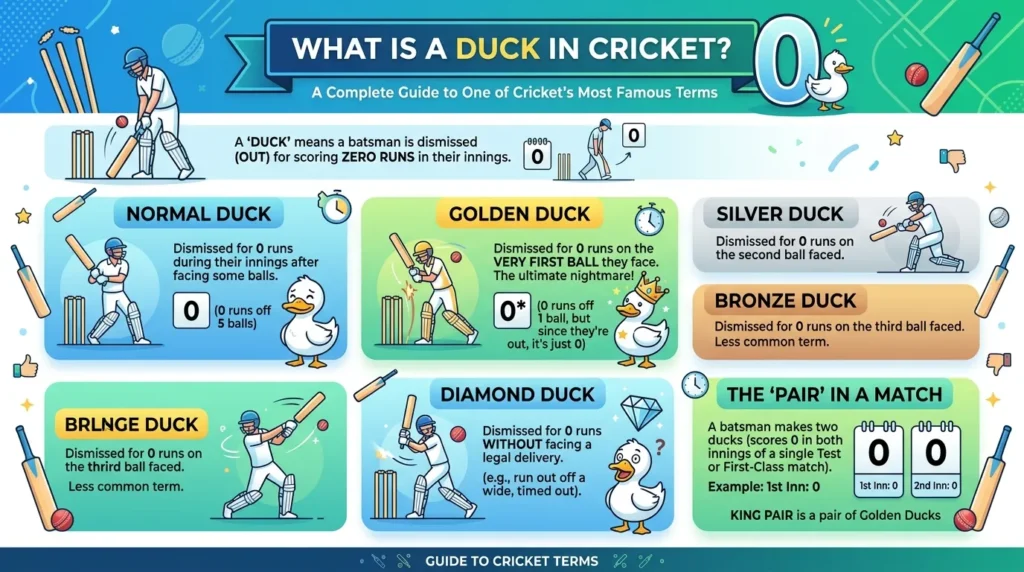
A duck in cricket occurs when a batter is dismissed without scoring any runs during their innings.
If a batter’s score remains zero when they are out, the scorecard records a duck.
Examples include:
- Bowled for 0
- Caught for 0
- LBW for 0
- Run out for 0
Regardless of the dismissal method, a score of zero after being dismissed is considered a duck.
Quick Definition of a Duck
A duck means:
- The batter scores 0 runs
- The batter is dismissed
- The innings ends without contributing runs
It is one of the most disappointing outcomes for a batter.
Origin of the Term “Duck”
Why Is It Called a Duck?
The term “duck” comes from the phrase “duck’s egg.”
A duck’s egg has an oval shape that resembles the number zero (0).
Because a batter’s score of zero looks like an egg on the scoreboard, the term became associated with being dismissed without scoring.
Historical Background
The expression has been used in cricket since the 19th century.
Over time, “duck’s egg” was shortened to simply “duck.”
Today, it is one of the most recognized terms in cricket.
Why Is a Duck Important in Cricket?
A duck is significant because it reflects a batter’s inability to score runs during an innings.
Impact on Team Performance
Every batter is expected to contribute to the team’s total.
A duck means:
- No runs added
- Increased pressure on teammates
- Potential loss of momentum
Impact on Statistics
Ducks affect:
- Batting averages
- Career records
- Tournament performance
Psychological Impact
Getting out for zero can affect a player’s confidence, especially if it happens repeatedly.
How Does a Duck Occur?
A duck can occur through any legal dismissal while the batter remains on zero.
Bowled
The ball hits the stumps before the batter scores.
Caught
The batter hits the ball and a fielder catches it before it touches the ground.
LBW (Leg Before Wicket)
The batter is trapped in front of the stumps without scoring.
Run Out
The batter fails to reach the crease safely.
Stumped
The wicketkeeper removes the bails while the batter is outside the crease.
All these dismissals can result in a duck if no runs have been scored.
Types of Ducks in Cricket
One of the most interesting aspects of cricket terminology is the different types of ducks.
Golden Duck
A golden duck occurs when a batter is dismissed on the very first ball faced.
Example:
- First ball
- Out for 0
This is one of the most common special types of ducks.
Silver Duck
A silver duck occurs when the batter gets out on the second ball faced without scoring.
Bronze Duck
A bronze duck occurs when the batter is dismissed on the third ball faced without scoring.
Diamond Duck
A diamond duck happens when a batter is dismissed without facing a ball.
Examples:
- Run out at the non-striker’s end
- Timed out dismissal
Pair
A pair occurs in Test cricket when a batter scores a duck in both innings of a match.
King Pair
A king pair happens when a batter records a golden duck in both innings of a Test match.
This is considered particularly unfortunate.
Duck in Different Cricket Formats
Test Cricket
In Test matches, ducks can occur in either innings.
A batter has another chance if the team bats again.
One Day Internationals (ODIs)
ODI cricket provides only one innings per batter.
A duck means no opportunity for recovery during that match.
T20 Cricket
In T20 cricket, every run is valuable.
A duck can significantly impact the team’s scoring potential.
Famous Ducks in Cricket History
Even legendary players have experienced ducks.
Many world-class batters have been dismissed for zero despite scoring thousands of career runs.
This demonstrates that:
- Cricket is unpredictable
- Every batter is vulnerable
- Even great players make mistakes
Ducks are considered a natural part of the game.
Common Reasons Batters Get Ducks
Poor Shot Selection
Attempting risky shots too early can lead to dismissal.
Quality Bowling
Excellent deliveries often defeat even skilled batters.
Lack of Concentration
Mental errors frequently result in ducks.
Pressure Situations
Important matches can increase nervousness.
Difficult Pitch Conditions
Swing, seam movement, or spin may create challenging conditions.
Strategies to Avoid a Duck
Watch the Ball Carefully
Good batters focus intensely on the ball from the moment it leaves the bowler’s hand.
Start Conservatively
Playing safely early in the innings reduces risk.
Build Confidence Gradually
Many players aim to score a quick single to get off the mark.
Respect Good Bowling
Patience often helps batters survive difficult spells.
Maintain Concentration
Mental focus is critical during the first few deliveries.
Player Roles and Ducks
Opening Batters
Openers face the new ball and are often most vulnerable to ducks.
Top-Order Batters
These players are expected to provide stability.
A duck can put early pressure on the team.
Middle-Order Batters
Middle-order players may encounter challenging match situations.
Finishers
Finishers usually bat aggressively and sometimes risk ducks while chasing quick runs.
Equipment Used by Batters
Proper cricket equipment helps reduce the chances of early dismissal.
Cricket Bat
Provides control and shot-making ability.
Helmet
Protects against fast bowling.
Batting Gloves
Improve grip and hand safety.
Pads
Protect the legs from impact.
Cricket Shoes
Enhance balance and movement.
Protective Guards
Offer additional safety.
Modern equipment supports player performance and confidence.
Major Cricket Tournaments Where Ducks Matter
ICC Cricket World Cup
A duck in a World Cup match can significantly affect team performance.
ICC T20 World Cup
Quick dismissals are especially costly in T20 cricket.
ICC World Test Championship
Batters seek consistency across multiple innings.
Indian Premier League (IPL)
Ducks often become major talking points in IPL matches.
The Ashes
Every wicket is crucial in this historic Test series.
Benefits of Playing Cricket
Although ducks are disappointing, cricket provides numerous benefits.
Physical Benefits
- Improved fitness
- Better coordination
- Increased stamina
- Enhanced reflexes
Mental Benefits
- Stronger concentration
- Better decision-making
- Strategic thinking
- Mental resilience
Social Benefits
- Teamwork
- Communication
- Leadership development
- Sportsmanship
Interesting Facts About Ducks
- The term comes from the shape of a duck’s egg.
- A score of zero is recorded as a duck only when the batter is dismissed.
- Some legendary players have accumulated dozens of ducks during long careers.
- A diamond duck can occur without facing a ball.
- A king pair involves two golden ducks in a Test match.
- Fast bowlers often target opening batters to create early ducks.
- Many players consider getting off the mark one of the most important moments of an innings.
Common Misconceptions About Ducks
A Duck Means Poor Skill
Not necessarily. Even elite batters get ducks.
Only Beginners Score Ducks
Professional players also experience ducks regularly.
A Duck Ends a Career
Many great players have recovered from ducks and achieved remarkable success.
Every Zero Is a Duck
A score of zero counts as a duck only if the batter is dismissed.
Why Coaches Focus on Avoiding Ducks
Coaches encourage batters to:
- Start carefully
- Assess conditions
- Build confidence
- Minimize unnecessary risks
Reducing early dismissals improves team performance and batting consistency.
Conclusion
Understanding what a duck in cricket is helps fans appreciate one of the sport’s most famous terms. A duck occurs when a batter is dismissed without scoring a run, and it can happen to players of all skill levels. From golden ducks and diamond ducks to pairs and king pairs, cricket has developed several variations of this unique statistic. Although ducks can be frustrating, they are a natural part of the game and often motivate players to improve. Whether you are a beginner learning cricket terminology or an experienced fan following international matches, understanding ducks provides deeper insight into batting performance and cricket strategy.