
Cricket is a sport filled with traditions, strategies, and constantly evolving rules. One of the biggest modern rule changes in international cricket is the “Saliva Ban.” This rule changed how bowlers maintain the cricket ball and affected the game’s balance between bat and ball. The saliva ban became a major discussion point among players, coaches, cricket boards, and fans around the world.
For decades, bowlers used saliva to shine one side of the ball to help create swing movement. However, health concerns during the global COVID-19 pandemic forced cricket authorities to rethink this practice. As a result, the saliva ban was introduced to protect player safety and hygiene standards.
Today, the saliva ban remains an important topic in cricket because it directly affects fast bowlers, reverse swing techniques, ball management strategies, and match conditions. This article explains everything about the saliva ban in cricket, including its history, rules, effects on players, bowling strategies, major tournaments, and future impact on the game.
What Is the Saliva Ban in Cricket?
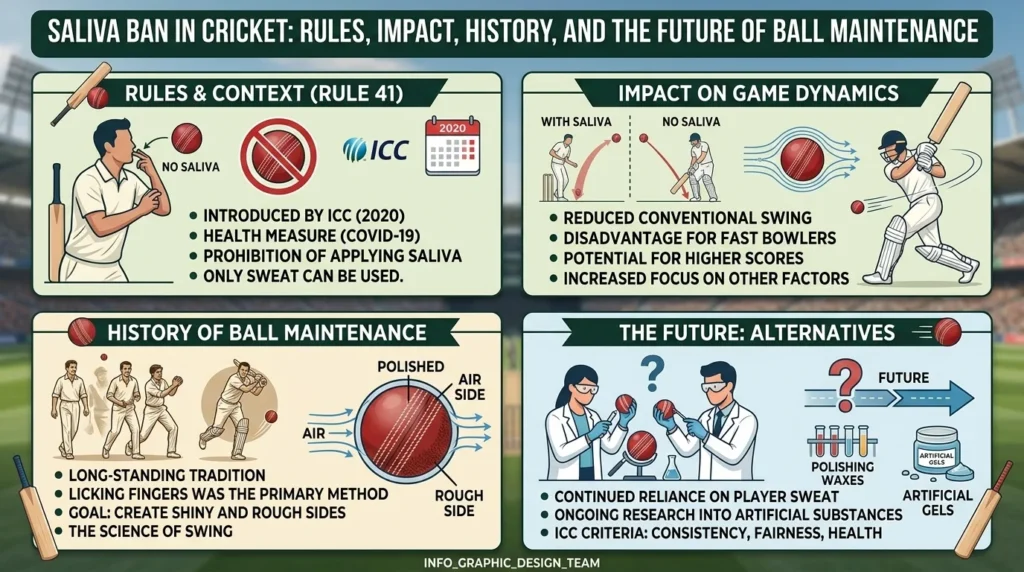
The saliva ban is a cricket rule that prohibits players from applying saliva to the cricket ball. Players are only allowed to use sweat for polishing and shining the ball.
Traditionally, bowlers used saliva to maintain one shiny side of the ball while allowing the other side to become rough. This difference helped create swing and reverse swing during matches.
Why Bowlers Use Saliva
Fast bowlers rely on swing movement to trouble batters. Saliva helped by:
- Making one side of the ball smoother
- Improving airflow around the ball
- Increasing conventional swing
- Supporting reverse swing in older balls
In cricket, bowlers use saliva on the ball to help improve its condition and create better movement in the air. The cricket ball has two different sides during a match: one side remains shiny while the other side becomes rough because of contact with the ground, bat, and pitch. Bowlers and fielders apply saliva to one side of the ball and polish it using their trousers or clothing to keep that side smooth and shiny. This difference between the shiny side and rough side helps the ball swing in the air, making it more difficult for batsmen to predict its movement. Swing bowling is one of the most important skills in cricket, especially in longer formats like Test matches. When the shiny side faces one direction and the rough side faces the other, air flows differently around the ball, causing it to curve during flight. Fast bowlers use this technique to move the ball either toward or away from the batsman. Saliva helps create natural moisture and shine on the surface, which improves aerodynamic movement. Apart from swing bowling, maintaining the ball’s condition is also important for reverse swing, which usually happens with an older ball. Reverse swing becomes effective when one side is very rough and the other side stays polished. Legendary bowlers such as Wasim Akram, Waqar Younis, and James Anderson became famous for mastering swing and reverse swing through excellent ball maintenance skills. However, the use of saliva became a major topic during the COVID-19 pandemic because of health concerns. The International Cricket Council temporarily banned saliva use to reduce the risk of virus transmission among players. Instead, players were allowed to use sweat to shine the ball. Many bowlers argued that saliva works better than sweat for maintaining shine and generating swing. Despite the restrictions, bowlers still try different legal methods to maintain the ball’s condition because swing bowling remains a crucial part of cricket strategy. Using saliva correctly was always considered a traditional skill in cricket rather than cheating, as long as no artificial substance was applied to the ball. The ability to control swing through ball maintenance shows the technical knowledge, patience, and experience of fast bowlers in professional cricket.
Saliva became part of cricket culture for generations before the ban changed the practice.
Introduction of the Ban
The saliva ban was first introduced temporarily during the COVID-19 pandemic to reduce the spread of infection through shared contact. Later, cricket authorities decided to make the rule permanent.
The governing body of world cricket, International Cricket Council, officially enforced the rule in international cricket competitions.
History of Ball Shining in Cricket
Ball maintenance has always been a major part of cricket strategy. Since the early days of cricket in England, players discovered that polishing the ball affected movement through the air.
The history of ball shining in cricket is closely connected with the development of swing bowling and fast bowling tactics. In the early days of cricket during the 18th and 19th centuries, players noticed that the condition of the cricket ball had a major effect on how it moved in the air and off the pitch. Bowlers gradually discovered that keeping one side of the ball smooth and shiny while allowing the other side to become rough could create swing. This discovery changed fast bowling forever and became one of the most important skills in cricket history. Initially, players used natural methods such as rubbing the ball on their white trousers or polishing it with sweat and saliva during matches. Over time, bowlers learned that a properly maintained shiny side helped air move differently around the ball, causing it to swing toward or away from the batsman. This technique became especially popular in countries like England, Pakistan, Australia, and New Zealand, where weather conditions often supported swing bowling. Legendary fast bowlers such as Fred Trueman and Dennis Lillee used ball maintenance techniques to improve swing and seam movement. During the 1970s and 1980s, reverse swing bowling became famous, especially through Pakistani bowlers like Imran Khan, Wasim Akram, and Waqar Younis. Reverse swing depended heavily on maintaining one shiny side and one rough side of an older ball. Their mastery of ball shining made Pakistan one of the strongest fast-bowling nations in cricket history. However, the process of ball shining also created controversies. Some players illegally used foreign substances like bottle caps, sandpaper, mint sweets, or other objects to change the ball’s condition, a practice known as ball tampering. Cricket authorities, especially the International Cricket Council, introduced strict rules allowing only natural substances like sweat and saliva for polishing the ball. During the COVID-19 pandemic, saliva use was temporarily banned because of health concerns, and players were allowed to use only sweat. This rule significantly affected traditional swing bowling techniques. Today, ball shining remains an important part of cricket strategy and fast-bowling science. Modern bowlers continue to carefully maintain the ball within legal rules to achieve swing, reverse swing, and better control. The history of ball shining shows how small details and technical skills can greatly influence the game of cricket.
Early Cricket Practices
In traditional cricket:
- Players polished the ball using saliva and sweat.
- Teams protected one side from rough damage.
- Bowlers worked together to maintain shine.
This process became a natural part of the sport.
Rise of Reverse Swing
During the 1970s and 1980s, bowlers from Pakistan became famous for reverse swing bowling.
Legendary bowlers such as:
- Wasim Akram
- Waqar Younis
- Imran Khan
used ball maintenance techniques to generate late swing at high speed.
The rise of reverse swing changed the world of cricket and became one of the most dangerous weapons for fast bowlers. Reverse swing is a special bowling technique in which an older cricket ball moves in the opposite direction compared to normal swing. Unlike conventional swing, which usually works with a newer shiny ball, reverse swing becomes effective when the ball is older, rough on one side, and shiny on the other. This unusual movement confused batsmen and made fast bowling more challenging and exciting. Reverse swing became widely famous during the 1970s and 1980s, especially through Pakistani fast bowlers. Imran Khan played an important role in developing and promoting this skill at the international level. Later, legendary bowlers like Wasim Akram and Waqar Younis mastered reverse swing and terrified batsmen around the world with their speed and control. Their ability to bowl deadly yorkers combined with late reverse swing made them among the greatest fast bowlers in cricket history. Reverse swing works because air moves differently around the two sides of an old cricket ball. The rough side creates more turbulence while the shiny side allows smoother airflow, causing the ball to move late in the air at high speed. Dry pitches, hot weather, and rough outfields often help reverse swing become more effective. Because the movement happens very late, batsmen get less reaction time and often struggle to play safely. The rise of reverse swing also created controversies because some teams were accused of ball tampering to make the ball rougher illegally. However, legal ball maintenance using sweat and saliva has always been an accepted part of cricket. Today, reverse swing remains one of the most respected fast-bowling skills in international cricket. Modern bowlers continue learning this art because it can completely change the outcome of a match, especially in Test cricket and long-format games.
Ball Tampering Controversies
Before the saliva ban, cricket also faced ball-tampering controversies where players illegally altered the ball using foreign objects.
Famous incidents increased the need for stricter ball-management rules.
Why Was the Saliva Ban Introduced?
The saliva ban was mainly introduced for health and safety reasons.
COVID-19 Pandemic Impact
During the COVID-19 outbreak, health experts warned that saliva could spread infection through close physical contact.
Cricket authorities wanted to:
- Protect players and officials
- Reduce health risks
- Maintain safe playing conditions
- Continue international cricket safely
As a result, temporary restrictions became necessary.
ICC Safety Measures
The International Cricket Council introduced several safety protocols, including:
- Saliva ban
- Bio-secure environments
- Social distancing
- Reduced player interaction
- Frequent sanitization
These changes helped international cricket continue during difficult times.
Rules of the Saliva Ban
The saliva ban is now part of modern cricket regulations.
What Players Cannot Do
Players are not allowed to:
- Apply saliva to the ball
- Use spit for shining
- Deliberately spread saliva on the surface
If a player breaks the rule, the umpire may issue warnings or penalties.
Allowed Ball Maintenance Methods
Players may still:
- Use sweat to shine the ball
- Dry the ball with towels
- Polish the ball on clothing
These methods remain legal under cricket laws.
Penalties for Violations
Umpires can:
- Warn the team captain
- Replace the ball if needed
- Award penalty runs in repeated cases
Strict enforcement ensures fairness and player safety.
How the Saliva Ban Affects Bowlers
The saliva ban significantly changed bowling conditions, especially for fast bowlers.
Reduced Swing Movement
Many bowlers believe saliva helps create better swing than sweat alone.
Without saliva:
- Conventional swing may reduce
- Reverse swing becomes harder
- Bowlers lose an old traditional method
Impact on Fast Bowlers
Fast bowlers who depend on reverse swing faced challenges adapting to the new rules.
Some affected bowlers include:
- James Anderson
- Mohammed Shami
- Mitchell Starc
Spin Bowlers and the Saliva Ban
Spin bowlers are less affected because they rely more on grip, turn, and flight than ball shine.
However, a rougher ball may still slightly influence spin bowling control.
Bowling Techniques After the Saliva Ban
Bowlers have developed new strategies to remain effective.
Improved Fitness and Pace
Fast bowlers now focus more on:
- Speed
- Accuracy
- Seam position
- Fitness training
Better Seam Bowling
Seam bowlers target movement off the pitch instead of relying mainly on swing.
Tactical Bowling Plans
Teams use smarter field settings and bowling rotations to maintain pressure.
Using Conditions Wisely
Bowlers now depend more on:
- Weather
- Pitch conditions
- Cloud cover
- Wind direction
Natural conditions help compensate for reduced swing.
Role of Umpires in Enforcing the Saliva Ban
Umpires play a critical role in maintaining the rule.
Monitoring Players
Umpires carefully observe players during ball maintenance.
Educating Teams
Officials explain the updated laws and ensure players understand them.
Maintaining Fair Play
Strict enforcement helps maintain equal conditions for both teams.
Impact on Batters
The saliva ban also affects batting conditions.
Easier Batting Conditions
Some batters believe reduced swing makes batting easier, especially in limited-overs cricket.
Longer Partnerships
Less ball movement may lead to:
- Higher scores
- More boundaries
- Longer innings
Increased Confidence
Batters can play attacking shots more freely when swing is limited.
Saliva Ban in Different Cricket Formats
The impact varies across cricket formats.
Test Cricket
Test cricket depends heavily on swing and reverse swing, so the saliva ban has a larger effect.
One Day Internationals (ODIs)
ODI bowlers still use seam movement and variations to control scoring.
T20 Cricket
In T20 cricket, bowlers rely more on slower balls, yorkers, and tactical variations than swing.
Major cricket tournaments affected by the saliva ban include:
- ICC Cricket World Cup
- ICC T20 World Cup
- Indian Premier League
- Big Bash League
Equipment and Ball Maintenance
The cricket ball remains central to the saliva ban discussion.
Structure of the Cricket Ball
The cricket ball contains:
- Cork center
- Leather covering
- Raised seam
Its condition directly affects movement.
Importance of Ball Shine
A shiny side helps bowlers generate aerodynamic movement in the air.
Sweat as an Alternative
Players now use sweat instead of saliva, though many bowlers feel it is less effective.
Benefits of the Saliva Ban
Despite criticism, the saliva ban offers several advantages.
Improved Hygiene
The ban reduces health risks among players and officials.
Modernized Cricket Rules
Cricket continues evolving with safer playing conditions.
Fairer Playing Environment
Some experts believe reduced reverse swing creates more balanced contests.
Increased Focus on Skill
Bowlers now rely more on:
- Accuracy
- Tactical planning
- Natural swing
- Fitness
rather than traditional saliva polishing.
Challenges Created by the Saliva Ban
The rule also introduced several concerns.
Difficulty for Reverse Swing Bowlers
Reverse swing specialists lost an important technique.
Reduced Assistance for Bowlers
Many bowlers feel modern cricket already favors batters.
Adaptation Period
Players needed time to adjust to new playing conditions.
Interesting Facts About the Saliva Ban
Here are some fascinating facts about the saliva ban:
- The saliva ban became permanent after positive feedback from cricket authorities.
- Bowlers practiced new polishing methods after the rule change.
- Reverse swing remains possible without saliva, though more difficult.
- The rule applies across international cricket formats.
- Some former players still debate whether the ban should continue permanently.
Opinions From Cricket Experts
The saliva ban created mixed reactions across the cricket world.
Supporters of the Ban
Supporters believe the rule:
- Protects player health
- Modernizes cricket
- Encourages fair play
Critics of the Ban
Critics argue:
- Bowlers lose an important skill advantage
- Batters already dominate modern cricket
- Reverse swing becomes less effective
The debate continues among fans and experts.
Future of the Saliva Ban
The saliva ban may remain a permanent part of cricket for many years.
Possible Future Changes
Cricket authorities could:
- Adjust ball rules
- Introduce alternative polishing methods
- Develop new cricket-ball technologies
Continued Adaptation
Players and coaches will continue adjusting techniques to modern cricket conditions.
Conclusion
The saliva ban is one of the most important modern rule changes in cricket. Introduced during the COVID-19 pandemic, the ban changed how bowlers maintain the cricket ball and forced teams to adapt their strategies.
Although many fast bowlers miss using saliva for swing and reverse swing, the sport continues evolving with new tactics and safer conditions. The rule highlights cricket’s ability to balance tradition with modern health standards.
From international tournaments to domestic leagues, the saliva ban remains a major talking point in cricket. Whether fans support or criticize the rule, it has permanently changed the way bowlers approach the game.

Jon Smith is a passionate sports writer specializing in cricket and global sporting events. With a keen eye for match analysis and player performance, he creates clear, engaging, and informative content. His work focuses on simplifying complex sports insights, making them accessible for beginners and experienced fans alike worldwide.